Electromagnetic spectrum (Edexcel GCSE Physics): Revision Notes
📚Revision Notes
Electromagnetic spectrum
Note
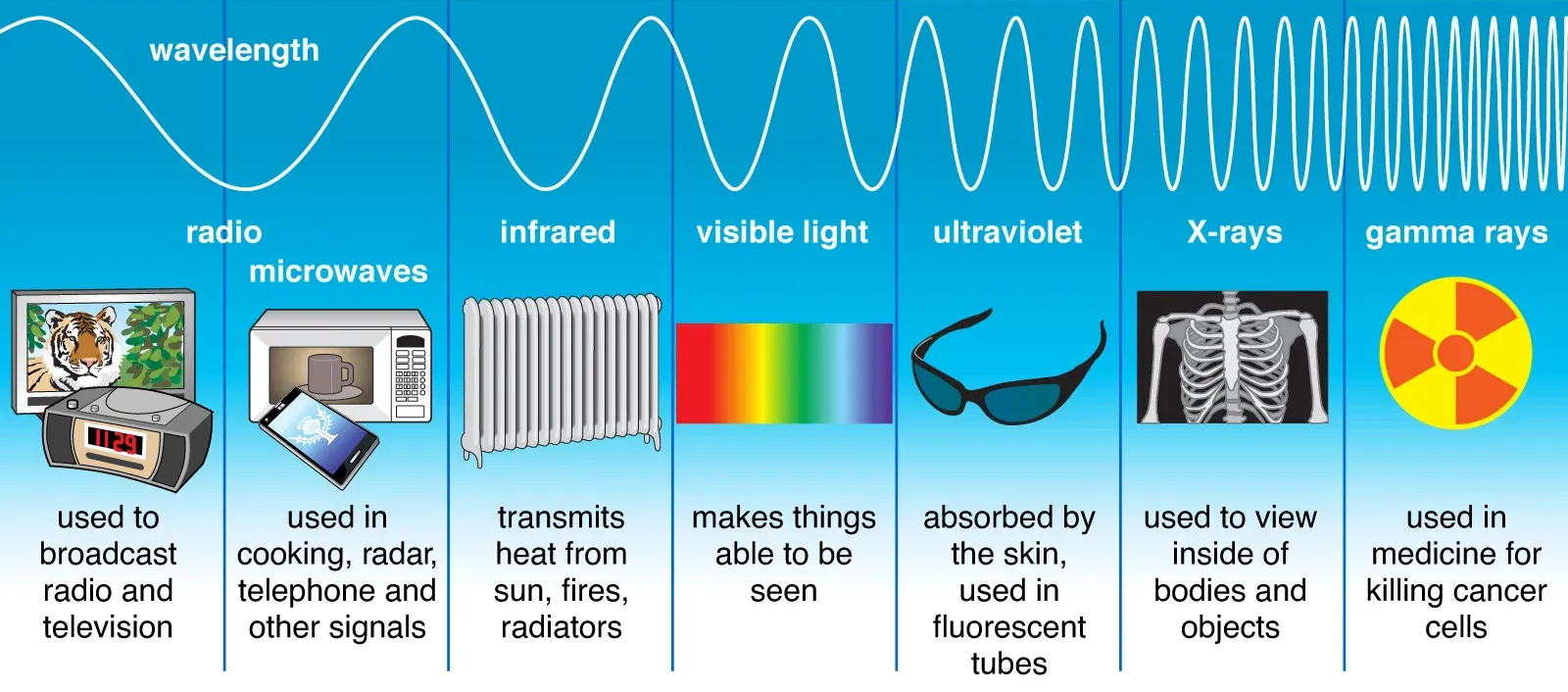
Electromagnetic (EM) waves are transverse waves that transfer energy from a source to an absorber. They are categorised based on their wavelength and frequency, forming the electromagnetic spectrum.
Key Features of EM Waves:
- All EM waves travel at the same speed in a vacuum (space).
- We can only see a small portion of the spectrum: visible light.
- EM waves are generated by changes in atoms and their nuclei, which create a wide range of frequencies. Energy Transfer: All EM waves transfer energy.
Note
For example: When you warm yourself near a heater, infrared waves transfer energy from the heater's thermal energy store to your thermal energy store.
Frequency and Energy:
-
The higher the frequency of the wave, the more energy it transfers.
-
Higher frequency waves, like X-rays and gamma rays, are more dangerous due to the larger amount of energy they transfer. Speed in Different Materials:
-
EM waves travel at different speeds in different materials, which causes refraction (bending of the wave) and dispersion (spreading out of different wavelengths).
EM Waves Interaction at Boundaries:
When EM waves meet a boundary between materials, they can be:
- Absorbed: The wave's energy is taken in by the material.
- Transmitted: The wave passes through the material.
- Refracted: The wave changes direction as it enters a new material.
- Reflected: The wave bounces off the material's surface.
Note
Electromagnetic Spectrum Overview:
- Radio Waves: Longest wavelength, lowest frequency.
- Microwaves: These are shorter wavelengths than radio waves and are used in communication and cooking.
- Infrared: Felt as heat, emitted by all warm objects.
- Visible Light: The only part of the spectrum humans can see.
- Ultraviolet (UV): Higher frequency, can cause damage to skin and eyes.
- X-rays: Penetrate skin, used in medical imaging.
- Gamma Rays: Highest frequency, very dangerous, used in cancer treatment.