Infrared & seismic waves (Edexcel GCSE Physics): Revision Notes
📚Revision Notes
Infrared & seismic waves
Infrasound
Note
Infrasound refers to sound waves with frequencies below 20 Hz, which are too low for humans to hear. These waves are used in a variety of natural and scientific applications.
Uses of Infrasound:
- Animal Communication:
- Certain animals, such as elephants and whales, use infrasound to communicate over long distances. Scientists can track these animals using infrasound to help with conservation efforts.
- Monitoring Natural Events:
- Volcanoes, avalanches, and earthquakes produce infrasound in their local areas.
- By detecting infrasound, scientists can monitor and sometimes predict eruptions or other natural events.
- Earth Exploration:
- Earthquakes produce seismic waves, some of which are infrasound, that travel through the Earth's layers. These waves help scientists explore the Earth's structure, revealing the composition and properties of its layers.
Seismic Waves
Note
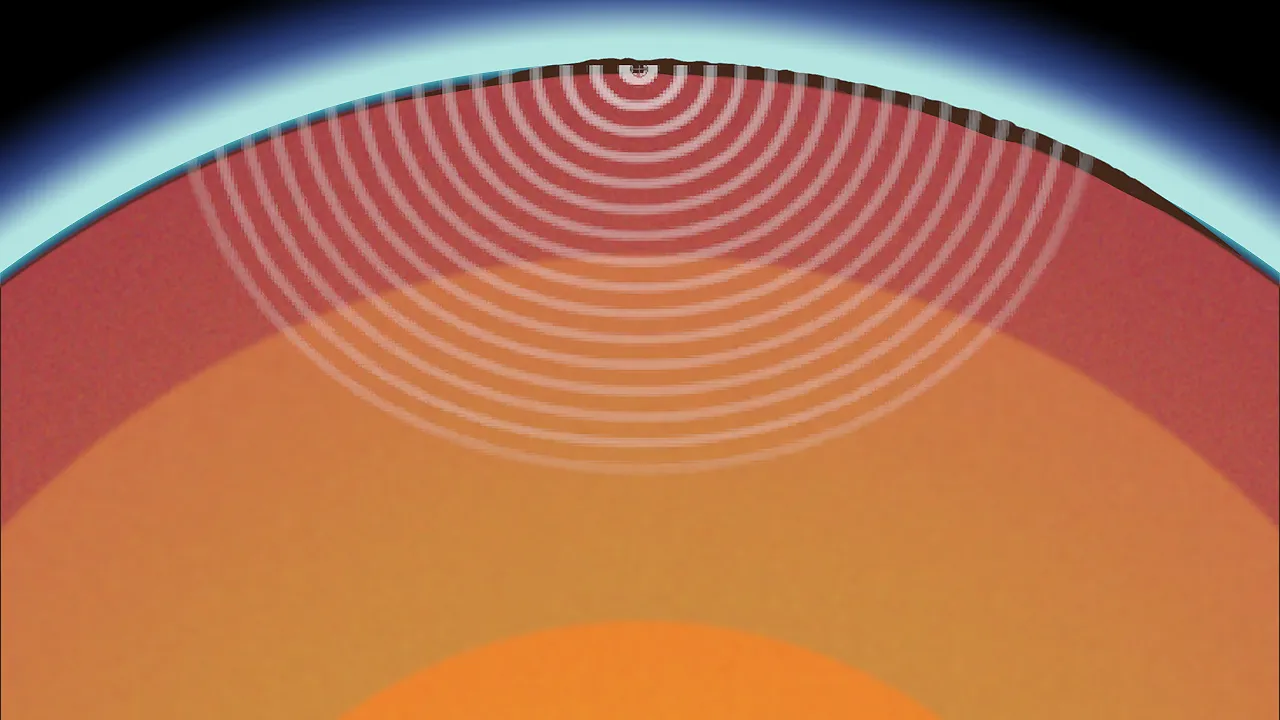
Seismic waves are produced by events like earthquakes or large explosions. These waves travel through the Earth and can be detected worldwide.
Types of Seismic Waves:
- P-waves (Primary Waves):
- Longitudinal waves.
- Faster and can travel through solids and liquids.
- P-waves can travel through the Earth's core.
- S-waves (Secondary Waves):
- Transverse waves.
- Slower and can travel only through solids (not liquids).
- S-waves cannot travel through the Earth's core, which helps scientists understand the structure of the planet.
How Seismic Waves Are Detected:
Note
Seismometers are instruments that detect seismic waves across the Earth's surface.
Seismologists study the arrival time of these waves at different locations to map out how they travel through the planet. They also track which areas do not receive certain types of waves, indicating changes in the Earth's structure.
Wave Behaviour in Earth's Layers:
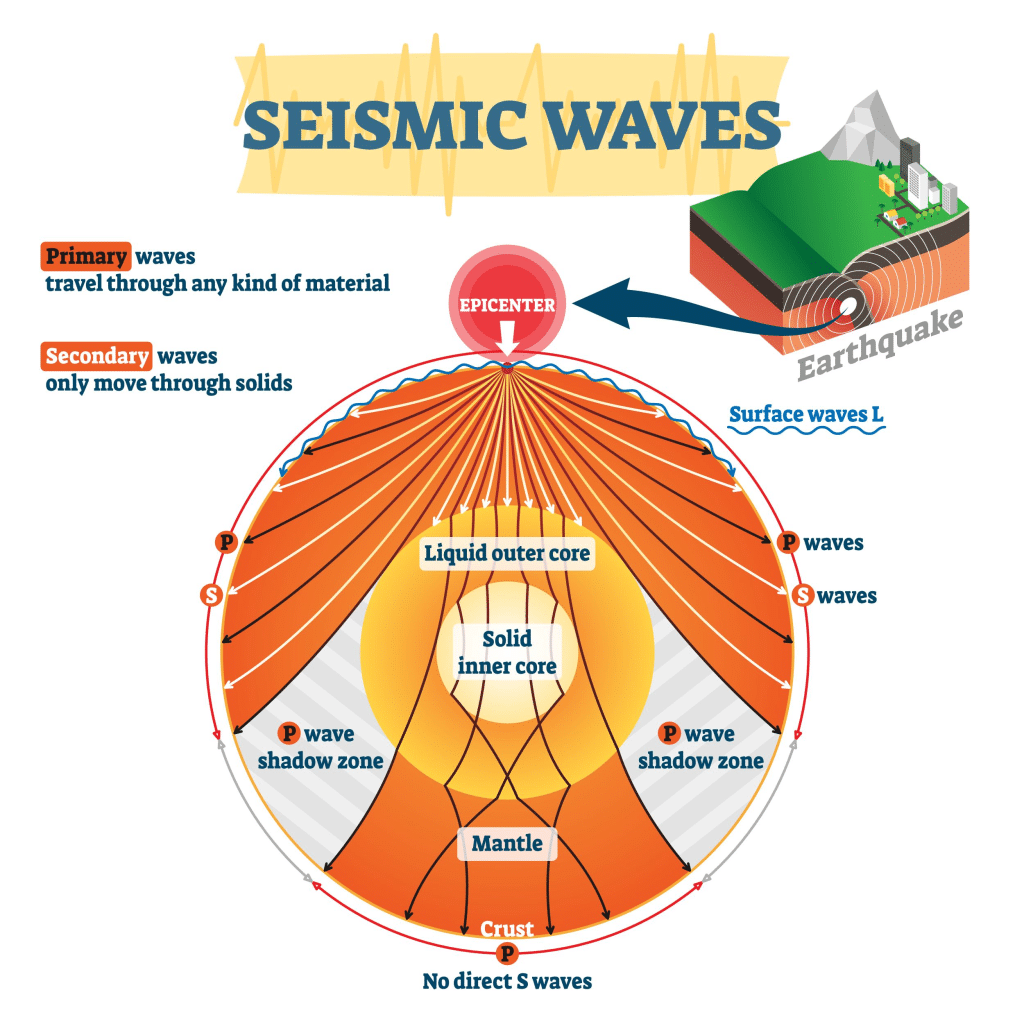
When seismic waves reach a boundary between materials with different densities, such as between Earth's crust and mantle, some waves are absorbed, and others are refracted (bent).
Normally, seismic waves change speed gradually as they pass through layers of varying density, creating a curved path.
However, if there is a sudden change in material properties, the wave changes speed abruptly, causing a kink in its path.
Understanding Earth's Structure Through Seismic Waves:
By studying how seismic waves are absorbed and refracted at different points in the Earth, scientists can deduce where significant changes in the Earth's layers occur.
Note
For example, the fact that P-waves can travel through the core while S-waves cannot tell scientists that the Earth's outer core is liquid.