Lenses (Edexcel GCSE Physics): Revision Notes
📚Revision Notes
Lenses
Note
Lenses form images by refracting light and changing its direction. There are two main types of lenses, each with different shapes and opposite effects on light rays:
Two Types of Lenses:
| Effect on Light | Principal Focus | |
|---|---|---|
| Converging Lens (Convex) | Causes parallel rays of light to come together (converge) at the principal focus. | The point where rays hitting the lens parallel to the axis all meet. |
| Diverging Lens (Concave) | Causes parallel rays of light to spread out (diverge) as if they are coming from a focal point behind the lens. | The point where rays hitting the lens parallel to the axis appear to come from (behind the lens). |
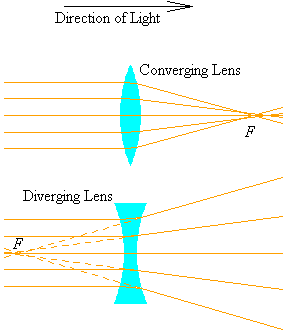
Types of Images Formed by Lenses
Images are formed at points where light rays from an object appear to come together.
| Image Type | Description | Example |
|---|---|---|
| Real Image | Formed when light rays actually come together to form an image that can be projected onto a screen. | The image formed on the retina of your eye. |
| Virtual Image | Formed when light rays appear to come from a location different from where they actually are. The rays do not actually meet, so the image cannot be projected onto a screen. | The image seen through a magnifying glass. |
Power of a Lens and Focal Length:
The power of a lens increases with its curvature.
Note
Focal length is the distance from the lens to the principal focus. A more powerful lens has a shorter focal length.
To make a more powerful lens:
- Use a material that focuses light better.
- Increase the curvature of the lens, as a more curved lens will focus light more strongly, resulting in a shorter focal length.