Dance (Grade 10 NSC Matric Life Orientation): Revision Notes
📚Revision Notes
Dance
What is dance?
Dance involves moving your body in a rhythmic way using coordinated steps and arm movements, typically performed in time to music. Dancing serves as an enjoyable form of recreation that helps develop coordination and teaches you how to move effectively. It contributes to maintaining physical fitness whilst providing an excellent opportunity to socialise, make new friends, and simply have fun.
During your dance unit, you'll explore the fundamentals of line dancing, break dancing, ballroom dancing, hip-hop, and ribbon dancing. Many of these dance styles incorporate basic gymnastic movements as foundational elements.
Note
Dance is not just about physical movement - it's a complete experience that combines rhythm, coordination, creativity, and social interaction. Each dance style you'll learn offers unique benefits and challenges that will help develop different aspects of your physical and social skills.
Safety for dance
Important
Essential Safety Guidelines for Dance
Before beginning any dance activity, it's crucial to follow these safety guidelines to prevent injuries:
- Be spatially aware - Always know where you are in relation to other dancers to avoid collisions or bumping into others
- Watch your step - Take care not to step on your partner's feet during partner dances
- Mind slippery surfaces - If the floor is slippery, exercise extra caution to prevent falls
- Understand the risks - Some movements can cause injury if performed incorrectly, so learn proper technique first
- Know your limits - Don't attempt movements you're unsure about until you've received proper instruction and feel confident
Remember: Safety always comes first in any physical activity!
Line dancing
Line dancing is a group activity where everyone dances in rows or lines, performing identical steps in unison to music. The steps are designed to be relatively simple, making it easy to learn basic movements that can be used in various sequences and dances. Most line dancing music has a tempo of or beats per minute with a 32-count structure.

Basic line-dance moves
Line dancing involves fundamental movements that create the foundation for more complex sequences:
- Forward and back movement - Simple stepping motions in these directions
- Diagonal stepping - Step your right foot forwards diagonally, touching your left foot beside your right foot
- Reverse diagonal - Step your left foot back diagonally, touching your right foot beside your left foot
- Cross-over steps - Step your right foot back diagonally, touching your left foot beside your right foot
- Forward diagonal touch - Step your left foot forwards diagonally, touching your right foot beside your left foot
Example
Worked Example: Basic Forwards Shuffle
Step 1: Start with feet together, weight evenly distributed
Step 2: Step forwards with your right foot
Step 3: Slide your left foot next to your right foot without changing weight
Step 4: Step forwards again with your right foot
Result: You've completed one forwards shuffle sequence
Line-dance turn techniques
Two main turning methods are used in line dancing:
Pivot or turn - Rotate on the ball of your supporting foot by turning your upper body while your free leg extends forwards or backwards. You can make small turns (half turn) or complete 180-degree rotations.
Spiral - Turn in place on the ball of your supporting foot, moving in the direction opposite to your supporting foot. For example, if standing on your left foot, turn right. Finish with your legs slightly twisted and ankles together, step to get balanced over your supporting foot, then execute a sharp turn on that spot.
Important line dancing terminology
Note
Key Line Dancing Terms
Understanding these terms will help you follow dance instructions more effectively:
- And - Represents half of a quick count (1 and 1, or 1 and), equivalent to a half-beat of music
- Lock - A firm crossing of your feet
- Count - The number of beats required to complete one repetition or sequence of the dance
- Foot positions - Five basic positions: feet together, feet parallel (hip-width apart), heel to instep, forwards or back, toe to heel
- Forward shuffle - Step forwards with your right foot, then slide your left foot next to your right foot
- Hitch - Lift your knee up with your weight on the opposite leg
- Hips rock and hold - Move hips left, right, left, then hold position
- Rock steps - Step forwards with right foot, rock back onto left foot, recovering your weight
- Switches - Extend one foot out, return to centre, transfer weight, then extend opposite foot
- Together tap or touch - The toe or heel of your foot touches the floor without weight change
- Weave - Bring one foot next to the other with a weight change
Ballroom dancing
Ballroom dancing is a partner-based social dance form that requires coordination between two people. This elegant dance style emphasises proper posture, smooth movement, and connection with your partner.

Basic techniques for ballroom dancing
Successful ballroom dancing depends on mastering these fundamental techniques:
- Maintain eye contact - Face your partner throughout the dance
- Proper weight distribution - Carry your weight on the ball of your foot rather than your heel
- Quality steps - Take deliberate, controlled steps without dragging your feet
- Straight movement - Step with toes pointed straight ahead when moving forwards or backwards
- Hip initiation - Begin movement from your hip, allowing your legs to swing freely from the joints
- Foot positioning - Place feet parallel to your partner's feet, with your right foot pointed between your partner's feet
- Tempo adjustment - Take shorter steps for fast music, longer steps for slow music
- Balance maintenance - When unsure of the next move, simply continue stepping to maintain balance
- Close foot positioning - Keep feet closer together when changing direction for better balance
- Turning technique - For turns, twist from your ribcage base and engage your hips for more powerful spins
- Continuous movement - If your partner turns, keep stepping to the beat until they face you again
Note
Partnership Success Tips
The key to successful ballroom dancing lies in communication and trust between partners. Lead and follow roles are essential - the lead provides clear direction while the follow responds with sensitivity. Remember, both partners contribute equally to creating beautiful, flowing movement across the dance floor.
Break dancing and hip-hop
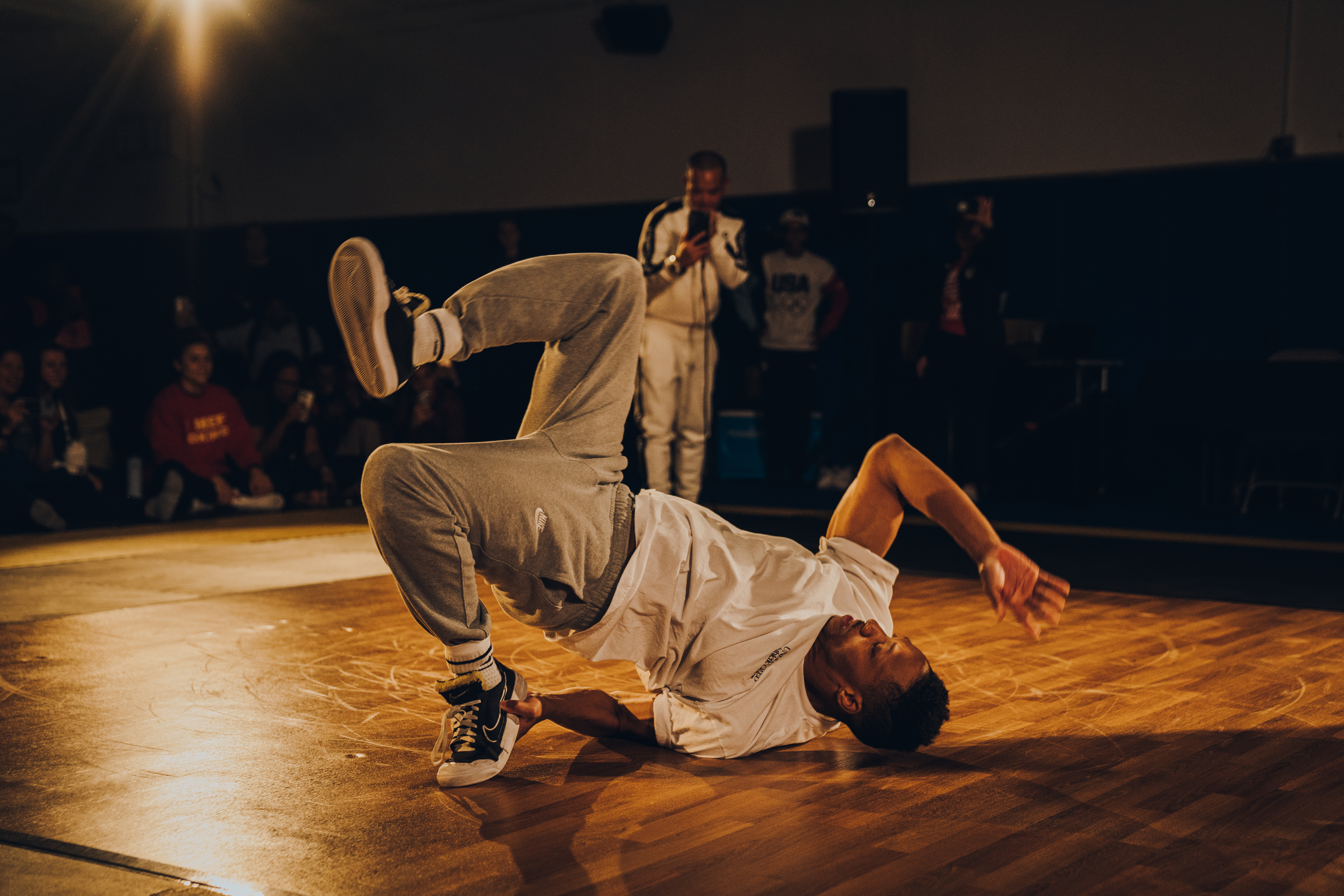
Break dancing incorporates many movements rooted in gymnastics, providing excellent workout opportunities. This dynamic dance style involves floor work, spins, and athletic movements that require strength, coordination, and practice.
Key break dancing moves
Break dancing includes various challenging moves that require dedication to master:
Six step - A foundational move beginning in a squatting position, involving hand placement, leg movements, and returning to the starting position through a series of six coordinated steps.
Hand spin - A spinning move where you balance on your hand whilst spinning your body. This requires significant practice to develop the necessary balance and technique.
Toprock - A four-step, four-beat dance that serves as an excellent starting move. It involves hopping movements with feet in different positions, allowing for personal style and creativity.
Other essential moves include running person (lunging movements), various applejacks, the flare (a six-step sequence), coffee grinder (spinning on the ground), head spin (spinning on your head), and the worm (wave-like floor movement).
Important
Athletic Requirements and Safety
Break dancing is highly athletic and demands significant physical conditioning. These moves require:
- Core strength for floor work and spins
- Upper body strength for hand balances
- Flexibility for fluid movement
- Balance and coordination for complex sequences
Always warm up properly and don't attempt advanced moves without building the necessary strength and technique first.
Ribbon dancing
Ribbon dancing draws inspiration from Chinese choreography and involves performing dance movements while holding a long ribbon attached to a stick. This graceful dance form emphasises fluid movement and artistic expression.

Ribbon dancing fundamentals
The essence of ribbon dancing lies in moving the ribbon to match the musical beat. Your routine will incorporate various movements including swings, waves, circles, spirals, snake-like motions, flicks, figure eights, and throws.
Note
Key Principles for Ribbon Dancing
- Ensuring the ribbon doesn't become twisted around your body or knotted
- Treating the ribbon as an extension of your arm, moving with elegance and control
- Using your entire arm from the shoulder when creating wave motions
- Starting with basic arm waves and watching the ribbon follow the same path
- Gradually increasing speed and range of motion to create larger, more dynamic ribbon movements
- Incorporating walking, dancing, and running while maintaining ribbon control
The ribbon should flow like water, creating beautiful patterns that complement your body movements and the music's rhythm.
Assessment in physical education
Important
Assessment Information
Your dance performance will be evaluated as part of your Physical Education assessment. Remember that you receive marks for each PE period in which you actively participate.
During this term, your Movement Performance will be assessed twice - once during weeks 1-5 and once during weeks 6-10. Each movement assessment session contributes to your overall mark out of 5.
Active participation and effort are key to achieving your best possible grade!
Summary
Key Points to Remember:
- Dance is rhythmic movement - Coordinate your body movements with music for the best results
- Safety comes first - Always be aware of your surroundings and don't attempt moves beyond your skill level
- Line dancing builds coordination - Practice basic steps and terminology to master group choreography
- Ballroom requires partnership - Focus on posture, proper foot placement, and connection with your partner
- Break dancing demands dedication - These athletic moves require significant practice and physical conditioning to master safely
- Ribbon dancing emphasises flow - Treat the ribbon as an extension of your body for graceful, artistic expression