Physical Fitness Activities (Weeks 7-10) (Grade 10 NSC Matric Life Orientation): Revision Notes
📚Revision Notes
Physical Fitness Activities (Weeks 7-10)
Understanding physical fitness activities
Physical fitness activities for weeks 7-10 focus on three main areas that will help you develop cardiovascular fitness, coordination, and overall physical wellbeing. These activities combine fun with fitness, using both indoor and outdoor exercises to keep you engaged and active.
Note
The beauty of these fitness activities lies in their combination of fun with fitness. By using both indoor and outdoor exercises, you'll stay engaged while developing essential physical skills that benefit your overall health.
Aerobic dance: rhythmic aerobic exercise
Rhythmic dance is a series of rhythmic steps and movements performed in time to music. Many movements used in rhythmic dance come from gymnastics, and this combination provides your body with excellent balance and alignment training whilst giving you a solid aerobic workout.
South African cultural connection
Note
Cultural Heritage in Fitness
South Africa is blessed with a rich heritage of indigenous rhythmic dances that form part of our cultural identity. We also have access to aerobic traditional African dance music and reggae, which makes our fitness activities uniquely South African and culturally meaningful.
Diski dance moves

Diski dance incorporates football-inspired movements that are both fun and challenging. Here are the five essential moves you need to master:
Move 1: The juggle (also called "Teka")
Example
Worked Example: Mastering The Juggle
This move involves juggling an imaginary football from your left foot to your right foot and back again. The sequence involves:
Step 1: Standing straight with legs apart, knees bent, and elbows against your body
Step 2: Jumping to bring your feet together
Step 3: Kicking your right foot forwards
Step 4: Bringing your right foot back
Step 5: Kicking your left foot forwards and bringing it back
Step 6: Repeating steps 3 to 5 four times
Move 2: The header
Example
Worked Example: The Header Technique
This move focuses on bouncing an imaginary ball on your head whilst engaging your whole body. The technique requires:
Step 1: Standing as if looking at a football in the air
Step 2: Bouncing the imaginary ball up to the right, letting your whole body follow the movement
Step 3: Standing as if the ball is coming down towards you
Step 4: Bouncing the ball up to the left, again following with your whole body
Step 5: Repeating the sequence four times
Move 3: Table mountain
Example
Worked Example: Table Mountain Position
This playful move requires you to position yourself bent over with your back flat like a table, imagining the ball is on your back. The steps include:
Step 1: Placing hands on bent knees and flattening your back
Step 2: Taking a step back with your left leg whilst lifting your left arm to point at the ball
Step 3: Taking a step back with your right leg whilst lifting your right arm to point at the ball
Step 4: Continuing this alternating pattern
Move 4: Trepa
Example
Worked Example: The Trepa Movement
Trepa is a uniquely South African move that involves holding the ball behind your neck, flicking it over your head, and kicking it twice with your right foot. The sequence flows from:
Step 1: Releasing an imaginary ball from behind your back over your head after four counts
Step 2: Holding the ball with your right foot
Step 3: Kicking the ball and bouncing it using your right leg
Move 5: The bridge (also called "Brija")
Example
Worked Example: The Bridge Technique
This move involves passing the ball with your right foot over your left foot and back again four times, then ending by kicking the ball. The technique requires using your right leg only to jump over an imaginary ball four times, then kicking the ball to finish.
Step aerobics
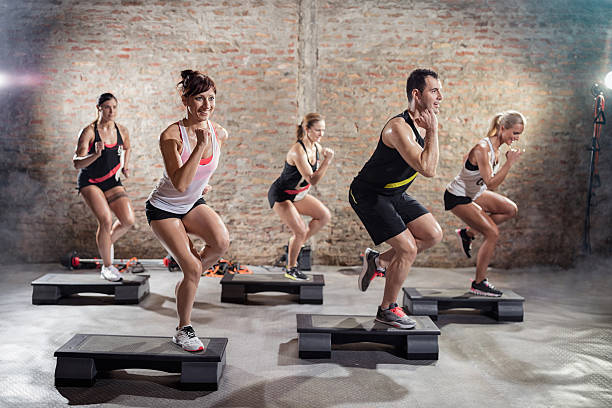
Step aerobics provides an excellent workout that is both low-impact and enjoyable. This form of exercise involves stepping up and down on a step or strong box for an extended period whilst incorporating various movements.
Key principles of step aerobics
Step aerobics works by having you step up and down from a platform, moving from one end of the step to the other, and using your arms to maintain high intensity throughout the session. High-tempo music (around 140 beats per minute) helps maintain the energy and rhythm needed for an effective workout.
Safety guidelines for step aerobics
Important
Essential Safety Guidelines
Following proper safety measures is crucial for preventing injury and maximising benefits:
- Use soft, flat-soled shoes to provide adequate grip and cushioning
- Perform step-ups gently and softly to avoid straining your legs and feet
- Avoid putting extra pressure on your feet by stamping hard
- Keep your upper body straight whilst doing step-ups to strengthen leg muscles
- Ensure the whole sole of your foot is positioned on the step
- Avoid standing on your toes whilst your leg is up on the step box
- Maintain a comfortable distance from the step as you move
- Don't bend your knees more than 90 degrees whilst stepping up
- Choose a step that is approximately 30 cm high (higher if you are very tall)
Step aerobics routine
A proper step aerobics session should include these elements:
- Choose appropriate music with 140 beats per minute for optimal pacing
- Select your equipment - any step, block, stone, log, or low bench that is 30 cm high
- Establish rhythm - get into a good rhythm before beginning the main exercise
- Start the exercise by stepping onto the step with your left leg, keeping your left foot on the block, then stepping with your right foot
- Step back down leading with the left leg and bringing your right foot down to join it
- Continue for one minute maintaining this pattern
- Repeat but start with your right leg for variation
- Maintain good posture - hold your chest high with your upper body relaxed and abs tight
- Keep your head up - only look down briefly if you need to check your foot placement
- Complete the session by repeating and alternating starting legs 20 times
Outdoors fitness circuit
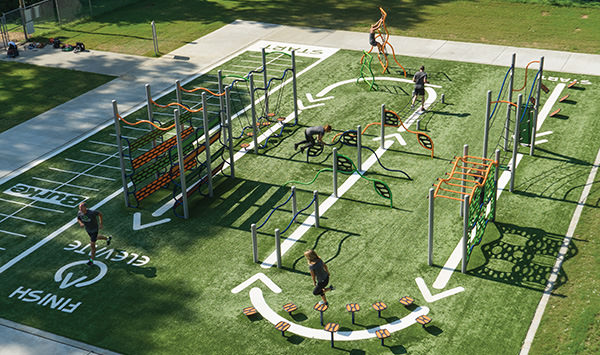
An outdoors fitness circuit is an area set up with different stations that require specific exercises at each location. This type of training combines the benefits of an obstacle course (items arranged for rolling, jumping, crawling, weaving, hopping, running, and climbing) with structured fitness training.
Benefits of circuit training
Completing circuit courses as quickly as possible helps you stay fit and develops your muscles and movement skills simultaneously. This type of training is excellent for building both cardiovascular endurance and muscular strength.
Setting up your circuit
Note
Circuit Organization
The circuit works best with groups of 5-6 learners, with each group receiving a card showing a different sequence of numbers from 1-10. Groups start at different stations according to their first number, which prevents everyone from queuing at the same station.
Circuit stations breakdown
Station 1: Desk crawling
This station develops agility and core strength through:
- Carrying five desks or tables from your classroom and running whilst doing so
- Setting up the desks at station 1 with space between each one
- Crawling under each desk or table as fast as possible without touching them
- Repeating the exercise three times
Station 2: Rope jumping
This station focuses on cardiovascular fitness and coordination:
- Tying a rope between two objects such as trees, bushes, or poles on your school grounds
- Using old socks, stockings, or string bits tied together to make the rope
- Setting the rope height at least 50 cm or knee-high from the ground
- Jumping over the rope and repeating five times
Station 3: Net crawling
This station develops flexibility and core strength:
- Putting a large net over the ground, raised 50 cm off the ground
- Using an old net, covering, or tied plastic bags to form a large cover
- Crawling under this cover, then crawling backwards
- Repeating the exercise five times
Station 4: Box jumping
This station builds explosive leg power:
- Setting out several large stones or cardboard boxes filled with sand
- Placing them a few paces apart
- Jumping over these items without touching the stones or boxes
- Repeating five times
Station 5: Tyre exercises
This station combines step aerobics with agility training:
- Placing several old tyres on the ground flat (not stacked)
- Using them as step-up and step-down exercise tools
- Hopping into them using both feet, hopping out without touching sides
- Alternatively hopping on one foot
- Performing step-ups for two minutes
Station 6: Jump rope
This station focuses on cardiovascular endurance and coordination:
- Using five jump ropes for continuous jumping
- Jumping rope for five minutes before moving to the next station
- Jumping as fast as possible for maximum benefit
Station 7: Hopping course
This station develops balance and leg strength:
- Drawing a long line in the sand with a stick or making a chalk line
- Following the line and performing hopping actions without stepping over it
- Hopping with one foot from one end to the next
- Turning around and using the other foot to hop back
- Repeating twice
Station 8: Weight lifting
This station builds upper body and core strength:
- Using plastic bottles filled with water or containers filled with sand to make weights between 1 and 2 kg
- Estimating weight using items like a 2 kg soap powder box or 2 litre plastic bottle
- Lifting two weights high above your head, then putting them down
- Repeating five times
Station 9: Agility course
This station improves coordination and quick movements:
- Laying out markers such as different tins or stone shapes
- Weaving between the markers without touching them using winding, zigzag, or criss-cross steps
- Moving as fast as possible whilst maintaining control
- Repeating five times
Station 10: Hoop crawling
This station develops flexibility and core strength:
- Setting out hoops made from discarded hosepipes, rubber pipes, or hula hoops (circular tubes used in PE activities)
- Crawling through the hoops forwards and then backwards
- Repeating five times
Summary
Key Points to Remember:
-
Aerobic dance combines rhythmic movements with fitness training, celebrating South African cultural heritage through moves like Diski dance
-
Step aerobics provides low-impact cardiovascular exercise using a 30cm step with 140 bpm music for optimal results
-
Safety is paramount - always use proper footwear, maintain good posture, and avoid overexertion during all activities
-
Circuit training combines multiple exercise stations to develop various fitness components including strength, endurance, and agility
-
Cultural connection makes fitness more meaningful - embrace South African dance traditions whilst getting fit and healthy