Playground, Indigenous, and Community Games (Grade 10 NSC Matric Life Orientation): Revision Notes
📚Revision Notes
Playground, Indigenous, and Community Games
Introduction to playground and community games
Playground, indigenous and community games are an essential part of Physical Education that help develop fitness, teamwork, and social skills. These games are designed to be fun, inclusive, and adaptable to different environments and abilities. The goal is to participate in at least four different games during each PE period.
Time allocation: 4 hours total (Weeks 4-7)
Important
Safety First!
Safety should always be your top priority when participating in any physical activity. Here are the key safety principles to remember:
- Always warm up at the beginning of each PE lesson to prepare your body for activity
- Cool down at the end of each session to help your body recover properly
- Be aware of your surroundings and other players
- Follow the rules of each game to prevent injuries
- Use appropriate equipment and check it's in good condition
Categories of games
The games in this unit can be broadly categorised into several types, each developing different physical and social skills:
Chasing and tagging games
These games involve players pursuing others to tag them or avoid being tagged. They develop speed, agility, and quick decision-making skills.
Ball games
Various games using balls that develop hand-eye coordination, teamwork, and strategic thinking. These can be adapted for different abilities and equipment availability.
Team cooperation games
Games that require players to work together towards a common goal, building communication and collaborative skills.
Individual skill games
Games that focus on developing personal abilities whilst still being enjoyable and social.
Detailed game instructions
Capture the flag
Purpose: This classic team game develops strategy, speed, and teamwork as players work together to capture the opposing team's flag.

Example
Game Setup: Capture the Flag
Equipment needed:
- Two flags (or substitute with tied plastic bags on sticks)
- Large playing area divided into two team zones
- Flags placed at opposite ends of each team's area
Step-by-step rules:
- Divide the class into two equal teams
- Each team tries to capture the opponent's flag by crossing into their area
- Players can be tagged and put in 'jail' when in enemy territory
- Tagged players must stand still until a teammate touches them to free them
- Players cannot guard their own flag directly - everyone must keep moving
- You're safe in your own area, but can only stay there for one minute maximum
- First team to successfully bring the opponent's flag back to their area wins
Stuck in the mud
Purpose: This energetic chasing game improves cardiovascular fitness and develops quick reactions and spatial awareness.
Example
Game Setup: Stuck in the Mud
Equipment needed:
- Open playing area suitable for running
Step-by-step rules:
- Choose four players as 'chasers' to start the game
- Chasers must try to tag other players who are running freely
- When tagged, players become 'stuck in the mud' - they must stand with arms and legs stretched out
- 'Stuck' players can only be freed when another free player crawls through their legs or under their arms
- The game continues for about five minutes or until most players are stuck
- Rotate chasers so everyone gets a turn in different roles
Move the blanket
Purpose: This cooperative game builds teamwork, communication, and problem-solving skills whilst providing good physical exercise.
Example
Game Setup: Move the Blanket
Equipment needed:
- Two large blankets or tarpaulins
- Large playing area
Step-by-step rules:
- Divide class into two teams positioned at opposite ends of the playing area
- Each team forms groups of four players
- Groups must carry one team member lying on a blanket to the opposite end
- Once they reach the other end, they help the carried player jump off safely
- That player then runs back to the starting point
- A new group of four carries a different team member across
- Continue until every team member has been carried across
- First team to transport all members wins the challenge
Safety reminder: Handle blankets carefully to prevent anyone from being dropped or injured.
Jump, run and rest
Purpose: This fitness-focused game develops cardiovascular endurance, coordination, and teamwork through timed physical challenges.
Example
Game Setup: Jump, Run and Rest
Equipment needed:
- Playing area where participants can lie down safely
Step-by-step rules:
- Choose one person as the 'shouter' who calls out instructions
- Divide remaining class into teams of 11-12 players each
- Team members lie in a circle on their backs, feet pointing towards the centre
- Leave arm's-length space between each person for safety
- Each team member receives a number
- When the shouter calls a number, that person jumps up quickly and runs around the outside of their circle, jumping over teammates
- After completing the circuit, they lie down again in their original position
- Continue with different numbers until all team members have participated
- The team whose members complete the sequence fastest wins
Safety tip: Be very careful not to step on other players when running and jumping.
Wall handball
Purpose: This skill-based game develops hand-eye coordination, reaction time, and strategic thinking whilst being adaptable for various skill levels.

Example
Game Setup: Wall Handball
Equipment needed:
- Wall (ensure it's away from windows for safety)
- Tennis balls or similar bouncing balls
- Space can accommodate pairs of players
Step-by-step rules:
- Play in pairs with each pair having their own ball and wall space
- Bounce the ball against the wall and hit it with hands or fists
- Try to make shots that your opponent cannot return successfully
- Points are scored only by the server
- A point goes to the server if the receiver misses or if the ball bounces twice before being returned
- The server loses their serve (opponent becomes server) if they miss a return or hit the ball incorrectly
- First player to reach 21 points wins the match
Practice suggestions:
- Start by standing 10 steps from the wall, then increase distance as skills improve
- Focus on keeping your eyes on the ball and moving quickly to reach it
- Develop strategies for shots that are difficult for opponents to return
Wheelchair handball
Purpose: This inclusive adaptation ensures all students can participate regardless of physical abilities, promoting equality and teamwork.
Note
This game demonstrates the importance of inclusive design in physical education. By adapting traditional games, we ensure that every student can experience the joy and benefits of team sports, regardless of their physical abilities.
Example
Game Setup: Wheelchair Handball
Equipment needed:
- Chairs positioned at each end of playing area as goals
- Ball suitable for throwing and catching
- Optional: bells or bottle caps attached to ball for visually impaired players
Step-by-step rules:
- Divide class into two teams with chairs at each end serving as goals
- One player from each team sits in a chair as goalkeeper
- Teams pass the ball between members, working towards the seated goalkeeper
- Each successful catch by the goalkeeper scores one point for that team
- Players cannot enter the goal area - maintain 30cm distance from goalkeeper
- If ball is dropped or knocked down, opposing team gains possession
- Teams earn bonus points for making ten or more consecutive passes
- Team with highest score after ten minutes wins
Five-a-side soccer
Purpose: This modified version of soccer allows more players to be actively involved whilst developing ball skills, teamwork, and fitness in a smaller space.
Example
Game Setup: Five-a-side Soccer
Equipment needed:
- Football or similar ball
- Playing area (smaller pitches work better for this format)
- Markers for goalposts (desks, chairs, or bins work well)
Progressive Game Rules (30 minutes total):
First 10 minutes: All team members must touch the ball at least once before anyone can shoot at goal. Only one or two touches allowed per player (maximum 3 seconds possession)
Next 10 minutes: Use only your non-preferred foot for passing and receiving
Final 10 minutes: Goals can only be scored with headers
Bonus: Teams earn extra points for completing more than 20 consecutive passes
Team with highest score after 30 minutes wins
This format ensures everyone participates actively and develops different skills throughout the game.
Get down
Purpose: This elimination-style game develops catching skills, alertness, and quick reactions whilst building excitement through progressive challenges.
Example
Game Setup: Get Down
Equipment needed:
- Playing area suitable for movement
- Tennis ball or similar sized ball
Progressive Rules:
- Players spread out randomly across the playing area
- Throw the ball between players in no particular order - everyone must stay alert
- When someone drops the ball, all other players shout "Get down!"
- Progressive penalties for drops:
- 1st drop: get down on one knee
- 2nd drop: get down on both knees
- 3rd drop: get down on one elbow
- 4th drop: get down on both elbows
- Players must stay in whatever position they're in to catch and throw
- Once most players are on both elbows, restart the game
- This creates increasing difficulty and excitement as players become more restricted
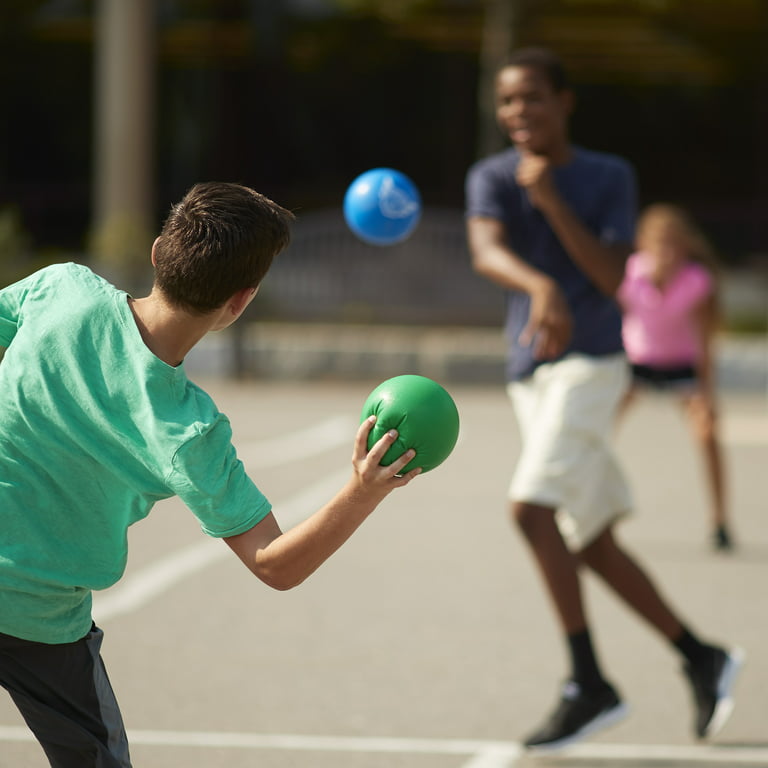
Dodge ball
Purpose: This classic playground game develops throwing accuracy, dodging skills, and strategic thinking whilst providing vigorous exercise.
Example
Game Setup: Dodge Ball
Equipment needed:
- Soft ball or pair of rolled-up socks for safety
Step-by-step rules:
- Form a large circle with one player standing in the middle
- Players in the circle throw the soft ball at the middle player
- The middle player tries to avoid being hit by dodging, jumping, or moving
- Once the middle player is hit, they join the circle
- The player who successfully hit them becomes the new middle player
- Continue rotating so everyone gets experience in both roles
Safety requirements:
- Always use soft balls to prevent injury
- Never throw the ball at someone's face, chest, or sensitive areas
- Focus on hitting legs or lower body areas safely
- Emphasise fun and fair play over aggressive throwing
Key principles for success
Understanding these fundamental principles will help you get the most out of playground games while ensuring everyone can participate safely and enjoyably.
Inclusivity and adaptation
Many games can be modified to include players with different abilities. Wheelchair handball demonstrates how traditional games can be adapted, and using audio cues (like bells on balls) can help visually impaired students participate fully.
Equipment flexibility
Most games can be played with improvised equipment. Use available materials creatively - chairs become goalposts, blankets become transport devices, and various objects can mark boundaries.
Safety first approach
Always prioritise safety through proper warm-ups, appropriate equipment, clear boundaries, and modified rules when necessary.
Team rotation and fairness
Ensure everyone gets opportunities to play different roles - chaser and chased, offensive and defensive positions, different skill challenges.
Assessment and participation tips
Note
Assessment Focus Areas
Remember that assessment in Physical Education goes beyond just physical performance. Teachers will be looking at your overall participation, understanding, and attitude towards the activities.
For practical performance:
- Focus on participation and effort rather than just winning
- Demonstrate good sportsmanship and fair play
- Show understanding of rules and safety procedures
- Adapt games appropriately for different situations
For written assessment:
- Understand the basic rules and objectives of each game
- Know the safety considerations and equipment needed
- Explain how games can be modified for different abilities or spaces
- Describe the physical and social benefits of playground games
Summary
Key Points to Remember:
- Safety is paramount - always warm up before activities and cool down afterwards
- These games develop multiple skills - fitness, coordination, teamwork, and strategic thinking
- Adaptability is key - games can be modified for different spaces, equipment, and abilities
- Inclusion matters - ensure all students can participate meaningfully regardless of their abilities
- Fair play and sportsmanship are just as important as physical skills in making games enjoyable for everyone