Blood Typing (VCE SSCE Biology): Revision Notes
📚Revision Notes
Blood Typing
Introduction to blood typing
Blood typing is a critical medical procedure used to identify specific antigens present on the surface of red blood cells (RBCs). Understanding blood types is essential for safe blood transfusions, as incompatible blood can trigger dangerous immune responses in the recipient.
Human blood can be classified using two major antigen systems: the ABO blood group system and the Rhesus (RhD) factor. These two systems work together to determine a person's complete blood type, which has important implications for medical treatments and blood donation.
Note
Blood type compatibility is one of the most critical factors in medical care. Before any blood transfusion, healthcare providers must verify blood type matches to prevent potentially life-threatening immune reactions in patients.
ABO blood group system
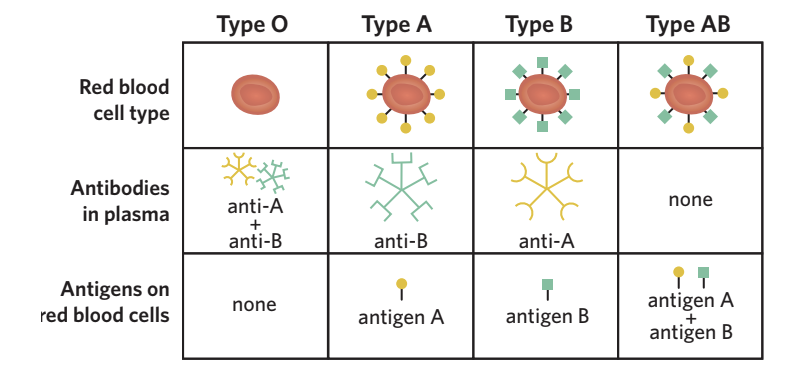
The ABO blood group system classifies blood based on the presence or absence of two specific antigens, called A and B antigens, on the surface of red blood cells. There are four possible blood types in this system:
Type A blood: Type A individuals display the A antigen on the surface of their RBCs. Their plasma naturally contains anti-B antibodies, which will attack any B antigens they encounter.
Type B blood: Type B individuals display the B antigen on the surface of their RBCs. Their plasma contains anti-A antibodies, which will attack any A antigens they encounter.
Type AB blood: Type AB individuals display both the A and B antigens on the surface of their RBCs. Interestingly, their plasma contains no anti-A or anti-B antibodies, as these would attack their own blood cells.
Type O blood: Type O individuals display neither the A nor B antigens on the surface of their RBCs. Their plasma contains both anti-A and anti-B antibodies.
Note
Memory Aid:
- Type O has nO antigens on its surface
- Type AB has All Both antigens - A and B
- Type A makes Anti-B antibodies (opposite pairing)
- Type B makes Anti-A antibodies (opposite pairing)
Understanding agglutination
The immune system recognises antigens on red blood cells in the same way it identifies other foreign antigens. When incompatible blood types mix, antibodies in the recipient's plasma will bind to the antigens on the donated red blood cells. This triggers a process called agglutination, which involves the clumping together of blood cells.
Important
Why Agglutination is Dangerous:
When incompatible blood types mix during transfusion, agglutination causes red blood cells to clump together. These clumps can block blood vessels and prevent oxygen delivery to tissues, leading to serious medical complications including organ damage, kidney failure, or even death. This is why blood type matching is absolutely crucial before any transfusion.
Example
Example: Type A Blood Receiving Type B Transfusion
Consider a patient with type A blood who has anti-B antibodies in their plasma. If they receive a transfusion of type B blood:
- The donated type B red blood cells enter the patient's bloodstream
- The patient's anti-B antibodies immediately recognize the B antigens as foreign
- The antibodies bind to the B antigens on the donated cells
- This binding causes the red blood cells to clump together (agglutinate)
- The clumps block small blood vessels, causing serious complications
This demonstrates why careful blood type matching is essential for patient safety.
Rhesus blood type system
The Rhesus factor is another important antigen system used to classify blood types. This system is controlled by a gene that determines whether the RhD antigen is present on the surface of red blood cells.
Rhesus positive (Rh+): Individuals who are Rh+ have the RhD antigen present on their red blood cells.
Rhesus negative (Rh-): Individuals who are Rh- do not have the RhD antigen on their red blood cells.
Transfusion compatibility with Rhesus factor
The Rhesus factor affects blood transfusion compatibility in specific ways. A patient who is Rh+ can safely receive Rh- blood because Rh- blood lacks the RhD antigen, so it won't trigger an immune response. However, Rh+ blood cannot be given to an Rh- patient because the RhD antigen would be foreign to the recipient's immune system and would cause an antibody response.
Note
Transfusion Rule: Think of the Rhesus factor as a one-way street for transfusions. Rh+ patients can receive both Rh+ and Rh- blood, but Rh- patients can only receive Rh- blood safely.
Eight possible blood types
When we combine the ABO and Rhesus blood type systems, there are eight possible blood types that a person can have:
- A+
- A-
- B+
- B-
- O+
- O-
- AB+
- AB-
Each blood type has specific transfusion compatibility rules. For instance, O- blood is the "universal donor" because it lacks A, B, and RhD antigens, making it compatible with all other blood types in emergency situations. Conversely, AB+ is the "universal recipient" because individuals with this blood type can receive blood from any other type without their antibodies causing agglutination.
Important
Universal Blood Types:
- O- (Universal Donor): Can give to everyone because it has no A, B, or RhD antigens that could trigger an immune response
- AB+ (Universal Recipient): Can receive from everyone because it has all antigens (A, B, and RhD) already present, so no foreign antigens will trigger a reaction
These blood types are particularly valuable in emergency medical situations where there isn't time to perform blood typing tests.
Blood typing investigation
This investigation demonstrates how to determine unknown blood types using antibody sera. Blood typing is a classification and identification technique used in medical laboratories.
Aim
To determine the blood type of four unknown samples using antibody serum testing.
Materials
Blood typing kits typically contain synthetic blood samples and antibody serums for testing. For this investigation, you will need:
- Sample 1 synthetic blood
- Sample 2 synthetic blood
- Sample 3 synthetic blood
- Sample 4 synthetic blood
- Synthetic anti-A serum (blue)
- Synthetic anti-B serum (yellow)
- Synthetic anti-D (anti-RhD) serum (white)
- Paddle pop sticks (for mixing)
- Microscope slides
- Pipettes
Important
Safety Note: While this investigation uses synthetic blood, always follow proper laboratory safety procedures and dispose of materials correctly. Treat all biological materials as potentially hazardous.
Method
Follow these steps carefully to test each blood sample:
- Transfer two drops of Sample 1 synthetic blood into three different areas on a microscope slide.
- Add one drop of anti-A serum to the first area on the microscope slide.
- Add one drop of anti-B serum to the second area.
- Add one drop of anti-D serum to the third area.
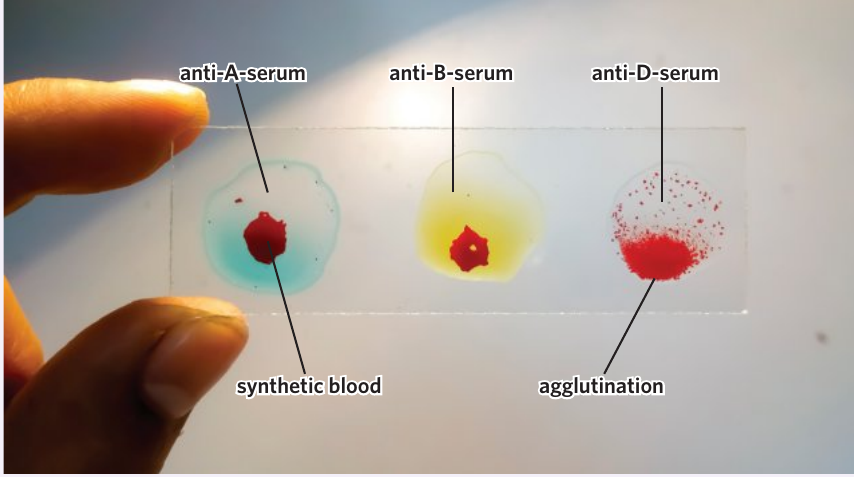
- Using a different paddle pop stick for each area, mix the blood and serum together. Observe any changes carefully. When agglutination happens, the blood mixture changes from a smooth texture to a grainy, clumped appearance. This granular texture indicates a positive reaction between the antibody serum and the antigens on the synthetic blood cells.
- Repeat steps 1-5 for Samples 2-4. Important: Rinse and dry the microscope slide thoroughly between each sample to prevent contamination that could affect your results.
- Record whether agglutination occurred or not for each combination of sample and antibody serum. Use your results to determine the blood type of each sample.
Note
What to Look For: Agglutination appears as visible clumping or a grainy texture in the blood-serum mixture. A smooth, uniform mixture indicates no agglutination. Compare treated samples with an untreated blood sample to help identify agglutination more easily.
Results
Record your observations in the table below. Write "Yes" if agglutination occurred (indicating the presence of that antigen) or "No" if no agglutination occurred (indicating the absence of that antigen).
| Antibody serum | Sample 1 | Sample 2 | Sample 3 | Sample 4 |
|---|---|---|---|---|
| Anti-A | ||||
| Anti-B | ||||
| Anti-D | ||||
| Blood type |
Interpreting your results
To determine the blood type from your results:
- If agglutination occurred with anti-A serum, the sample contains A antigens.
- If agglutination occurred with anti-B serum, the sample contains B antigens.
- If agglutination occurred with anti-D serum, the sample is Rh+.
- If no agglutination occurred with anti-D serum, the sample is Rh-.
Example
Example: Determining Blood Type from Results
Suppose a blood sample showed the following results:
- Anti-A serum: Agglutination occurred (Yes)
- Anti-B serum: No agglutination (No)
- Anti-D serum: Agglutination occurred (Yes)
Interpretation:
- Agglutination with anti-A = A antigens present
- No agglutination with anti-B = No B antigens present
- Agglutination with anti-D = RhD antigen present (Rh+)
Conclusion: The blood type is A+
Key learning points
This investigation helps you understand several important concepts:
Self-antigens: Self-antigens are molecules on the surface of your own cells that identify them as "self" to your immune system. The ABO and RhD antigens are examples of self-antigens on red blood cells.
Transfusion compatibility: Blood transfusions must be carefully matched. For example, a person with AB+ blood can receive A- blood safely because they have A antigens already (so won't react to them) and the absence of RhD antigens in the donated blood means no immune reaction will occur. However, a person with A- blood cannot receive AB+ blood because they would react to the B antigens and RhD antigens present in the donated blood.
Universal donor status: O- blood is in highest demand by blood banks because it lacks A, B, and RhD antigens. This makes it safe to transfuse to patients of any blood type in emergency situations when there isn't time to determine the patient's blood type.
Note
Improving Experimental Accuracy:
To improve this experiment's accuracy and precision, you could:
- Test each sample multiple times (replicates) to verify results
- Use fresh serums to ensure potency
- Maintain consistent drop sizes using calibrated pipettes
- Mix samples for a standardised amount of time
- Control temperature during testing
Potential Sources of Error:
- Systematic errors: Cross-contamination between samples, inadequate mixing, expired serums
- Random errors: Inconsistent drop sizes, timing variations, observer interpretation differences
Remember!
Summary
Key Points to Remember:
-
Blood types are determined by antigens: The presence or absence of A, B, and RhD antigens on red blood cells determines a person's blood type.
-
Antibodies cause agglutination: When incompatible blood types mix, antibodies in the plasma bind to foreign antigens and cause red blood cells to clump together, which can be dangerous.
-
Eight blood types exist: Combining the ABO system (A, B, AB, O) with the Rhesus system (+ or -) creates eight possible blood types.
-
Transfusion compatibility matters: Safe blood transfusions require careful matching. Rh+ patients can receive Rh- blood, but Rh- patients cannot receive Rh+ blood. O- is the universal donor, and AB+ is the universal recipient.
-
Blood typing uses agglutination tests: By mixing blood samples with different antibody serums and observing whether agglutination occurs, we can identify which antigens are present and determine the blood type.