Observing Osmosis Using Chicken Eggs (VCE SSCE Biology): Revision Notes
📚Revision Notes
Observing Osmosis Using Chicken Eggs
Introduction to the investigation
This practical investigation is a controlled experiment that demonstrates osmosis through the plasma membrane. It uses chicken eggs with their shells removed to observe how water moves across biological membranes in response to different solute concentrations.
Note
This hands-on experiment provides a visible, measurable demonstration of osmosis using a model that is large enough to observe clear changes over a short time period.
Understanding the plasma membrane
The plasma membrane is a selectively permeable barrier that controls which molecules can enter and exit cells. This membrane allows some substances to pass through while blocking others, based on several factors including molecule size, polarity, and concentration differences on either side of the membrane.
Molecules can cross the plasma membrane through both active and passive transport mechanisms. Active transport requires energy, while passive transport does not. Water movement across membranes occurs through a specific type of passive transport called osmosis.
What is osmosis?
Osmosis is the passive movement of water molecules from areas of low solute concentration to areas of high solute concentration across a selectively permeable membrane. This process happens naturally without requiring cellular energy, driven by the concentration gradient.
Important
Osmosis is always about water movement, not the movement of solutes. Water moves to balance concentrations on both sides of the membrane.
Understanding tonicity
The relationship between solute concentrations inside and outside a cell determines the direction of water movement. Three key terms describe these relationships:
Hypertonic describes a solution that has a higher solute concentration than another solution. When a cell is placed in a hypotonic environment (meaning the cell is hypertonic relative to its surroundings), water will move into the cell by osmosis.
Hypotonic describes a solution with a lower solute concentration than another solution. When a cell is placed in a hypertonic environment (meaning the cell is hypotonic relative to its surroundings), water will move out of the cell.
Isotonic describes two solutions with equal solute concentrations. When a cell and its environment are isotonic, there is no net movement of water in either direction, although water molecules continue to move across the membrane in both directions at equal rates.
Important
Common Confusion: Remember that these terms describe the solution relative to something else. A cell can be hypertonic compared to its environment, or hypotonic compared to its environment. Always ask: "Which solution has more solute?"
The structure of a chicken egg
The yolk of an unfertilised chicken egg is actually a single, very large cell. This makes it an excellent model for studying osmosis on a scale that's easy to observe and measure.
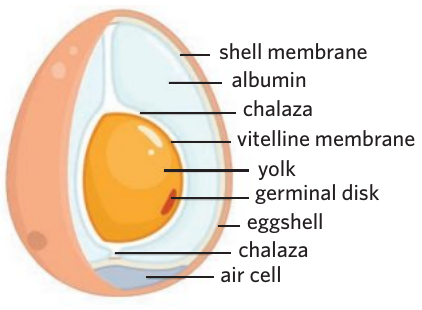
Key components of the egg include:
- The germinal disk is a small spot sometimes visible on the yolk, containing the nuclear material. In a fertilised egg, this is where the embryo would develop.
- The yolk (the cell body) stores nutrients that would feed a developing chick. The plasma membrane sits just inside the vitelline membrane.
- The vitelline membrane is a thin membrane that surrounds the yolk, and the plasma membrane lies just beneath it.
- The egg white (albumin) is not made of cells, but rather consists of water and albumin, a protein product. This layer supports and cushions the yolk.
- The chalaza are proteinous fibres that connect the yolk to membranes near the shell, helping keep the yolk centred.
- The shell membranes are mostly made of keratin and connect to the eggshell. These do not function like plasma membranes.
- The eggshell provides protection but must be removed for this experiment, as it would prevent osmosis from occurring.
Note
The chicken egg's large size makes it perfect for this investigation. Unlike microscopic cells that require special equipment to observe, changes in the egg can be seen with the naked eye and measured with a simple balance.
Aim
To investigate how varying levels of solute concentration affect the movement of water across a chicken egg membrane.
Materials
The following equipment and solutions are required:
- 3 chicken eggs
- 5% NaCl (sodium chloride) solution
- 10% NaCl solution
- Distilled water
- 1 spoon
- 1 electronic balance
- 3 beakers
- 3 jars
- Vinegar
- Paper towel
Method
This experiment requires preparation 24 hours before the main investigation takes place.
Preparation (24 hours prior to class)
Step 1: Pour one cup of vinegar or weak acid solution into each of three jars.
Step 2: Add one egg to each jar. Bubbles will appear rising from the shell. These bubbles are carbon dioxide () gas, produced by the chemical reaction between calcium carbonate in the eggshell and the acetic acid in the vinegar.
Step 3: Leave the eggs submerged in vinegar for 24 hours. Do not exceed this time, as prolonged exposure to the low pH will eventually damage the protein structure of the membrane underneath.
Step 4: Remove the eggs, examine them, and touch them gently to confirm the shells have completely dissolved.
Important
Safety Note: Handle the de-shelled eggs very carefully - they are fragile and will break easily. The egg membrane is the only thing holding the contents together.
During class
Step 5: Very carefully pick up a de-shelled egg using a spoon. Rinse it gently with distilled water and allow it to drip-dry on a paper towel.
Step 6: Carefully weigh the first egg using an electronic balance. Record the initial mass in your results table or spreadsheet.
Step 7: Repeat steps 5 and 6 for the two remaining eggs, recording each mass carefully.
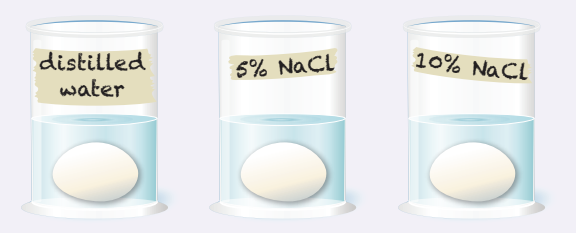
Step 8: Place the first egg in a beaker containing distilled water.
Step 9: Place the second egg into a beaker containing 5% NaCl solution.
Step 10: Place the third egg in a beaker containing 10% NaCl solution. Ensure that the same volume of solution is present in each beaker and that each egg is completely submerged.
Step 11: Before continuing, write a hypothesis stating what you expect to happen to each egg. Justify your prediction using your understanding of osmosis and tonicity.
Step 12: Leave the eggs in their respective solutions for 10 minutes. After this time, remove each egg carefully, rinse it, and allow it to drip-dry for one minute.
Step 13: Weigh each egg again and record the final mass. Keep careful track of which solution each egg was placed in.
Note
Tip for Accuracy: Try to dry each egg in exactly the same way - use the same dabbing motion and count to ensure consistency. This will improve the reliability of your results.
Results
Record all measurements in a properly formatted table. Include rows for initial mass, final mass, mass change (gain or loss), and percentage mass change.
| Solution | Distilled water | 5% NaCl | 10% NaCl |
|---|---|---|---|
| Initial mass (g) | |||
| Final mass (g) | |||
| Mass gain/loss (g) | |||
| Percentage mass gain/loss (%) |
Example
Calculating Mass Changes
To calculate mass change:
To calculate percentage change:
Example calculation: If an egg had an initial mass of 60g and a final mass of 65g:
- Mass gain =
- Percentage change =
Discussion questions
Understanding your results requires careful analysis and application of osmosis theory.
Question 1: Describe the process of osmosis.
Osmosis is the passive movement of water molecules across a selectively permeable membrane from a region of low solute concentration (high water concentration) to a region of high solute concentration (low water concentration). This continues until equilibrium is reached or other factors intervene.
Question 2: Compare and contrast osmosis, diffusion, and facilitated diffusion.
All three are forms of passive transport (requiring no cellular energy). Diffusion is the general movement of any molecules from high to low concentration. Osmosis specifically refers to water movement across a membrane. Facilitated diffusion involves molecules moving through protein channels or with carrier proteins, while osmosis and simple diffusion occur directly through the membrane.
Note
The key similarity is that all three processes are driven by concentration gradients and require no energy input from the cell. The differences lie in what substances move and how they cross the membrane.
Question 3: Explain any changes that you observed in the mass of the eggs based on your understanding of osmosis.
The egg in distilled water should have gained mass because water moved into the egg by osmosis (the egg cytoplasm has a higher solute concentration than pure water, making the egg hypertonic relative to its environment). The eggs in NaCl solutions should have lost mass, with greater loss in the 10% solution, because water moved out of the egg into the more concentrated salt solutions (making the egg hypotonic relative to its environment).
Example
Interpreting Your Results
Distilled water (0% solute): Water moves INTO the egg
- Egg is hypertonic relative to the solution
- Solution is hypotonic relative to the egg
- Result: Egg gains mass
5% NaCl solution: Water moves OUT of the egg
- Egg is hypotonic relative to the solution
- Solution is hypertonic relative to the egg
- Result: Egg loses some mass
10% NaCl solution: Water moves OUT of the egg rapidly
- Egg is hypotonic relative to the solution
- Solution is more hypertonic than the 5% solution
- Result: Egg loses more mass
Question 4: Estimate the solute concentration of the egg's cytoplasm. Explain how you arrived at your estimation.
By comparing mass changes across different concentrations, you can estimate the egg's internal solute concentration. The solution that produces the least mass change is closest to being isotonic with the egg cytoplasm. If the egg gains mass in distilled water but loses mass in both salt solutions, the egg's solute concentration lies between 0% and 5% NaCl.
Question 5: Given your results, explain what would happen to a microscopic animal cell if you placed it in each of these solutions.
In distilled water (hypotonic environment), water would rush into the cell, causing it to swell and potentially burst (lysis). In 5% NaCl (likely hypertonic), water would leave the cell, causing it to shrink (crenation). In 10% NaCl (definitely hypertonic), even more water would leave, causing severe shrinkage. The egg doesn't burst because the vitelline membrane provides structural support that typical cell membranes lack.
Important
Why Don't Eggs Burst? Unlike most animal cells, the egg has a tough vitelline membrane that provides extra structural support. Normal animal cells lack this protection, which is why they can undergo lysis (bursting) when placed in hypotonic solutions.
Question 6: Identify the independent, dependent, and controlled variables in this investigation.
The independent variable (what you deliberately change) is the solute concentration of the solution surrounding each egg.
The dependent variable (what you measure in response) is the mass change of each egg.
Controlled variables (kept constant) include: the volume of solution in each beaker, the time eggs remain in solutions, the type of egg used, the initial egg preparation method, temperature, and the type of solute (NaCl in all cases except the control).
Question 7: It is difficult to dry all the eggs in exactly the same way/exactly the same amount. Identify the type of error that this might introduce, and explain how this might affect the precision and accuracy of your results.
This introduces random error, which affects the precision (consistency) of measurements rather than accuracy (closeness to true value). Different amounts of water remaining on the eggs after drying will cause variation in the measured masses. This makes it harder to identify clear patterns, particularly if mass changes are small. To minimise this error, use a consistent drying technique (same time, same dabbing pattern) for all eggs.
Note
Understanding Error Types:
- Random errors cause measurements to vary unpredictably and affect precision
- Systematic errors cause measurements to be consistently too high or too low and affect accuracy
- Random errors can be reduced by taking multiple measurements and averaging them
Question 8: There are many different variables that influence the rate of transport across membranes. Select one of these variables, and design a method to test the effect this variable has on the rate of transport across cell membranes. Provide details of the following aspects of your experiment:
Example
Sample Investigation: Testing the Effect of Temperature on Osmosis Rate
a) Replication: Use three eggs per temperature condition (e.g., 5°C, 20°C, 35°C) to ensure results are reliable and not due to chance variation in individual eggs.
b) Independent and dependent variables:
- Independent variable: temperature
- Dependent variable: rate of mass change (measured by weighing eggs at regular intervals)
c) Control group: Eggs kept at room temperature (20°C) serve as the control, representing standard conditions.
d) Hypothesis: As temperature increases, the rate of osmosis will increase because higher temperatures give water molecules more kinetic energy, causing them to move faster across the membrane.
e) Minimising errors: Use a water bath to maintain constant temperatures, standardise the drying procedure, use the same concentration of solution for all eggs, and measure at consistent time intervals.
Conclusion requirements
A complete conclusion should address four key areas:
Summary
Key Components of Your Conclusion:
1. Hypothesis evaluation: State whether your results supported or refuted your hypothesis. Reference specific data from your results table. For example, "The hypothesis was supported, as the egg in distilled water gained 5.2g (8.7% increase), while eggs in salt solutions lost mass."
2. Limitations: Identify weaknesses in the experimental design. Examples include difficulty achieving uniform drying, short duration of experiment, using only three eggs (minimal replication), temperature variations in the room, or inability to control the exact starting mass of each egg.
3. Improvements: Suggest specific ways to address the limitations. These might include using more eggs for each condition, conducting the experiment over longer time periods with regular measurements, using a controlled drying method (perhaps measuring in a humid chamber), or maintaining constant temperature using a water bath.
4. Broader implications: Discuss how this investigation relates to real biological contexts. For example, why cells in your body need to maintain isotonic conditions, what happens when people drink seawater, how preservation techniques like salting work, or why intravenous solutions must be carefully formulated.
Remember!
Summary
Key Points to Remember:
-
Osmosis is the passive movement of water from low to high solute concentration across a selectively permeable membrane.
-
Hypertonic solutions have higher solute concentrations and draw water out of cells. Hypotonic solutions have lower solute concentrations and cause water to enter cells. Isotonic solutions produce no net water movement.
-
The egg yolk is a single large cell, making it ideal for observing osmosis at a visible scale. The shell must be removed to allow osmosis to occur.
-
In this experiment, the independent variable is the solution concentration, the dependent variable is the egg mass change, and controlled variables include time, volume, and temperature.
-
Proper experimental design requires replication, clear identification of variables, appropriate controls, and consideration of potential errors that could affect results.