Retracing the Human Odyssey (VCE SSCE Biology): Revision Notes
📚Revision Notes
Retracing the Human Odyssey
Introduction to Human Migration
Modern humans, scientifically known as Homo sapiens, have an incredible evolutionary story spanning approximately 200,000 years. Our ancestors originated in Africa and gradually spread across the globe through multiple migration waves, eventually occupying around 85% of Earth's land surface. This remarkable journey transformed our species and shaped the diverse human populations we see today.
Note
Scientists study this ancient migration using two key types of evidence that work together to reveal our evolutionary past:
Archaeological sites provide physical remains such as bones, tools, and burial sites that show where and when ancient humans lived.
Genetic material extracted from ancient fossies reveals information about relationships between different human populations and even interbreeding with other hominin species like Neanderthals.
Understanding the Investigation
This investigation focuses on classifying and identifying significant archaeological findings by examining an interactive timeline of human migration. The task involves two scientific methodologies that help us understand our evolutionary journey:
Classification and identification: Organizing archaeological discoveries by their timing, location, and significance to understand patterns in human evolution.
Simulation: Using an interactive digital map to visualize how humans migrated across continents over thousands of years, allowing us to see the relationship between archaeological evidence, climate conditions, and human encounters.
Note
Understanding the Evidence Markers
The interactive timeline uses a color-coded system to distinguish different types of evidence:
- Yellow markers indicate archaeological sites where physical remains were found
- Orange markers show climate conditions that influenced migration
- Red markers represent human encounters, including evidence of different hominin species meeting
This visual system helps researchers identify patterns in how climate, geography, and human interaction shaped migration routes.
Key Archaeological Findings Timeline
Important
Why This Timeline Matters
Each discovery in this timeline represents a crucial piece of the puzzle in understanding human migration. By studying when and where humans appeared across the globe, scientists can reconstruct the routes our ancestors took, the challenges they faced, and how they adapted to new environments. These archaeological findings provide concrete evidence that supports the Out of Africa theory of human evolution.
Scientists have identified several crucial moments in human migration history. Each discovery helps build our understanding of when, where, and how humans spread across the world.
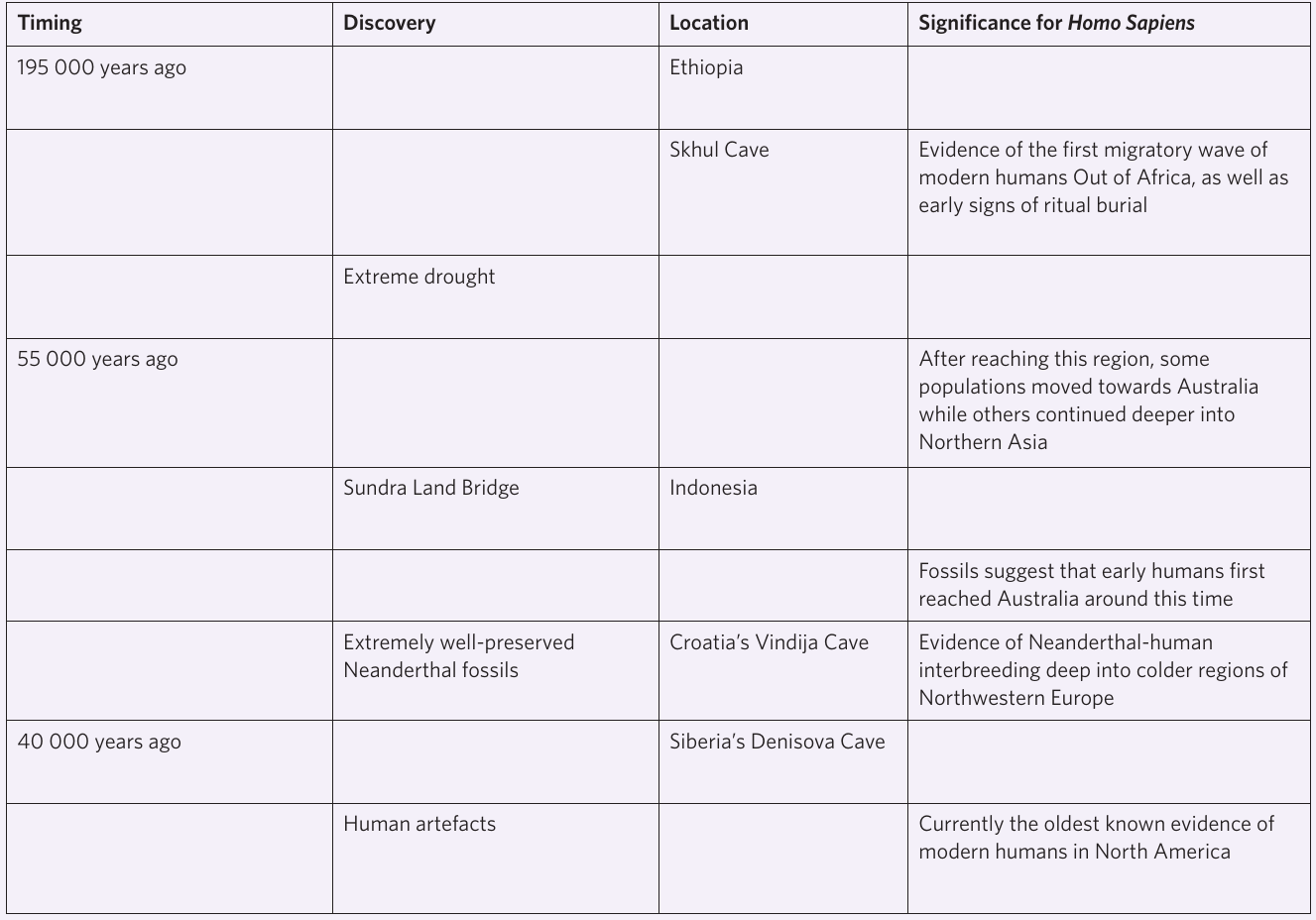
Method
-
Go to the following website: pbslearningmedia.org/resource/interactive-human-migration-map/interactive-map/
-
Open the Interactive Human Migration Map.
A new window will appear showing the beginning of the timeline (around 200,000 years ago). -
Observe the map carefully:
- Note the key at the top showing the three marker types (archaeological sites, climate conditions, human encounters).
- Pay attention to how these are represented across the map.
-
Use the timeline at the bottom of the screen to:
- Move from 200,000 years ago to the present
- Track how humans migrated across different regions over time
-
As you progress through the timeline:
- Identify important archaeological sites
- Note climate events (e.g. droughts, ice ages)
- Observe human encounters between species
-
Record key information from the simulation:
- Timing (when the event occurred)
- Location (where it happened)
- Discovery (what was found)
- Significance (why it matters for Homo sapiens)
-
Use this information to:
- Complete the classification table
- Identify patterns in migration and evolution
Ethiopia: The Birthplace of Modern Humans (195,000 Years Ago)
The earliest evidence of anatomically modern humans comes from Ethiopia in East Africa. These early Homo sapiens possessed the same basic skeletal structure and brain capacity as humans today. This African origin supports the Out of Africa theory, which suggests all modern human populations descended from these early African ancestors.
Skhul Cave: The First Great Migration
Skhul Cave provides evidence of the first major wave of modern humans migrating out of Africa. This site is particularly significant because it contains some of the earliest signs of ritual burial practices. The intentional burial of the dead suggests these early humans had developed complex social behaviours and possibly spiritual beliefs, marking an important milestone in human cultural evolution.
Note
The Significance of Ritual Burial
The presence of ritual burial at Skhul Cave tells us that early humans were not just physically similar to modern humans, but also demonstrated advanced cognitive abilities. Intentional burial of the dead suggests:
- Recognition of death as a significant event
- Possible belief in an afterlife or spiritual realm
- Social bonds and emotional connections between individuals
- Cultural practices passed down through generations
Climate and Migration Patterns
Extreme drought events played a crucial role in shaping human migration. When severe droughts struck certain regions, they created barriers that prevented movement or forced populations to seek new territories with better resources. Understanding these climate patterns helps explain why humans migrated when and where they did.
The Sundra Land Bridge and Australian Migration (55,000 Years Ago)
Around 55,000 years ago, humans reached the Sundra Land Bridge in Indonesia, marking a critical junction in migration history. From this region, some populations continued south and eventually reached Australia, becoming the ancestors of Aboriginal Australians. Other groups pushed deeper into Northern Asia, spreading throughout the continent.
Important
A Remarkable Achievement: Seafaring to Australia
The migration to Australia is particularly remarkable because it required seafaring abilities, suggesting early humans had developed sophisticated technology and navigation skills. This wasn't just walking across land bridges - it involved intentionally crossing open water, planning journeys, and possibly building watercraft. This demonstrates advanced cognitive abilities and technological innovation far earlier than previously thought.
Vindija Cave: Evidence of Neanderthal Encounters
Croatia's Vindija Cave contains extremely well-preserved Neanderthal fossils that provide compelling evidence of interbreeding between Neanderthals and modern humans. This discovery revolutionised our understanding of human evolution, showing that Homo sapiens didn't simply replace other hominin species but actually bred with them.
Today, most people of European and Asian descent carry small amounts of Neanderthal DNA, approximately 1-4% of their genome. This genetic legacy demonstrates that different human species coexisted and interbred in Northwestern Europe and other regions.
Denisova Cave: Penetrating the Far North (40,000 Years Ago)
Siberia's Denisova Cave, located in one of the coldest regions humans had reached by this time, shows that by 40,000 years ago, humans had developed the technological and cultural adaptations necessary to survive in harsh arctic climates. This includes sophisticated clothing, shelter construction, and food preservation techniques.
North American Arrival
The oldest known evidence of modern humans in North America consists of human artefacts that demonstrate when humans first crossed from Asia into the Americas. This migration likely occurred via the Bering Land Bridge, which connected Siberia and Alaska during periods when sea levels were lower.
Understanding What Makes Us Human
From a biological perspective, being "human" means belonging to the species Homo sapiens, which is part of the tribe Hominini. Understanding what defines our species helps us recognize what makes us unique among all the hominins that have existed.
Summary
Key Biological Characteristics Defining Modern Humans:
Brain capacity: Humans have large brains relative to body size, approximately 1,300-1,400 cubic centimetres, enabling complex thought, language, and problem-solving.
Bipedalism: Humans walk upright on two legs, which frees the hands for tool use and carrying objects.
Skeletal structure: Modern humans have relatively gracile (lightly built) skeletons compared to earlier hominins, with less prominent brow ridges and smaller jaws.
Chin presence: Unlike other hominins, modern humans have a distinct bony chin on the lower jaw.
Advanced culture: Humans create complex tools, use symbolic language, produce art, and engage in ritual behaviours like burial of the dead.
Comparing Humans with Other Hominins
The Hominini tribe includes modern humans and our extinct relatives such as Neanderthals, Denisovans, and earlier species like Homo erectus. Comparing skull structures reveals important differences that reflect different evolutionary adaptations and lifestyles.
Note
Skull Comparison: Modern Humans vs. Neanderthals
Modern human skulls have:
- High, rounded skulls with vertical foreheads
- Small or absent brow ridges
- Small faces positioned below the braincase
- Prominent chins
- Relatively small teeth and jaws
Neanderthal skulls have:
- Longer, lower skulls with sloping foreheads
- Prominent brow ridges
- Larger nasal openings (adaptation to cold climates)
- No chin projection
- Larger, more robust teeth and jaws
Despite these structural differences, both species had similar brain volumes, suggesting comparable cognitive capabilities.
Climate's Influence on Human Migration
Important
Climate as a Driving Force
Climate conditions profoundly shaped when and where ancient humans could migrate. Understanding climate's role is essential because it acted as both a barrier and a pathway - preventing movement in some periods while opening new routes in others. Climate wasn't just a background factor; it was a primary driver of human evolution and migration patterns.
Several climate factors influenced migration patterns:
Droughts and water availability: Severe droughts created barriers to movement by eliminating water sources and food supplies. Conversely, wetter periods could open new routes by creating grasslands and forests that supported game animals.
Ice ages: During glacial periods, sea levels dropped significantly, exposing land bridges like the Bering Strait connection between Asia and North America, and the Sundra Land Bridge to Australia. These land bridges created migration corridors that didn't exist during warmer periods.
Temperature changes: As humans developed better clothing and shelter technology, they could penetrate colder northern regions, as evidenced by the occupation of Siberia by 40,000 years ago.
Resource availability: Climate determined where plants and animals could survive, directly affecting where human populations could establish themselves.
Fossils and Fossilisation
A fossil is any preserved remains or traces of an organism from the past. This includes:
- Bones and teeth that have been mineralised
- Imprints or moulds of organisms
- Preserved footprints or burrows
- Ancient DNA preserved in remains
Important
Fossils vs. Artefacts: An Important Distinction
Stone tools are not fossils in the strict sense because they were never part of a living organism. However, they are crucial archaeological artefacts that provide evidence of human behaviour and technology. The term "fossil" specifically refers to biological remains, while stone tools are classified as artefacts.
This distinction is important for understanding how scientists categorize and study evidence of the past.
Why Are Fossils Often Found in Ancient Waterbeds and Lakes?
Fossilisation requires specific conditions, and waterlogged environments provide ideal circumstances for preservation. Understanding this process helps explain why we find fossils where we do and why the fossil record is incomplete.
Example
How Fossilisation Works in Aquatic Environments
The process of fossilisation in water environments follows several key steps:
Step 1: Rapid burial
When organisms die in or near water, sediments quickly cover the remains, protecting them from scavengers and weathering.
Step 2: Low oxygen conditions
Water-saturated sediments have low oxygen levels, which slows bacterial decay that would otherwise destroy organic material.
Step 3: Mineralisation
Minerals dissolved in groundwater gradually replace the original bone material, creating a fossil that preserves the bone's structure while transforming it into stone.
Step 4: Protection from weathering
Sediment layers shield buried remains from erosion and physical disturbance that would break down the bones.
Step 5: Continuous deposition
Lakes and riverbeds accumulate sediment layers over time, creating stratified deposits that preserve fossils in chronological order, helping scientists date findings.
Result: A perfectly preserved fossil that can survive for millions of years, providing evidence of ancient life.
Summary
Key Points to Remember:
-
Modern humans (Homo sapiens) originated in Africa approximately 200,000 years ago, with the earliest evidence found in Ethiopia.
-
The Out of Africa migration occurred in multiple waves, with the first major wave evidenced at Skhul Cave, where ritual burial practices demonstrate advanced cultural behaviour.
-
Climate conditions, particularly droughts and ice ages, significantly influenced migration routes and timing, creating both barriers and pathways for human movement.
-
Archaeological evidence shows humans interbred with other hominins like Neanderthals (Vindija Cave, Croatia) and Denisovans, meaning modern non-African populations carry genetic material from these extinct species.
-
By 40,000 years ago, humans had developed sufficient technological and cultural adaptations to survive in extreme arctic environments (Denisova Cave, Siberia) and had spread to most continents, including Australia and eventually the Americas.
-
Fossilisation occurs most successfully in waterlogged environments where rapid burial, low oxygen, and mineral-rich water create ideal preservation conditions.
-
The study of human migration combines archaeological evidence (physical remains and artefacts) with genetic material from ancient fossils to build a complete picture of our evolutionary journey.