To Seed or Not to Seed (VCE SSCE Biology): Revision Notes
📚Revision Notes
To Seed or Not to Seed
Introduction
Aerobic cellular respiration is a fundamental biochemical process that cells use to obtain usable energy from glucose. This process requires oxygen and produces ATP (adenosine triphosphate), which is the energy currency that powers cellular activities. During aerobic respiration, cells break down glucose molecules and release carbon dioxide and water as waste products.
The overall equation for aerobic cellular respiration is:
(Glucose + Oxygen → Carbon dioxide + Water + Energy)
Note
Memory Aid: "GO → CWA"
Remember the reactants and products: Glucose + Oxygen → Carbon dioxide + Water + ATP
How temperature affects cellular respiration
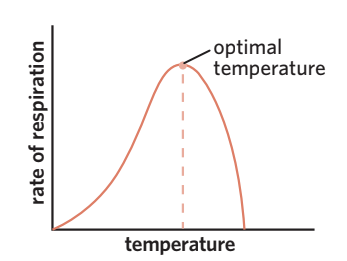
Cellular respiration depends on enzymes to catalyse the various reactions involved. Like all enzymes, those involved in respiration are highly sensitive to temperature changes. Each enzyme has an optimal temperature at which it works most efficiently.
When the temperature is below optimal, enzyme activity decreases because molecules move more slowly and collide less frequently. This results in a lower rate of cellular respiration. However, when temperatures rise above the optimal range, enzymes begin to denature. Denaturation means the enzyme's three-dimensional structure breaks down, causing it to lose its function. This can slow the reaction dramatically or stop it altogether.
Important
Temperature and Enzyme Function: "Too Cold = Slow, Too Hot = Stop"
- Below optimal temperature: Enzymes work slowly because molecular movement decreases
- At optimal temperature: Enzymes work at maximum efficiency
- Above optimal temperature: Enzymes denature and lose their function permanently
The link between carbon dioxide and pH
One of the products of aerobic cellular respiration is carbon dioxide (CO₂). When carbon dioxide dissolves in water, it forms carbonic acid (H₂CO₃), which then breaks down to release hydrogen ions (H⁺) into the solution:
The release of H⁺ ions makes the solution more acidic, causing the pH to decrease. This relationship allows us to measure the rate of cellular respiration indirectly by monitoring pH changes - more respiration means more CO₂ production, which means a lower pH.
Note
The Respiration-pH Connection
More respiration = More CO₂ = Lower pH (more acidic)
This inverse relationship between respiration rate and pH is the foundation of this experimental investigation.
Measuring pH with universal indicator
To detect pH changes in this investigation, we use universal indicator (UI). Universal indicator is created by combining multiple different pH indicators, giving it the ability to show a wide spectrum of colours across the entire pH range. By observing the colour of a solution containing universal indicator, we can estimate its pH value.

The colour changes from red (very acidic, pH 0-2) through orange and yellow (acidic, pH 3-6), green (neutral, pH 7-8), to blue and purple (alkaline, pH 9-14).
Note
Universal Indicator Color Spectrum: "ROYGBIV acid to base"
- Red/Orange/Yellow = Acidic (pH 0-6)
- Green = Neutral (pH 7-8)
- Blue/Indigo/Violet = Basic/Alkaline (pH 9-14)
Germinated vs ungerminated seeds
During germination, bean seeds undergo rapid growth and development. They rely heavily on stored nutrients in their endosperm tissue until they can produce their own food through photosynthesis. This active growth requires substantial amounts of energy, which the seeds obtain through cellular respiration. Therefore, germinated seeds are expected to have much higher rates of respiration compared to ungerminated (dormant) seeds.
This investigation examines how different temperatures affect the rate of aerobic cellular respiration in both germinated and ungerminated bean seeds by measuring CO₂ production through pH changes.
Aim
To investigate the relationship between temperature and the rate of aerobic cellular respiration in germinating bean seeds.
Note
Identifying the Variables
- Independent variable: Temperature (what we change)
- Dependent variable: Rate of respiration measured through pH change (what we measure)
Materials
- 4 × 250 mL conical flasks
- 4 × rubber stoppers with associated delivery tubing
- 4 × test tubes
- 4 × trays to hold ice or water
- Water (room temperature and 60°C)
- 1 × hot plate or kettle
- 1 × thermometer
- Ice
- Paper towel
- Cotton wool buds
- Bean seeds (ungerminated and germinated)
- Universal indicator
- Stopwatch timer
Method
Part A: Preparing the bean seeds
Important
Time Required: This preparation phase takes approximately 48 hours and must be completed before the main experiment.
- Working in small groups, gather 30 bean seeds and place them in a conical flask (or multiple flasks if needed). Cover the seeds with water and allow them to soak overnight.
- After soaking, drain the water from the conical flask(s). Cover the soaked bean seeds with a damp paper towel and leave them for 48 hours. This allows the seeds to germinate.
- Once germinated, select groups of 10 seeds and place each group on top of a layer of cotton wool buds in separate conical flasks. Label these flasks:
- "1G – ice"
- "2G – RT" (room temperature)
- "3G – 60°C"
- Prepare a fourth conical flask containing 10 ungerminated bean seeds (seeds that have not been soaked or germinated). Label this flask "4UG".
Note
Why Four Different Conditions?
The three germinated seed groups allow us to test the effect of temperature on respiration rate, while the ungerminated seeds serve as a control to demonstrate the difference between dormant and active seeds.
Part B: Analysing aerobic cellular respiration
Important
Time Required: This is the main experimental procedure that takes 45 minutes to complete.
- Use the hot plate and thermometer to heat water to 60°C.
- Prepare three trays containing different temperature water baths:Place the appropriately labelled conical flasks into their corresponding temperature baths. For the 60°C water bath, continue using the hot plate to maintain a stable temperature throughout the experiment.
- Tray 1: Ice bath
- Tray 2: Room temperature water
- Tray 3: Water heated to 60°C
- Prepare four test tubes with the same labels as the conical flasks (1G-ice, 2G-RT, 3G-60°C, 4UG). Add deionised water to each test tube, then add exactly five drops of universal indicator to each.
- Seal each conical flask with a rubber stopper. Connect the delivery tube from each flask to its corresponding labelled test tube. This creates a closed system where any gas produced by the seeds will bubble through the universal indicator solution.
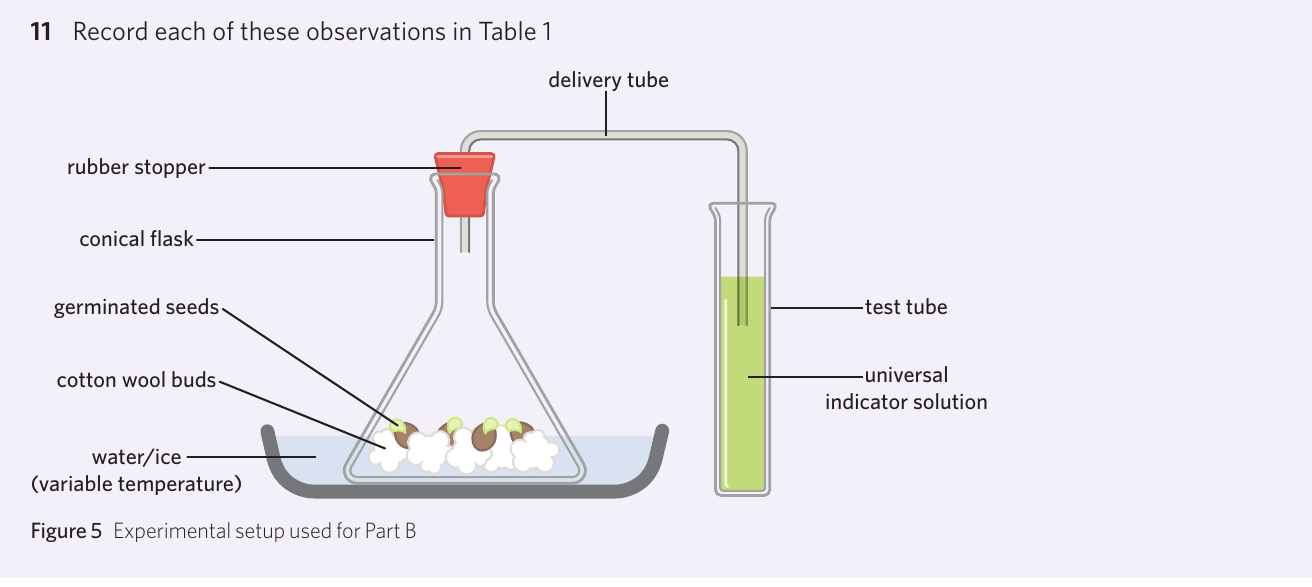
- Allow the entire setup (all four conical flasks with their connected test tubes) to sit undisturbed for 45 minutes.
- After 45 minutes, carefully observe the colour of the universal indicator solution in each test tube. Record these observations in your results table.
- Use the universal indicator colour chart to estimate the approximate pH of each solution based on its colour. Record these pH values in your results table.
Note
What to Look For
- Greater CO₂ production will cause more color change toward the acidic (red/orange/yellow) end of the spectrum
- Lower pH values indicate higher respiration rates
- Little to no color change suggests minimal or no respiration
Results
Record your observations after 45 minutes in the table below:
| Condition | 1G – ice | 2G – RT | 3G – 60°C | 4UG |
|---|---|---|---|---|
| Colour of the UI solution | ||||
| Approximate pH |
Note
Recording Observations
Be as specific as possible when describing the universal indicator color. Use the color chart provided to estimate pH values accurately.
Discussion questions
- State your hypothesis for this experiment. Identify whether your results support your chosen hypothesis.
- Identify the dependent and independent variables in this experiment.
- State the products of aerobic cellular respiration.
- In an aerobic environment, which organelle allows the maximum amount of ATP to be obtained from one molecule of glucose?
- Consider the following statement: "As the temperature of a cell's environment increases, the rate of aerobic cellular respiration will increase due to enzyme activity increasing." Evaluate the accuracy of this statement.
Note
Hint for Question 5
Think about what happens to enzymes at different temperatures. Is this statement true for all temperature increases, or only up to a certain point?
- Identify which group of bean seeds experienced the greatest rate of aerobic cellular respiration in your experiment. Explain your reasoning, making sure to justify your answer with reference to the pH and carbon dioxide production.
- Ungerminated and early germinating bean seeds are unable to photosynthesise, and so do not consume carbon dioxide as part of their metabolic processes. Explain whether the varying levels of aerobic cellular respiration due to temperature in a photosynthetic plant could be measured using this experimental setup.
- Identify any possible errors that may have affected your results. Classify any error(s) as a personal, systematic, or random error.
- Identify any uncontrolled variables in this experiment, and suggest how they may have affected your results. Then, explain how you could change the method to deal with these uncontrolled variables.
- Considering your method, what steps could you add in or modify to increase the precision of your experiment?
- Did any of the results surprise you? If so, why? What could be a possible explanation for any irregular or surprising results?
Important
Common Pitfalls to Avoid
When analyzing your results, remember:
- Temperature fluctuations in water baths can affect consistency
- Air bubbles in delivery tubes can interfere with gas collection
- Initial pH of water may vary between test tubes
- Seed quality and germination rates may not be uniform
Conclusion
Write a concluding paragraph to summarise your investigation. Be sure to include:
- Whether the aim was achieved by referring to the results
- Limitations in the experiment
- Potential ways to improve the experiment
- Broader implications of your research or further areas of exploration that stem from your findings
Remember!
Summary
Key Points to Remember:
-
Aerobic cellular respiration produces ATP, carbon dioxide, and water from glucose and oxygen. The rate of this process depends heavily on temperature.
-
Enzyme activity increases with temperature up to an optimal point. Above the optimal temperature, enzymes denature and lose function, causing respiration to slow or stop.
-
Carbon dioxide dissolves in water to form carbonic acid, which releases H⁺ ions and lowers pH. This allows us to measure respiration indirectly by monitoring pH changes with universal indicator.
-
Germinated seeds respire more rapidly than ungerminated seeds because they require large amounts of energy for growth. This should result in greater CO₂ production and a larger decrease in pH.
-
Controlled experiments require careful attention to variables. In this investigation, temperature is the independent variable, while the rate of respiration (measured through pH change) is the dependent variable.