Column Chromatography (AQA A-Level Chemistry): Revision Notes
📚Revision Notes
7.11.3 Column Chromatography
Column chromatography separates substances based on their differing levels of adsorption to the adsorbent within the column. As the compounds pass through the column at varying rates, they separate into distinct fractions. This technique can be applied on both a small and large scale to purify materials for use in future experiments. Column chromatography is a type of adsorption chromatography.
Principle of Column Chromatography
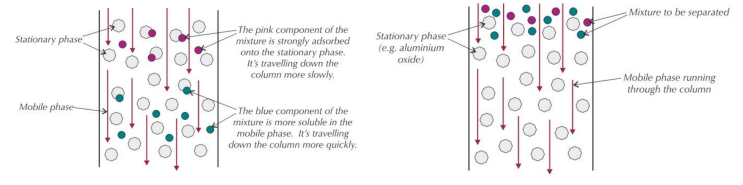
In column chromatography, the mobile phase containing the mixture to be separated is introduced from the top of the column. As the mixture moves down the column, its individual components travel at different rates due to variations in their affinity for the stationary phase.
- Components with Lower Adsorption: Substances with lower adsorption and weaker affinity for the stationary phase move faster down the column.
- Components with Higher Adsorption: Substances with stronger adsorption and greater affinity for the stationary phase move more slowly.
As a result, the components that travel faster are eluted (removed) first, while those that move more slowly are eluted last.
The adsorption of the solute molecules onto the stationary phase is reversible, allowing for separation based on differential rates of movement.
The movement of each component can be quantified using the retardation factor (Rf), calculated as:
This Rf value helps characterise and identify each component based on its relative movement in the chromatographic system.
Elution in Chromatography
Elution is a chemical process in chromatography where ions or molecules adsorbed on a solid phase are removed by exchanging them with a solvent or eluent. This involves using a solvent to extract the adsorbed substance from the solid adsorbent in the column.
- Eluent: The eluent is the mobile phase (solvent) that flows through the column. When the polarity of the eluent matches the polarity of the sample molecules, these molecules desorb from the adsorbent and dissolve in the eluent, allowing them to be carried through the column.
- Eluate: The eluate is the mixture that exits the column, consisting of the mobile phase (eluent) and the separated sample components (analytes).
- Function of Eluent: In chromatography, the eluent helps move and separate components of a mixture as they pass through the column. In liquid chromatography, the eluent is a liquid solvent, while in gas chromatography, it is a carrier gas.
The eluent plays a crucial role in transporting sample components through the column based on their affinities, enabling effective separation and collection of fractions.
The Method:
Mobile phase: liquid solvent (e.g. water or organic solvents). Stationary phase: powder (e.g. silicon dioxide or aluminium oxide) often packed into a glass column. This method is useful for separating large amounts of soluble substances.
- The mixture to be separated is dissolved in the solvent and placed at the top of the column.
- As the solvent (eluent, fancy word) moves down through the powder in the column, the substances in the mixture move through the column at different rates
- This allows them to collect separately at the bottom.
- The time it takes to move down the column depends on the balance between the solubility of each substance in the mobile phase and its retention in the stationary phase.
It is easiest to separate coloured substances using CC; that said, colourless substances are also separated this way.
Types of Column Chromatography
- Adsorption Column Chromatography: In adsorption chromatography, separation occurs as the components of the mixture are adsorbed onto the surface of a solid adsorbent. Different components are retained on the adsorbent surface based on their adsorption affinities.
- Partition Column Chromatography: This method involves two liquid phases—both the stationary phase and the mobile phase are liquids. Components of the mixture partition themselves between these two phases based on their relative solubilities.
- Gel Column Chromatography: In gel chromatography, separation occurs through a column filled with gel. The stationary phase consists of a solvent held within the pores of the gel, allowing molecules to separate based on their size as they move through the gel matrix.
- Ion Exchange Column Chromatography: This technique uses an ion exchange resin as the stationary phase. The resin contains charged sites that attract and bind ions from the mixture, allowing separation based on the charge of the components.