The pH of Soil (Leaving Cert Agricultural Science): Revision Notes
📚Revision Notes
The pH of Soil
What is soil pH and why does it matter?
Soil pH measures how acidic or alkaline soil is on a scale from 0 to 14. Understanding soil pH is crucial for farmers and gardeners because it affects nutrient availability, plant growth, and crop yields. Most plants thrive in slightly acidic to neutral soils (pH 6.0-7.0), whilst some prefer more acidic conditions.
Note
The pH scale ranges from 0-14, where 7 is neutral. Values below 7 are acidic, and values above 7 are alkaline. Each unit represents a 10-fold change in acidity level.
Key terms:
- pH: A scale measuring acidity/alkalinity (0-6 acidic, 7 neutral, 8-14 alkaline)
- Universal indicator: A chemical that changes colour based on pH levels
- Filtrate: The liquid that passes through philtre paper during filtration
Equipment needed
For this practical investigation, you'll need:
Note
Essential Equipment Checklist:
- Test tubes and test tube rack
- Beaker for mixing
- Glass rod for stirring
- Funnel and philtre paper
- Deionised water (pure water with no minerals)
- Universal indicator solution
- pH colour chart for comparison
- Soil sample for testing
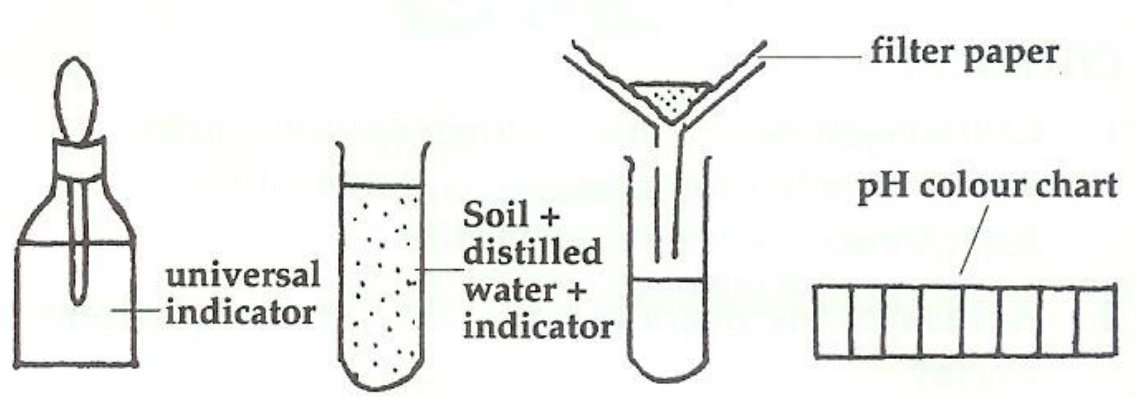
Step-by-step method
Step 1: Sample collection Collect a representative soil sample from the area you want to test. Remove any large stones, roots, or debris.
Step 2: Create soil solution Place some soil in a beaker and add deionised water. Stir thoroughly with a glass rod to create a muddy solution. This allows water-soluble components to dissolve.
Step 3: Filtration process Set up your funnel with philtre paper and carefully pour the soil mixture through it. The clear liquid (filtrate) that comes through contains the dissolved substances that will indicate pH.
Important
Why filtration is essential: The filtration step removes solid soil particles that would interfere with colour observation. Only the clear filtrate contains the dissolved ions that determine pH.
Step 4: Add universal indicator Add 2-3 drops of universal indicator to your clear filtrate. The solution will immediately change colour based on the pH level.
Step 5: Determine pH Compare the colour of your solution with the pH colour chart. Match the colours carefully to get an accurate reading.
Understanding your results
The colour changes you observe tell you about soil chemistry:
- Red/orange colours: Very acidic soil (pH 1-4) - may need lime treatment
- Yellow colours: Moderately acidic soil (pH 5-6) - good for acid-loving plants
- Green colours: Neutral soil (pH 7) - ideal for most crops
- Blue/purple colours: Alkaline soil (pH 8-14) - may need organic matter addition
Practical applications for Irish agriculture
Knowing soil pH helps farmers make informed decisions:
Example
Practical Application: Irish Farming Scenarios
Acidic soils: Common in areas with high rainfall like western Ireland. A farmer testing soil that shows yellow/orange colours (pH 4-5) would need to apply lime to raise pH for crops like barley and wheat.
Neutral soils: A green colour result (pH 7) indicates well-managed farmland, ideal for most vegetables and cereals - no treatment needed.
Alkaline soils: Less common in Ireland but may occur in limestone regions, requiring organic matter addition to lower pH.
- Acidic soils: Common in areas with high rainfall like western Ireland. May need lime application to raise pH for crops like barley and wheat
- Neutral soils: Found in well-managed farmland, ideal for most vegetables and cereals
- Alkaline soils: Less common in Ireland but may occur in limestone regions
Safety considerations
Important
Safety Requirements:
- Wear safety goggles when handling universal indicator
- Wash hands thoroughly after handling soil samples
- Use deionised water to avoid contamination
- Handle glassware carefully to prevent breakage
Exam tips
Summary
Key Points for Exam Success:
- Always mention using deionised water (not tap water) in your method
- Explain why filtration is necessary - to remove solid particles
- Remember that universal indicator shows a range of colours, not just one
- Be able to suggest improvements like taking multiple samples for accuracy
Remember!
Summary
Essential Takeaways:
- Soil pH affects nutrient availability - too acidic or alkaline soils can lock up essential nutrients
- Universal indicator changes colour based on hydrogen ion concentration in the soil solution
- Filtration is essential to get a clear solution for accurate colour comparison
- Deionised water must be used to avoid affecting the natural pH of the soil sample
- Irish soils tend to be acidic due to high rainfall, so lime treatment is often needed for crop production