Allen’s Rule (VCE SSCE Biology): Revision Notes
📚Revision Notes
Allen's Rule
What is Allen's rule?
Allen's rule is an ecogeographical principle proposed by Joel Allen in 1877 that describes how animals adapt to different climates through changes in their body proportions. The rule states that animals living in colder climates tend to have shorter appendages (such as ears, tails, legs, and beaks) compared to similar animals living in warmer climates.
This pattern is not just about appearance - it serves an important homeostatic function. Shorter appendages in cold environments help animals conserve body heat, while longer appendages in warm environments help them dissipate excess heat.
Note
The adaptation of body proportions to climate is a key example of how natural selection shapes physical characteristics to enhance survival in specific environments.
Connection to thermoregulation
The biological basis for Allen's rule lies in the relationship between surface area and volume ( ratio). Here's how it works:
In cold climates:
- Animals benefit from having smaller appendages
- Reduced surface area means less heat is lost to the environment
- Birds in cold conditions limit blood flow to their beaks, further minimizing heat loss
- This helps maintain stable body temperature (homeostasis)
In warm climates:
- Animals benefit from having larger appendages
- Increased surface area allows more heat to be released
- For example, toucans can dissipate approximately 60% of their body heat through their large beaks
- This prevents overheating in hot environments

Note
The diversity of beak shapes and sizes in different bird species partly reflects their need to regulate temperature in their specific habitats, alongside other factors such as diet and mating preferences.
Case study: Song sparrows
A research study by Greenberg et al. (2012) provided clear evidence for Allen's rule by comparing two subspecies of song sparrow using infrared thermal imaging.
The two subspecies studied
Example
Comparing Song Sparrow Subspecies
Atlantic Song Sparrow (Melospiza melodia atlantica)
- Lives in hot dune and salt marsh environments
- High exposure to heat throughout the day
- Has evolved adaptations to dissipate excess heat
Eastern Song Sparrow (Melospiza melodia melodia)
- Lives in mesic habitats (environments with well-balanced moisture and moderate temperatures)
- Green, vegetated areas with less extreme heat
- Requires less heat dissipation than the Atlantic subspecies
Research methodology
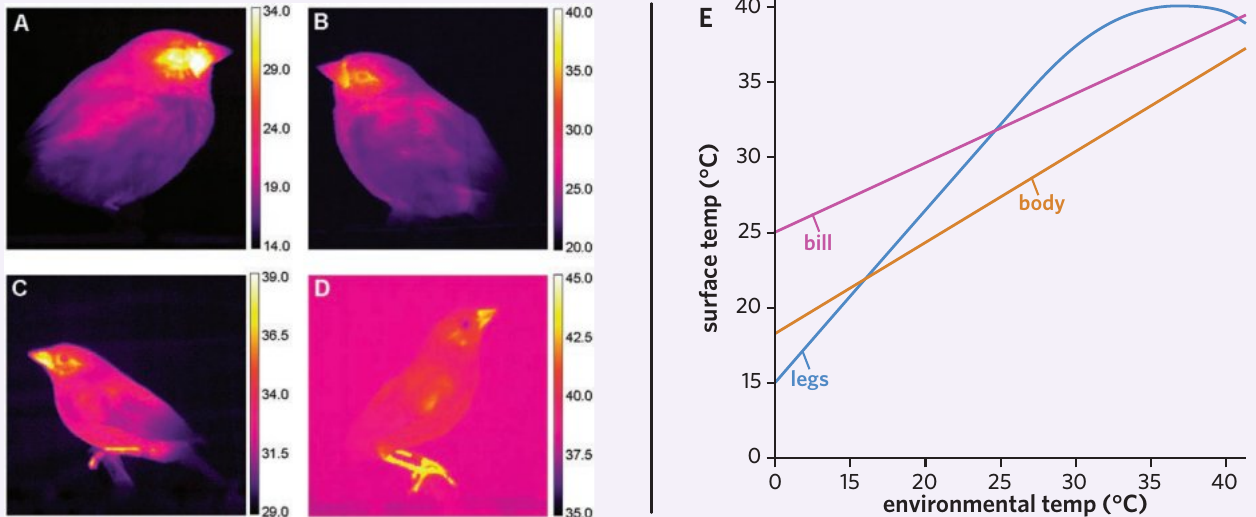
The researchers used infrared thermal imaging to visualize how heat was distributed across different body parts of the sparrows at various environmental temperatures. This non-invasive technique allowed them to measure surface temperatures of the bill, legs, and body under controlled conditions.
Note
The thermal images show clear temperature differences across the birds' bodies. Warmer areas appear in yellow and white, while cooler areas appear in purple and blue. As environmental temperature increased, the surface temperatures of different body parts changed at different rates. The bill and legs heated up more rapidly than the main body, demonstrating their role in heat exchange.
Key findings from the study
The research revealed several important differences between the two subspecies:
Physical measurements
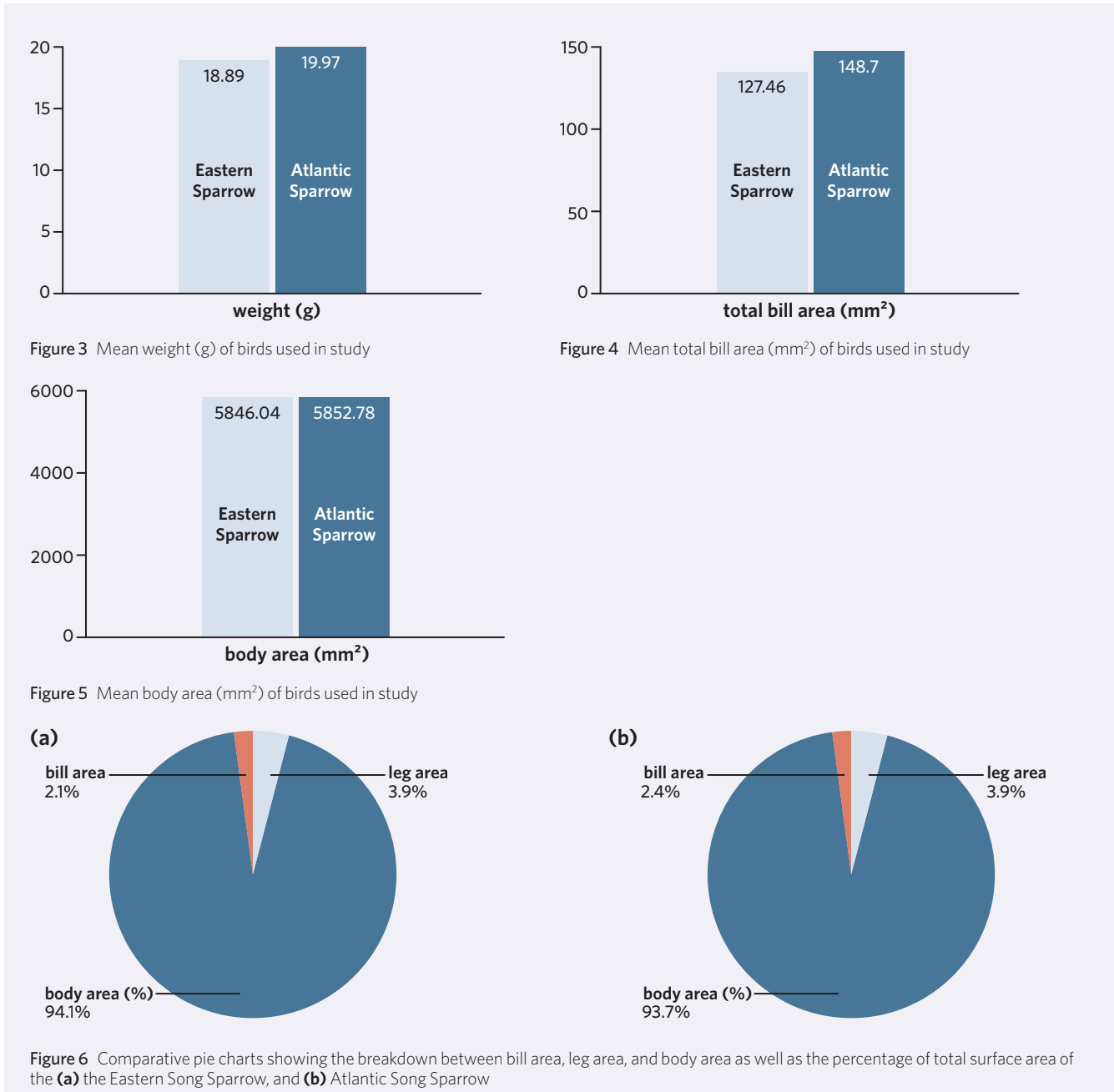
Weight:
- Eastern Song Sparrow: 18.89 g
- Atlantic Song Sparrow: 19.97 g
The birds were similar in overall body mass, making them suitable for direct comparison.
Bill surface area:
- Eastern Song Sparrow: 127.46 mm²
- Atlantic Song Sparrow: 148.7 mm²
Important
The Atlantic Song Sparrow's bill had 17% more surface area than the Eastern Song Sparrow's bill - a significant difference that supports Allen's rule.
Body surface area:
- Eastern Song Sparrow: 5846.04 mm²
- Atlantic Song Sparrow: 5852.78 mm²
Body surface areas were nearly identical, confirming that the bill size difference was the key distinguishing feature.
Proportional surface area breakdown
Eastern Song Sparrow:
- Body area: 94.1%
- Bill area: 2.1%
- Leg area: 3.9%
Atlantic Song Sparrow:
-
Body area: 93.7%
-
Bill area: 2.4%
-
Leg area: 3.9%
Note
Although bills represent only a small percentage of total body surface area, this difference is functionally significant for thermoregulation.
Heat dissipation findings
| Finding | Details |
|---|---|
| Bill surface area difference | Atlantic Song Sparrow's bill has 17% more surface area |
| Heat dissipation difference | Atlantic Song Sparrow's bill dissipated up to 33% more heat |
| Habitat difference | Atlantic lives in hot dune/salt marsh; Eastern lives in mesic habitats |
| Measurement method | Heat loss measured independently of evaporative water loss |
Important
The 33% increase in heat dissipation through the larger bill demonstrates that even modest differences in appendage size can have substantial effects on an animal's ability to regulate temperature.
Understanding extremities and surface area
In animal anatomy, extremities are body parts that extend from the main body mass - typically the parts furthest from the body's centre. These include:
- Limbs (legs, arms, wings)
- Tails
- Ears
- Beaks and bills
Extremities are particularly important for thermoregulation because:
- They have a high surface area relative to their volume
- They can be positioned to maximize or minimize heat exchange
- Blood flow to these areas can be regulated to control heat loss
Note
In the song sparrow study, both the bill and legs qualify as extremities. Despite constituting only 2.1-3.9% of total body surface area in each subspecies, these small appendages play a disproportionately important role in temperature regulation.
Evolutionary significance
The differences between Atlantic and Eastern Song Sparrows demonstrate how natural selection has shaped morphology in response to environmental challenges. The Atlantic Song Sparrow's larger bill is an adaptive feature that:
- Allows it to survive in hot, exposed habitats where overheating is a risk
- Provides a mechanism for heat dissipation without relying solely on water loss through evaporation (important in salt marsh environments where water conservation may be crucial)
- Demonstrates that even small structural changes can have significant physiological impacts
Important
This case study shows that Allen's rule is not just a descriptive pattern but reflects functional adaptations that help animals maintain homeostasis across different climatic zones.
Applications beyond birds
While this study focused on bird beaks, Allen's rule applies to many other animals and body parts:
Mammals:
- Arctic foxes have shorter ears than desert foxes
- Polar bears have smaller ears than their warm-climate relatives
- Humans from cold climates tend to have shorter limbs and stockier builds than those from tropical regions
Other appendages:
- Tail length varies with climate in many mammal species
- Limb length shows similar patterns across many vertebrate groups
Note
Understanding Allen's rule helps us predict how animals might adapt to climate change and why certain body proportions are advantageous in specific environments.
Summary
Key Points to Remember:
- Allen's rule states that animals in colder climates have shorter appendages than similar animals in warmer climates, helping with temperature regulation
- The principle is based on surface area to volume ratio - smaller appendages reduce heat loss in cold environments, while larger appendages increase heat dissipation in warm environments
- The Atlantic Song Sparrow (warm habitat) has a bill with 17% more surface area and dissipates 33% more heat than the Eastern Song Sparrow (cooler habitat)
- Even small differences in appendage size (bills were only 2.1-2.4% of total body surface area) can have significant impacts on an animal's ability to regulate temperature
- Allen's rule demonstrates how natural selection shapes physical characteristics to help animals maintain homeostasis in different climatic conditions