Celery Sucks (VCE SSCE Biology): Revision Notes
📚Revision Notes
Celery Sucks
Introduction
Plants need water for photosynthesis, but interestingly, most of the water they absorb from the soil doesn't stay in the plant. Instead, it's lost to the atmosphere through tiny openings in the leaves called stomata. This process is called transpiration, and it serves several vital functions for the plant:
Note
Why Transpiration Matters:
- Nutrient transport: Transpiration helps move nutrients from the roots throughout the plant
- Cooling: Similar to how sweating cools us down, transpiration helps regulate plant temperature
- Cell protection: It prevents cell damage and wilting by maintaining proper water pressure in cells
How transpiration works
Transpiration relies on three key mechanisms working together:
- Capillary action: The ability of water to move up narrow tubes (like plant stems) against gravity
- Cohesion: Water molecules stick together, creating a continuous column of water moving up the plant
- Pressure differences: Variations in pressure between different parts of the plant and the environment drive water movement
Environmental factors affecting transpiration
While transpiration is essential,
too much can be dangerous
. Excessive water loss can damage or even kill a plant. Several environmental conditions increase the transpiration rate:
- High temperatures: Warm air causes more evaporation from leaves
- Wind: Moving air carries away water vapour, increasing the rate of evaporation
- Low humidity: Dry air creates a stronger gradient for water to evaporate into
Plants have evolved various adaptations to regulate transpiration and prevent water loss in challenging conditions. This investigation allows you to explore how celery responds to different humidity levels and observe the transpiration process in action.
Aim
To observe and record the movement of water through a celery stalk in a humid, closed environment compared to a stalk exposed to a less humid, open environment.
Materials
Part A
- 4 celery stalks with leaves attached
- 2 beakers (or glasses or cups)
- Red or blue food colouring
- Single-edge razor blades or scalpels
- Cling wrap
- Clear, sealable plastic container (large enough to fit an upright celery stalk)
- 1 ruler
Part B (optional extension)
Materials are student-directed and may include:
- Petroleum jelly
- Fans
- Incubators/heaters
- Refrigerators
- Spray bottles
Method
Part A: Comparing transpiration in different humidity levels
Step 1: Prepare the coloured water
Fill two beakers with 150 mL of water each. Add 2-3 drops of food colouring to each beaker. The food colouring will help you visualise where water travels through the celery.
Step 2: Prepare the celery stalks
Select four celery stalks that are similar in size and have a comparable number of leaves. If needed, break stalks off the celery bunch to get similar specimens. Using a scalpel, carefully make a clean cut to remove the base of each stalk. After trimming, all four stalks should be approximately the same height.
Important
Critical for Fair Testing:
Ensure all stalks are similar in size and leaf count. This is a crucial controlled variable that prevents size differences from affecting your results.
Step 3: Set up the beakers
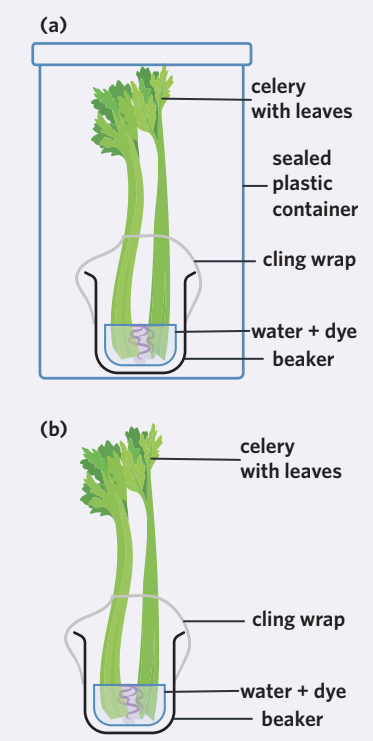
Place two celery stalks into each beaker. Cover the top of each beaker with cling wrap, ensuring the stalks remain upright and the beaker is sealed. The cling wrap prevents water from evaporating from the beaker surface (alternatively, you could pour a thin layer of oil over the water). Make sure you support all stalks in the same way to keep the experiment fair.
Step 4: Create the humid environment
Add 50-100 mL of room temperature water to the bottom of the plastic container. Place one of the celery beakers into this container and seal the lid tightly. This creates a humid, closed environment around one set of celery stalks.
Step 5: Position the experiments
Place both celery setups (the one in the container and the one exposed to air) next to each other. Ensure both receive the same amount of sunlight and are at the same temperature. This is crucial for a fair comparison.
Step 6: Form a hypothesis
Before continuing, write down your hypothesis. How do you expect the independent variable (humidity level) to affect the dependent variable (rate of transpiration), and why? Think about what you've learned about how humidity affects transpiration.
Note
Understanding Variables:
- Independent variable: What you deliberately change (humidity level)
- Dependent variable: What you measure in response (transpiration rate)
- Controlled variables: Factors kept the same (light, temperature, celery size)
Step 7: First observation (30-60 minutes)
Return to your experiment after 30-60 minutes. Remove one celery stalk from each beaker. Using a scalpel, cut each stalk longitudinally (lengthwise). Use a ruler to measure how far up the stalk the coloured water has travelled. Record your measurements.
Step 8: Examine the transect
Take a very thin cross-sectional cut (transect) of each celery stalk. Look carefully at the cut surface. You should notice that the dye has travelled through certain parts of the stem but not others. These pathways are the plant's vascular tissue. Prepare a scientific drawing of the transects, labelling all key structures you observe.
Step 9: Set up for overnight observation
Set up the apparatus again, but this time use only one untampered celery stalk in each beaker. Leave the experiment overnight.
Step 10: Final observations
The next day, remove the last two celery stalks and the cling wrap. Record the volume of solution remaining in each beaker. Carefully slice the stalks open longitudinally using a scalpel. Measure the distance the coloured water has travelled from the base of each celery stalk. Also, observe and record any colour changes in the leaves.
Part B: Improving and extending the investigation (optional)
Step 11: Analyse and improve the method
Review the method you followed in Part A. Identify at least two realistic ways to improve the accuracy, precision, or validity of the experiment. Consider:
- Would weighing the celery and beaker improve data accuracy?
- Is there a better way to support the celery and prevent evaporation than cling wrap?
- Was the laboratory warm enough to create a truly humid environment?
Record your suggested improvements in the results section.
Step 12: Design your own experiment
Several other factors affect transpiration rate besides humidity. Design and carry out a variation of Part A that tests how one or more of these factors influence transpiration. Remember to include:
-
Appropriate controlled variables
-
Replication (multiple trials)
-
A control or comparison group
-
The method improvements you identified in Step 11
Results
Part A
| Measurement | Beaker without container | Beaker in container | ||||
|---|---|---|---|---|---|---|
| Initial | After 30 mins | Final | Initial | After 30 mins | Final | |
| Volume of water and food colouring solution (mL) | ||||||
| Length of stalk where food colouring is visible (cm) | ||||||
| Observations |
Note
Recording Your Observations:
When completing the table, be specific and quantitative. Record exact measurements and describe any colour changes, wilting, or other visible effects you observe in the celery stalks and leaves.
Scientific drawing of the transect sections
When you examine the cross-section of the celery stalk, draw what you observe. Label the different tissues, particularly noting which parts contain the coloured water. This will help you identify the xylem vessels that transport water through the plant.
Note
Scientific Drawing Tips:
- Use a sharp pencil and draw clear, continuous lines
- Label all identifiable structures with horizontal label lines
- Indicate the magnification if using a microscope
- Focus on accuracy rather than artistic style
- Show which tissues have absorbed the coloured dye
Part B
Record your two suggested improvements:
For your extended experiment, identify:
- Independent variable(s): The factor(s) you are changing
- Dependent variable(s): What you are measuring (and how you will measure it)
- Controlled variables: Factors you are keeping the same
- Uncontrolled variables: Factors you cannot control
- Experimental group(s): The group(s) receiving the treatment
- Control/comparison group: The group used as a baseline
- Level of replication: How many times you will repeat the experiment
Discussion questions
These questions will help you analyse and understand your results from Part A:
1. Describe transpiration, including its purpose and mechanism.
Think about the biological processes involved and why plants need to transpire water, even though it means losing most of the water they absorb.
2. Compare and contrast phloem and xylem.
These are the two main types of vascular tissue in plants. What does each transport, and in what direction?
Note
Vascular Tissue Reminder:
- Xylem: Transports water and minerals upward from roots to leaves
- Phloem: Transports sugars and nutrients in multiple directions throughout the plant
3. Identify the independent and dependent variables in this investigation.
Remember: the independent variable is what you change, and the dependent variable is what you measure.
4. Identify any controlled variables in this experiment.
What factors did you keep the same to ensure a fair test?
5. Identify any possible errors that may have affected your results.
Consider personal errors (mistakes you made), systematic errors (problems with equipment or setup), and random errors (unpredictable variations).
6. State what this investigation tested, and describe your main results.
Summarise your findings clearly, referring to your data.
7. Using your understanding of transpiration, explain your results.
Why did the celery in different environments behave differently? Link your observations to the biological principles of transpiration.
Important
Connecting Theory to Practice:
Your explanation should reference key concepts like humidity gradients, water potential, and stomatal function. Consider how the sealed environment affected the rate of water loss compared to the open environment.
8. Explain the role of the cling wrap in this experiment.
Think about what might happen if you didn't use cling wrap. How does it help ensure a fair test?
9. Explain the importance of using similarly sized celery stalks in this experiment.
Why is this an important controlled variable?
Conclusion
When writing your conclusion, make sure to address these points:
Note
Conclusion Structure:
-
Hypothesis evaluation: State whether your hypothesis was supported or refuted, and justify your choice using evidence from your results
-
Limitations: Identify weaknesses or problems with the experimental design or execution that may have affected your results
-
Improvements: Suggest specific, realistic ways to improve the experiment if you were to repeat it
A good conclusion synthesises all your observations and analysis, clearly stating what you learned from the investigation and acknowledging any uncertainties or areas for improvement.
Remember!
Summary
Key Points to Remember:
-
Transpiration is the loss of water vapour from plant leaves through tiny pores called stomata. It's essential for nutrient transport, cooling, and maintaining cell structure.
-
Environmental factors significantly affect transpiration rates. High temperatures, wind, and low humidity all increase water loss from plants.
-
Capillary action and cohesion of water molecules work together to move water up through the plant, even against gravity.
-
The xylem vessels transport water and minerals upward through the plant, which you can visualise using coloured water in this experiment.
-
A controlled experiment requires careful attention to variables: change only the independent variable, measure the dependent variable accurately, and keep all controlled variables constant for a fair test.