Design a Bird (VCE SSCE Biology): Revision Notes
📚Revision Notes
Design a Bird
This investigation is a simulation that helps you understand how genes are passed from parents to offspring. By using coin flips to represent random inheritance, you'll create two birds and then predict what their offspring might look like based on genetic principles.
What this investigation teaches you
This practical simulation demonstrates several important genetic concepts. You'll learn how traits are inherited, how to use Punnett squares to predict offspring characteristics, and how different types of inheritance work. The investigation covers autosomal traits (located on regular chromosomes) and sex-linked traits (located on sex chromosomes), as well as the difference between monohybrid crosses (one trait) and dihybrid crosses (two traits).
Key genetic concepts
Before beginning the investigation, it's essential to understand some fundamental genetic terminology. These concepts form the foundation of how inheritance works.
Genes and alleles
We inherit one copy of each gene from each parent, giving us two copies of every gene in our cells. Different versions of the same gene are called alleles. For example, a gene for eye colour might have an allele for black eyes and another allele for green eyes. These alleles are what create variation in populations.
Note
Think of alleles as different "versions" of the same instruction manual. The gene is the instruction manual for a trait (like eye colour), but alleles are the different versions of those instructions (black eyes vs. green eyes). You inherit one version from mum and one from dad.
Genotype and phenotype
Your genotype is your genetic makeup - the specific combination of alleles you possess. For instance, if you have one allele for black eyes () and one for green eyes (), your genotype would be written as . Your phenotype is the physical characteristic that results from your genotype - in this case, what colour your eyes actually appear. The genotype is like a recipe, whilst the phenotype is the finished product.
Note
Memory Aid:
- GEN-O-TYPE = GEN-etic makeup - it's all about the genes you have
- PHEN-O-TYPE = what you SEE - it's the physical appearance
The genotype is invisible (hidden in your DNA), but the phenotype is visible (what you actually look like).
Incomplete dominance
In some cases, neither allele is completely dominant over the other. When this happens, a heterozygous individual (having two different alleles) will show a blended or intermediate phenotype. In this investigation, some of the bird traits display incomplete dominance, producing phenotypes that are between the two homozygous forms.
Important
Incomplete dominance is different from regular dominance! In regular dominance, one allele "wins" and the recessive allele is hidden. In incomplete dominance, both alleles contribute equally, creating a blend. For example: = black, = green, but = blue (a blend, not black).
Understanding bird traits
The birds in this simulation have four traits that are inherited: eye colour, wing colour, body colour, and beak length. Each trait is controlled by specific alleles, and the way these alleles interact determines what the bird looks like.
Eye colour ( alleles)
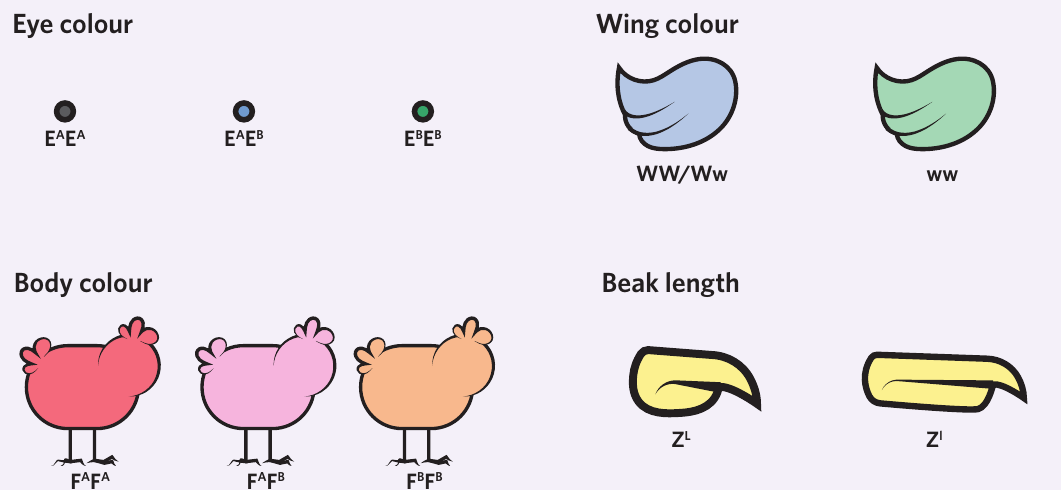
Eye colour is controlled by two alleles that show incomplete dominance. If a bird has two alleles (), it will have black eyes. If it has two alleles (), it will have green eyes. However, if the bird is heterozygous (), it will have blue eyes - a colour that's intermediate between black and green.
Wing colour ( alleles)
Wing colour follows a simpler dominant-recessive pattern. Birds with at least one allele ( or genotypes) will have blue wings, whilst birds with two recessive alleles ( genotype) will have green wings. This means the allele is dominant over the allele.
Body colour ( alleles)
Body colour also shows incomplete dominance. Birds with the genotype have pink bodies (sometimes appearing coral or red), whilst birds have orange bodies (sometimes appearing tan or peach). Heterozygous birds () have light pink bodies, demonstrating the blending effect of incomplete dominance.
Beak length ( alleles)
Beak length is different from the other traits because it's sex-linked - the genes are located on the Z sex chromosome. Male birds have two Z chromosomes (), so they can have genotypes like , , or . Female birds have one Z and one W chromosome (), so they can only have one beak length allele on their single Z chromosome, written as or . The allele produces a long curved beak, whilst produces a shorter beak.
Note
Remember the bird sex chromosomes:
- = males have matching chromosomes
- = females have mixed chromosomes
This is opposite to mammals, where males are XY and females are XX!
Materials required
To complete this investigation, you'll need:
- White paper or a printed results sheet
- Coloured pencils for drawing your birds
- 2 coins for generating random alleles
- 1 dice (though the main method uses coins)
Creating your bird (Part A)
The first part of the investigation involves creating your own unique bird by randomly determining its genotype for each trait. This simulates the random nature of inheritance from two parent birds.
Determining eye colour
Flip two coins simultaneously. Each coin represents one allele inherited from each parent. If a coin lands on heads, it represents the allele. If it lands on tails, it represents the allele. Record your result: two heads means (black eyes), two tails means (green eyes), and one of each means (blue eyes). Write this genotype down and note the corresponding phenotype.
Determining wing and body colour
Repeat the coin-flipping process for wing colour (where heads = and tails = ) and body colour (where heads = and tails = ). Remember to flip both coins at once each time. Notice that some phenotypes show incomplete dominance, meaning a heterozygous genotype produces a different appearance than either homozygous genotype.
Determining sex and beak length
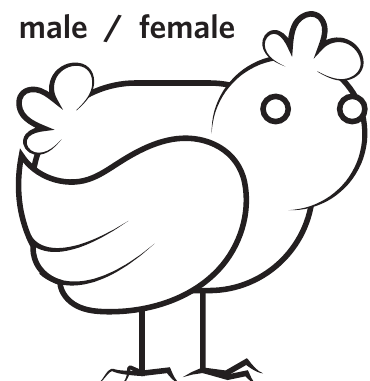
Flip one coin to determine whether your bird is male or female. Heads = male ( chromosomes), and tails = female ( chromosomes). This is important because beak length genes are located on the Z chromosome. If your bird is male, flip two coins to get both Z chromosome alleles (heads = , tails = ). If your bird is female, flip only one coin because females have just one Z chromosome.
Example
Worked Example: Creating Your Bird
Let's say you flip coins and get these results:
Step 1: Eye colour (flip 2 coins)
- Result: Heads, Tails
- Genotype:
- Phenotype: Blue eyes
Step 2: Wing colour (flip 2 coins)
- Result: Heads, Heads
- Genotype:
- Phenotype: Blue wings
Step 3: Body colour (flip 2 coins)
- Result: Tails, Tails
- Genotype:
- Phenotype: Orange body
Step 4: Sex (flip 1 coin)
- Result: Heads
- Sex: Male ()
Step 5: Beak length (flip 2 coins, since male)
- Result: Heads, Tails
- Genotype:
- Phenotype: Long curved beak (since is dominant)
Your bird is a male with blue eyes, blue wings, orange body, and a long curved beak!
Record all your results in a table:
| Trait | Genotype | Phenotype |
|---|---|---|
| Eye colour () | ||
| Wing colour () | ||
| Body colour () | ||
| Beak length () |
Once you've determined all traits, use coloured pencils to draw your bird with its specific characteristics.
Predicting offspring eye colour (Part B)
After creating your bird, you'll pair up with a classmate who has a bird of the opposite sex. Now you'll predict what offspring from these two birds might look like by using genetic crosses.
Understanding monohybrid crosses
A monohybrid cross tracks the inheritance of a single trait. For eye colour, you'll create a Punnett square that shows all possible combinations of alleles the offspring could inherit. Eye colour genes are located on autosomes (non-sex chromosomes), so both parents contribute one allele regardless of sex.
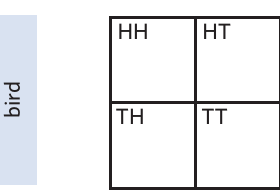
To complete the Punnett square, place one parent's alleles along the top and the other parent's alleles down the side. Fill in each box with the combination of alleles from that row and column. This grid shows the four possible genotypes for offspring. Each box represents a 25% probability.
Note
Understanding the Punnett Square:
The Punnett square works because:
- Each parent can only pass on one allele to the offspring
- The offspring gets one allele from each parent
- All combinations are equally likely to occur
- The number of boxes showing a particular genotype tells you its probability
In a Punnett square: each box = 25%, or probability
Using coin flips to determine your specific offspring
Rather than just calculating probabilities, you'll simulate which specific offspring you got by flipping coins. Each box in the Punnett square is labelled with a code (HH, HT, TH, or TT). Flip one coin twice and record the results in order (H for heads, T for tails). Your coin flip results tell you which box in the Punnett square represents your offspring's genotype. Record this genotype and determine the corresponding phenotype.
| Offspring genotype | |
|---|---|
| Offspring phenotype |
Predicting offspring wing and body colour (Part C)
Wing colour and body colour are controlled by genes on different chromosomes, meaning they assort independently during inheritance. To predict these two traits together, you need a dihybrid cross.
Understanding dihybrid crosses
A dihybrid cross tracks two traits simultaneously. Because the wing colour gene and body colour gene are on separate chromosomes, they're inherited independently of each other. This means all combinations of alleles are equally possible. The dihybrid cross requires a Punnett square, giving 16 possible offspring combinations.
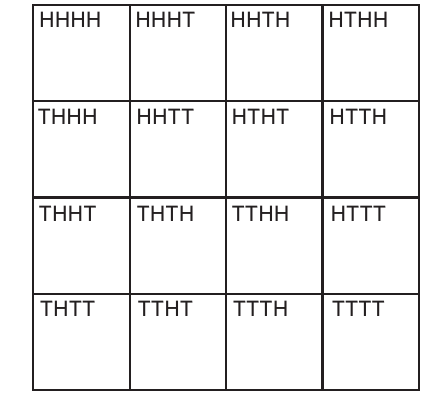
To use this grid, you need to identify all possible gamete combinations from each parent. Each parent can pass on one allele for wing colour and one for body colour in their gamete. List all possible combinations for each parent, then use the Punnett square to show all 16 possible offspring genotypes.
Important
Understanding Independent Assortment
When genes are on different chromosomes, they assort independently. This means:
- The allele a gamete gets for wing colour doesn't affect which allele it gets for body colour
- If a parent is , they can make four types of gametes: , , ,
- Each gamete type is equally likely (25% each)
This is why a dihybrid cross needs a grid - four gamete types from each parent!
Simulating your offspring's characteristics
Each box in the grid is labelled with a four-letter code of H's and T's. Flip a coin four times in succession and record your results in order. This code tells you which box represents your specific offspring. From that genotype, determine both the wing colour phenotype and body colour phenotype.
| Offspring genotype | |
|---|---|
| Offspring phenotype |
Note
The dihybrid cross demonstrates an important genetic principle: genes on different chromosomes are inherited independently, leading to new combinations of traits in offspring that neither parent had. This is called independent assortment and is one of Mendel's key laws of inheritance.
Predicting offspring beak length (Part D)
Beak length is unique among the traits in this investigation because it's sex-linked. The genes are located on the Z chromosome, which means inheritance patterns differ between male and female offspring.
Understanding sex-linked inheritance in birds
Unlike mammals, birds use Z and W sex chromosomes. Male birds are (having two Z chromosomes), whilst female birds are (having one Z chromosome and one W chromosome). The beak length gene is only found on the Z chromosome, not on the W. This means male offspring receive two copies of the beak length gene (one from each parent), but female offspring receive only one copy (from their father).
Important
Key Point About Sex-Linked Inheritance:
The sex of the offspring is determined by which parent contributed which chromosome:
- If the offspring receives Z from mum AND Z from dad = Male ()
- If the offspring receives W from mum AND Z from dad = Female ()
Notice that the mother determines the sex of the offspring in birds, since only she can pass on a W chromosome. Fathers always pass on a Z chromosome.
Creating the monohybrid cross for beak length
Set up a Punnett square with the father's Z chromosome alleles across the top and the mother's chromosomes (one Z and one W) down the side. Fill in the squares to show all possible offspring. Notice that some offspring will be male () and some will be female (), and they may have different beak length genotypes.
Flip one coin twice to determine which offspring you got, using the same H/T coding system as before. Record the genotype and phenotype, noting whether your offspring is male or female.
| Offspring genotype | |
|---|---|
| Offspring phenotype |
Example
Worked Example: Sex-Linked Cross
Father's genotype: (long curved beak, heterozygous) Mother's genotype: (short beak)
Setting up the Punnett square:
| (from dad) | (from dad) | |
|---|---|---|
| (from mum) | ||
| (from mum) |
Analyzing the results:
- - Male, long curved beak (25% probability)
- - Male, short beak (25% probability)
- - Female, long curved beak (25% probability)
- - Female, short beak (25% probability)
Notice that both males and females can have either beak length in this cross, but the inheritance pattern is different from autosomal traits.
Sex-linked traits often show different inheritance patterns than autosomal traits, and they can result in certain phenotypes being more common in one sex than the other.
Recording and analysing results
After completing all crosses, you should have determined the genotype and phenotype for all four traits of your offspring bird. Draw and colour your offspring bird to show all its characteristics. Then calculate the probability percentages from your Punnett squares to understand the likelihood of different trait combinations.
For the monohybrid crosses (eye colour and beak length), count how many boxes out of four show each phenotype, and multiply by 25% to get the probability. For the dihybrid cross (wing and body colour), count how many boxes out of 16 show each combination of phenotypes, and multiply by 6.25% to get the probability.
Note
Calculating Probabilities from Punnett Squares:
The formula is simple:
For a grid: Each box =
For a grid: Each box =
If 3 out of 4 boxes show a phenotype: probability
Why simulation is valuable
This investigation uses simulation to model genetic inheritance in a controlled, observable way. Whilst actual genetic inheritance is more complex, this simulation captures the key principle that inheritance is random - offspring randomly receive one allele from each parent. The coin flips represent this randomness accurately.
Simulations are particularly useful for genetics investigations because they allow you to quickly observe patterns across multiple generations. In real life, breeding birds and waiting for offspring would take considerable time. The simulation lets you explore inheritance patterns, test predictions using Punnett squares, and understand probability in genetics without needing live specimens.
Note
Why Coin Flips Work:
Coin flips are a perfect model for genetic inheritance because:
- Each flip has two equally likely outcomes (just like each parent has two alleles to choose from)
- The outcome is completely random (just like which allele gets passed on is random)
- Each flip is independent of previous flips (just like each offspring's inheritance is independent)
- The probability is always 50:50 (just like the probability of passing on each allele is 50:50)
Key learning outcomes
Through this investigation, you've explored several important genetic concepts that apply to real organisms, not just simulated birds.
Monohybrid crosses involve tracking a single trait and typically use a Punnett square. They're useful for understanding simple dominant-recessive relationships and incomplete dominance.
Dihybrid crosses involve tracking two traits simultaneously and require a Punnett square. They demonstrate the principle of independent assortment - that genes on different chromosomes are inherited independently of each other.
Sex-linked inheritance follows different patterns than autosomal inheritance because males and females have different combinations of sex chromosomes. In birds, males () can have two different alleles for Z-linked genes, whilst females () can only have one allele.
Independent assortment means that genes on different chromosomes don't influence each other's inheritance. However, if genes were on the same chromosome (linked genes), they would tend to be inherited together, changing the expected ratios in offspring.
Important
Common Misconceptions to Avoid:
- Punnett squares show probabilities, not guarantees - just because a phenotype has a 25% probability doesn't mean you'll definitely get it once every four offspring
- Each offspring is an independent event - if you get three blue-eyed chicks in a row, the fourth is still 25% likely to have blue eyes, not guaranteed
- Sex-linked traits are not the same as sex-limited traits - sex-linked means the gene is on a sex chromosome; sex-limited means the trait only appears in one sex
- Incomplete dominance is not the same as codominance - incomplete dominance shows blending (blue from black and green), codominance shows both traits separately (like AB blood type)
Exam tips
When answering questions about genetic crosses:
- Always define your allele symbols clearly (e.g., = black eyes allele, = green eyes allele)
- Show all working in Punnett squares
- Distinguish between genotype (genetic makeup) and phenotype (physical appearance)
- Remember that probabilities are predictions - actual results may vary due to chance
- For sex-linked traits, identify the sex chromosomes in your answer ( for males, for females in birds)
- When calculating ratios, simplify them where possible (e.g., 2:2 becomes 1:1)
Summary
Key Points to Remember:
-
Genotype determines phenotype - Your genetic makeup (alleles) determines your physical characteristics, though the relationship isn't always straightforward
-
Inheritance is random - Offspring randomly receive one allele from each parent, which is why coin flips accurately model this process
-
Independent assortment applies to unlinked genes - Genes on different chromosomes are inherited independently, creating new trait combinations in offspring
-
Sex-linked traits follow special patterns - Traits on sex chromosomes are inherited differently in males versus females, leading to different probabilities for each sex
-
Punnett squares predict probabilities, not certainties - These tools show possible outcomes and their likelihoods, but actual results depend on chance, especially with small sample sizes
-
Different inheritance patterns exist - Incomplete dominance, complete dominance, and sex-linkage all affect how genotypes relate to phenotypes
-
Always show your working - In exams, marks are awarded for method as well as the final answer, so construct clear Punnett squares and explain your reasoning