Enzymes and Bubbles (VCE SSCE Biology): Revision Notes
📚Revision Notes
Enzymes and Bubbles
Introduction
Hydrogen peroxide (H₂O₂) is a chemical compound that forms naturally inside the cells of living organisms. While it's produced as a normal part of cellular processes, hydrogen peroxide can be very harmful. It has the potential to damage cells and important molecules within organisms. This means it must be broken down quickly into safer substances.
This is where the enzyme catalase comes in. Catalase is responsible for breaking down hydrogen peroxide into two much safer products: water (H₂O) and oxygen gas (O₂).
Note
The breakdown of hydrogen peroxide by catalase can be represented by the chemical equation:
This shows that two molecules of hydrogen peroxide are converted into two molecules of water and one molecule of oxygen gas.
Different organisms (such as humans, plants, and other animals) have slightly different versions of catalase. These variations evolved over time to work best under each organism's specific environmental conditions. However, the fundamental job of catalase remains the same across all organisms: breaking down the potentially dangerous H₂O₂ into harmless H₂O and O₂.
Aim of the investigation
The purpose of this investigation is to observe and compare the enzyme activity of catalase in different biological samples. By testing a variety of materials, we can determine which samples contain active catalase enzyme.
Materials required
To carry out this investigation, you will need:
- 9 test tubes
- 3% hydrogen peroxide solution (H₂O₂)
- Lab coat, goggles, and gloves for safety
- Small samples (test-tube sized portions) of the following materials:
- Sliced raw potato
- Baked potato
- Ground young leaves
- Ground old, dried leaves
- Yeast cells
- Liver sample (such as from a sheep)
- Ground raw meat
- Cooked meat
Note
You can use alternative samples as long as you have a good variety of both living and non-living materials to test. This variety will help you identify patterns in catalase activity.
Method
Follow these steps carefully:
- Label eight test tubes with the name of each sample you're testing.
- Label a ninth test tube as your control (this will have no sample added).
- Fill each test tube about one-third of the way up with hydrogen peroxide solution.
- Carefully add a small amount of one sample to its matching test tube. Be gentle to avoid splashing.
- Watch the test tube closely for one to two minutes. Note whether bubbles form or not. Record your observation in the results table.
- Repeat steps 4-5 for each of your remaining samples. Remember that the control test tube should have no sample material added to it.
Important
Safety First! Always wear your lab coat, goggles, and gloves when handling hydrogen peroxide solution. Hydrogen peroxide can cause irritation to skin and eyes.
Results
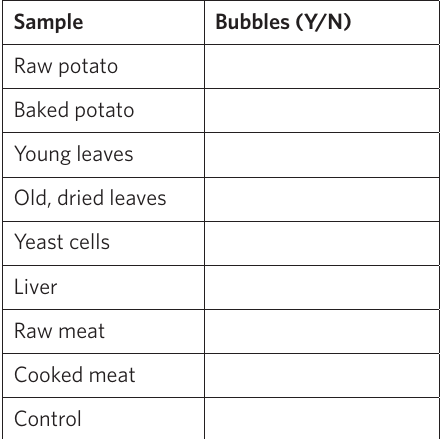
Record your observations using the table below. Mark 'Y' for yes if bubbles were produced, or 'N' for no if bubbles were not produced.
Note
What the bubbles mean: If bubbles appear, this indicates that oxygen gas (O₂) is being released. This happens when catalase enzyme in the sample breaks down the hydrogen peroxide. The presence of bubbles therefore shows that active catalase enzyme is present in that sample.
Discussion questions
After completing your investigation, consider these questions:
1. Identify the dependent and independent variables in this experiment.
Example
Understanding Variables:
- The independent variable is what you deliberately changed: the type of sample tested
- The dependent variable is what you measured: whether or not bubbles were produced
In this experiment, you controlled which sample went into each test tube (independent), and then observed the resulting bubble formation (dependent).
2. Did any of the results surprise you? If so, why?
3. Categorise the eight types of sample as living or non-living material.
4. From your observations, what can be concluded about the presence or absence of catalase in living and non-living material?
5. Considering your method, what steps could you add in or modify to increase the precision of your experiment?
Think about ways to make measurements more accurate or consistent. Consider factors such as:
- How could you measure bubble production more precisely?
- What variables should be kept constant?
- How many trials should you conduct?
6. Optimal conditions question:
Studies have shown that potato catalase works best at 35°C and at pH 8.2. Hydrogen peroxide solution at low concentration has a slightly acidic pH. If you were to run this experiment again, identify a change to the conditions for the raw potato sample that would produce more bubbles. Explain your reasoning.
Important
Common Mistake to Avoid:
Remember that enzymes are sensitive to environmental conditions. Heat can denature (destroy) enzymes, which is why cooked samples often show different results than raw samples. When considering optimal conditions, think about both temperature and pH.
7. Identify any possible errors that may have affected your results.
Be sure to state whether each was a personal error, systematic error, or random error:
- Personal errors: mistakes made by the person conducting the experiment
- Systematic errors: problems with equipment or method that affect all results the same way
- Random errors: unpredictable variations that affect results differently each time
Conclusion
When writing up your investigation, make sure your conclusion includes:
Note
Structuring Your Conclusion:
Your conclusion should address three key areas:
-
Limitations in the experiment: What factors might have affected the reliability or accuracy of your results?
-
Potential ways to improve the experiment: How could you modify the method to get better or more detailed results?
-
Broader implications: What do your findings tell us about enzymes and living organisms? What further questions could you investigate based on what you've learned?
Remember!
Summary
Key Points to Remember:
-
Hydrogen peroxide (H₂O₂) is produced in living cells but is harmful and must be broken down quickly.
-
Catalase is the enzyme that breaks down hydrogen peroxide into water and oxygen gas:
-
Bubbles in the test tubes indicate oxygen gas being released, showing that active catalase is present in that sample.
-
Living materials typically contain active catalase, while non-living or heat-treated materials do not.
-
Enzymes like catalase work best under specific conditions (optimal temperature and pH) and can be denatured (destroyed) by heat.