Modelling Meiosis Using Lego Bricks (VCE SSCE Biology): Revision Notes
📚Revision Notes
Modelling Meiosis Using Lego Bricks
Investigation type: Modelling
Introduction to meiosis
Meiosis is a specialised form of cell division where a single diploid parent cell undergoes two successive divisions to create four genetically unique haploid gametes. Each gamete produced contains exactly half the genetic information present in the original parent cell, and importantly, no two gametes are genetically identical to each other.
Key processes that increase genetic diversity
Two particular stages during meiosis are responsible for generating the remarkable genetic variation we observe in gametes:
Crossing over in prophase 1: During this stage, sections of genetic material are swapped between homologous chromosomes. This exchange creates recombinant chromatids, which are chromosomes containing a mixture of genetic information from both parental sources.
Independent assortment during metaphase 1: In this phase, homologous chromosome pairs position themselves randomly along the cell's equator. Because this arrangement is random, different combinations of maternal and paternal chromosomes end up in different daughter cells.
Note
These molecular-level processes can be challenging to visualise, which is why physical models are so valuable. This investigation uses Lego bricks to represent chromosomes and demonstrate how recombination occurs during meiosis.
Aim
To demonstrate the importance of crossing over and independent assortment in creating genetic diversity, using coloured Lego bricks to represent different chromosomes and alleles.
Materials required
- 4 rubber bands
- 40 red Lego bricks
- 40 yellow Lego bricks
- 2 black Lego bricks
- 2 white Lego bricks
- 2 blue Lego bricks
- 2 pink Lego bricks
Note
The specific colours are not critical. You can use whatever colour bricks are available, but you need six different colours in total to represent different genetic components.
Method
This investigation models meiosis in a diploid organism () with two pairs of homologous chromosomes. Follow each step carefully.
Step 1: Creating homologous chromosome pairs
Using half of your red and yellow Lego bricks, construct two pairs of chromosomes with different lengths. In this model, red bricks represent chromosomes inherited from the mother (maternal chromosomes), while yellow bricks represent those inherited from the father (paternal chromosomes).
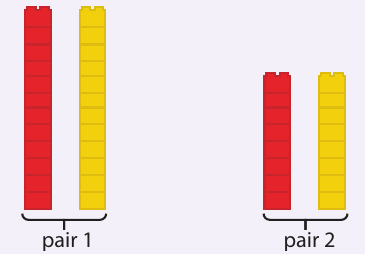
Each pair consists of one red chromosome and one yellow chromosome. These are homologous chromosomes because they carry genes for the same traits, although they may have different versions (alleles) of those genes.
Step 2: Adding genetic information
Now you'll add alleles to your chromosomes at two specific gene locations. Insert one coloured brick into each chromosome to represent different alleles. For this investigation, we'll examine two human traits:
| Gene | Dominant allele | Recessive allele |
|---|---|---|
| Hitchhiker's thumb | Regular thumb (black Lego brick) | Hitchhiker's thumb (white Lego brick) |
| Hairline shape | Widow's peak (pink Lego brick) | Straight hairline (blue Lego brick) |
Note
In the example shown, the chromosomes display a heterozygous genotype at both gene loci. This means each pair of homologous chromosomes carries one dominant and one recessive allele for each trait.
Step 3: DNA replication
Using the remaining red and yellow bricks, create an exact duplicate of each chromosome. Connect the original chromosome to its replica using a rubber band, which represents the centromere - the structure that holds sister chromatids together.
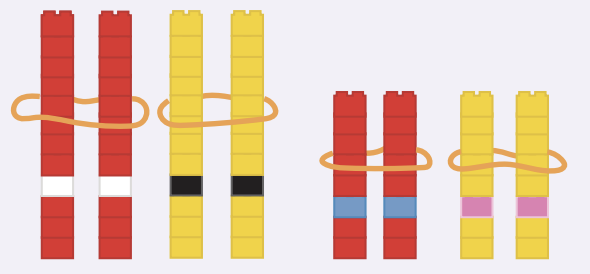
At this stage, each chromosome now consists of two identical sister chromatids joined at the centromere. This replication occurs during interphase, before meiosis begins.
Step 4: Simulating crossing over
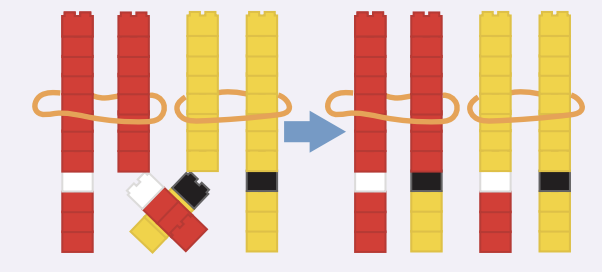
Create a chiasma (the point where chromosomes cross over) between each pair of homologous chromosomes. This represents the exchange of genetic material that occurs during prophase 1.
Important
When chromosomes cross over, segments of DNA are swapped between homologous chromosomes. This process creates recombinant chromatids - sister chromatids that now carry different combinations of alleles than they did originally.
Step 5: Demonstrating independent assortment
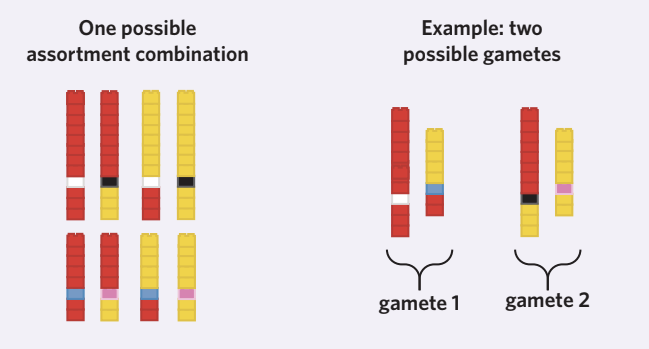
Arrange your homologous chromosome pairs in all the different possible configurations they could adopt at the metaphase plate during metaphase 1.
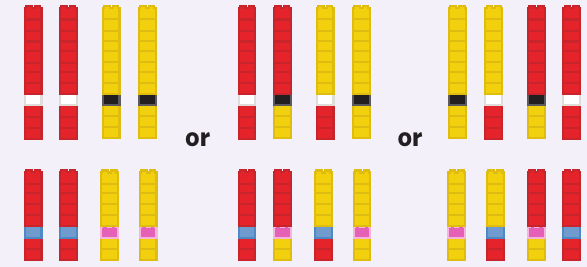
Because each pair of homologous chromosomes can orient itself in two different ways, and these orientations are random and independent of each other, multiple different arrangements are possible. This random arrangement is the essence of independent assortment.
Example
Worked Example: Calculating Possible Gamete Combinations
With 2 pairs of homologous chromosomes, we can calculate the number of possible gamete combinations:
Number of possible combinations = where is the number of chromosome pairs
Step 1: Identify the number of chromosome pairs pairs
Step 2: Calculate possible combinations different possible gamete combinations
This means independent assortment alone can produce 4 different types of gametes from this diploid cell, even before considering crossing over!
Step 6: Examining possible gametes
Select one arrangement from step 5 and separate the chromosomes to show what gametes would result from that particular configuration.
Each gamete receives one chromosome from each homologous pair. Depending on which arrangement you chose, the resulting gametes will have different combinations of maternal and paternal chromosomes, and different combinations of alleles.
Understanding the results
After completing the simulation, consider these important questions:
Note
Question 1: What are the inputs and outputs of meiosis in humans?
Answer: Input: one diploid cell with 46 chromosomes; Output: four haploid gametes with 23 chromosomes each
Note
Question 2: How does independent assortment create genetic diversity?
Answer: By randomly distributing maternal and paternal chromosomes into different gametes, creating numerous possible combinations
Note
Question 3: When do homologous chromosomes first appear in this model?
Answer: Step 1 - they're present from the beginning as the red and yellow chromosome pairs
Question 4: What genotypes and phenotypes did your gametes have?
This will vary depending on your specific allele combinations and crossing over events.
Question 5: How do your gametes compare with classmates' gametes?
They should show considerable genetic variation, demonstrating the power of meiosis to create diversity.
Question 6: What would happen if you combined your gamete with a classmate's gamete?
You'd create a new organism with a unique genotype and phenotype.
Important
Question 7: What is modelling, and how does it differ from a controlled experiment?
Modelling uses a simplified representation to demonstrate concepts; controlled experiments test hypotheses by manipulating variables. This is a modelling investigation, not an experiment.
Important concepts to remember
Diploid (): Cells containing two complete sets of chromosomes - one set inherited from each parent. In humans, diploid cells have 46 chromosomes arranged in 23 pairs.
Haploid (): Cells containing only one complete set of chromosomes. Human gametes are haploid, containing 23 chromosomes.
Note
Homologous chromosomes: Chromosome pairs that carry the same genes in the same locations, though they may have different alleles for those genes. One homologue comes from the mother, the other from the father.
Note
Sister chromatids: Two identical copies of a chromosome joined at the centromere, created during DNA replication.
Chiasma: The X-shaped structure formed when homologous chromosomes cross over and exchange genetic material.
Alleles: Different versions of the same gene. For example, black and white Lego bricks represent different alleles for the thumb shape gene.
Reflection on the simulation
When writing your conclusion, focus on:
- How crossing over and independent assortment contributed to genetic variation in your results
- Ways the simulation could be improved (perhaps using more chromosome pairs, or modelling both meiotic divisions)
- The limitations of using Lego to represent real biological processes
- What the model taught you about the importance of genetic diversity
Note
Think about both the strengths of this model (visual, hands-on, clear representation of key processes) and its limitations (simplified, doesn't show all stages of meiosis, doesn't represent the complexity of real DNA).
Summary
Key Points to Remember:
-
Meiosis creates genetic diversity through two main mechanisms: Crossing over (in prophase 1) exchanges genetic material between homologous chromosomes, while independent assortment (in metaphase 1) randomly distributes chromosomes into gametes.
-
Each gamete is genetically unique: Due to crossing over and independent assortment, no two gametes produced by meiosis are identical, which is crucial for evolution and adaptation.
-
The process produces four haploid cells: Meiosis reduces the chromosome number by half, ensuring that when gametes fuse during fertilisation, the diploid number is restored in the offspring.
-
Colour coding helps visualise inheritance: In this model, red represents maternal chromosomes and yellow represents paternal chromosomes, making it easier to track which genetic information came from which parent.
-
Modelling is a valuable scientific tool: Physical models like this Lego simulation help us understand complex molecular processes that are impossible to observe directly, though we must remember they are simplified representations of reality.