The Effect of Surface Area to Volume Ratio on the Rate of Diffusion (VCE SSCE Biology): Revision Notes
📚Revision Notes
The Effect of Surface Area to Volume Ratio on the Rate of Diffusion
Introduction
Cells must continuously exchange materials with their surroundings to survive. These materials include water, oxygen, nutrients, and waste products. The efficiency of this exchange is crucial for cell survival and depends largely on the cell's surface area to volume ratio (SA:V ratio).
The SA:V ratio is affected by both the size and shape of a cell. Understanding this relationship helps explain why cells remain small and why certain cell shapes are more efficient than others for particular functions.
What is this investigation about?
This practical investigation uses agar jelly cubes of different sizes to demonstrate how SA:V ratio affects the rate of diffusion. The experiment provides a visual model of what happens inside cells when substances move across their membranes.
Note
The agar cubes act as a simplified model of real cells. While cells are much more complex, the basic principle of diffusion across a boundary is the same. The colour change allows us to see and measure something that would normally be invisible.
The chemistry behind the colour change
The agar cubes contain two important chemicals:
- Phenolphthalein: A pH indicator that changes colour depending on acidity
- In alkaline (low-acid) conditions: turns pink
- In acidic conditions: turns clear
- Sodium hydroxide: An alkaline solution that makes the indicator (and therefore the cubes) appear pink
When sulphuric acid is added to the beakers, it gradually diffuses into the cubes. As the acid moves inward, it increases the acidity inside the cube, causing the phenolphthalein to change from pink to clear. This colour change allows us to measure how far the acid has diffused into each cube.
Important
The colour change from pink to clear is NOT caused by the indicator being "used up." Instead, the acid neutralises the alkaline sodium hydroxide, changing the pH and causing the indicator to change colour. This is a reversible chemical reaction.
Aim
To observe and record the effect of surface area to volume ratio on the rate of diffusion.
Materials
- Pre-prepared agar jelly containing phenolphthalein indicator and sodium hydroxide
- 0.1 M sulphuric acid
- 4 × 250 mL beakers
- Tongs
- 1 × scalpel or knife
- 1 × stirring rod
- Paper towel
- 1 × ruler
- 1 × timer
Safety equipment
- Lab coat
- Safety glasses
- Gloves
Important
Safety note: Sulphuric acid is corrosive. Always wear appropriate safety equipment and handle with care. If acid contacts skin, rinse immediately with plenty of water and inform your teacher.
Method
Follow these steps carefully to ensure accurate results:
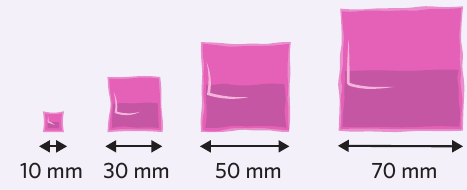
Step 1: Use the scalpel or knife to cut the agar jelly into four cubes with sides measuring 10 mm, 30 mm, 50 mm, and 70 mm in length. Take care to make accurate cuts, as precise measurements are essential for reliable results.
Step 2: Pour 125 mL of sulphuric acid into each of the four beakers, or until approximately half full.
Step 3: Set the timer for 10 minutes.
Step 4: Carefully add one cube to each beaker of sulphuric acid. Be very careful not to splash the acid. Start the timer immediately after adding all cubes.
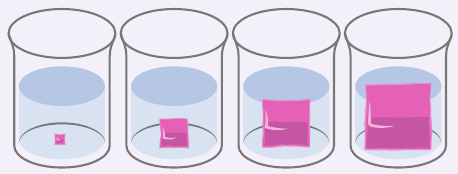
Step 5: Gently stir the acid in each beaker every few minutes using the stirring rod. This ensures even distribution of acid around each cube.
Step 6: When 10 minutes have elapsed, use tongs to carefully remove each cube from its beaker. Place the cubes onto paper towel to absorb excess acid.
Step 7: Cut each cube in half using the scalpel or knife. This reveals the interior and allows you to see how far the acid has diffused.
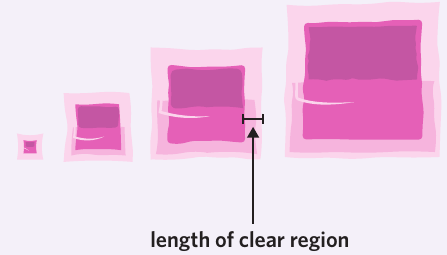
Step 8: Use a ruler to measure the distance of the clear region from the edge of each cube. This measurement represents how far the acid has diffused into the cube. Record your measurements in Table 2.
Results
Part A: Surface area to volume ratio
Before analysing your diffusion results, you need to calculate the SA:V ratio for each cube size. Complete the following calculations:
For a cube:
- Surface area =
- Volume =
- SA:V ratio =
| Cube size (mm) | Surface area (mm²) | Initial volume (mm³) | SA:V ratio |
|---|---|---|---|
| 10 × 10 × 10 | |||
| 30 × 30 × 30 | |||
| 50 × 50 × 50 | |||
| 70 × 70 × 70 |
Example
Worked Example: Calculating SA:V ratio for 10 mm cube
Step 1: Calculate surface area
Step 2: Calculate volume
Step 3: Calculate SA:V ratio
Part B: Percentage of diffusion
To determine how effectively the acid diffused into each cube, complete the following calculations for each cube size:
Step 1: Record the initial side length of the cube (already provided in Table 2).
Step 2: Measure and record the length of the clear region in each cube (the distance from the edge to where the pink colour begins).
Step 3: Calculate the inner pink cube's side length:
Step 4: Calculate the inner pink cube's volume:
Step 5: Calculate the diffusion volume (the volume that has turned clear):
Step 6: Calculate the percentage of volume diffusion:
| Measurement | Cube 1 | Cube 2 | Cube 3 | Cube 4 |
|---|---|---|---|---|
| 1. Side length (mm) | 10 | 30 | 50 | 70 |
| 2. Distance diffused by sulphuric acid (mm) | ||||
| 3. Inner cube side length (mm) | ||||
| 4. Inner cube volume (mm³) | ||||
| 5. Diffusion volume (mm³) | ||||
| 6. Percentage of volume diffusion (%) |
Example
Worked Example: Calculating percentage diffusion for 10 mm cube
Assuming the acid diffused 3 mm into the cube:
Step 1: Distance diffused = 3 mm
Step 2: Calculate inner cube side length
Step 3: Calculate inner cube volume
Step 4: Calculate diffusion volume
Step 5: Calculate percentage volume diffusion
Understanding the results
Key observations
After completing your calculations, you should notice an important pattern:
Note
Pattern 1: SA:V ratio decreases with size
Smaller cubes have higher SA:V ratios: As the cube size decreases, the SA:V ratio increases. This means smaller objects have proportionally more surface area compared to their volume.
Note
Pattern 2: Diffusion efficiency decreases with size
Smaller cubes show greater percentage diffusion: The smallest cube (10 mm) will typically show the highest percentage of volume diffusion after 10 minutes. This is because substances can reach the centre more quickly in smaller objects.
The clear region shows where acid has diffused into the cube, neutralising the alkaline sodium hydroxide and changing the indicator from pink to clear. This visual change makes it easy to measure the extent of diffusion.
Why does this happen?
The relationship between SA:V ratio and diffusion rate can be explained as follows:
Important
Higher SA:V ratio = More efficient diffusion
When an object has a high SA:V ratio, there is more surface area available for substances to enter relative to the total volume that needs to be supplied. In smaller cubes:
- Substances have less distance to travel to reach the centre
- The proportion of surface area to internal volume is greater
- Materials can diffuse throughout the entire volume more quickly
Lower SA:V ratio = Less efficient diffusion
In larger cubes:
- Substances must travel further to reach the centre
- The volume increases faster than the surface area (volume increases with the cube of the length, whilst surface area only increases with the square of the length)
- A smaller proportion of the total volume receives materials within the same time period
The mathematical relationship
As a cube increases in size:
- Its volume increases much faster than its surface area
- This causes the SA:V ratio to decrease
- The efficiency of diffusion decreases accordingly
Example
Worked Example: How doubling size affects SA:V ratio
If you double the side length of a cube from 10 mm to 20 mm:
Original cube (10 mm):
- Surface area =
- Volume =
- SA:V ratio =
Doubled cube (20 mm):
- Surface area = (increased by factor of 4)
- Volume = (increased by factor of 8)
- SA:V ratio = (halved!)
Conclusion: The surface area increases by a factor of , but the volume increases by a factor of . Therefore, the SA:V ratio is halved.
Real-world applications
Why are cells so small?
This investigation helps explain a fundamental principle of cell biology: cells must remain small to function efficiently.
If cells were too large, they would face several problems:
1. Insufficient nutrient supply
Nutrients diffusing in from the surface would take too long to reach the centre of the cell. The cell's interior would be starved of essential materials.
2. Waste accumulation
Waste products produced in the centre of the cell would take too long to diffuse out to the surface for removal, potentially becoming toxic.
3. Slow response times
Signals and regulatory molecules would take longer to spread throughout the cell, reducing the cell's ability to respond quickly to changes.
4. Inefficient gas exchange
Oxygen would struggle to reach all parts of the cell, and carbon dioxide would accumulate in the centre.
Important
By remaining small, cells maintain a high SA:V ratio, ensuring that all parts of the cell can receive nutrients and eliminate wastes efficiently through diffusion.
Strategies to increase SA:V ratio
Some cells and organisms have evolved special adaptations to increase their effective SA:V ratio:
Note
Biological Adaptations for Increased SA:V
- Cell shape modifications: Some cells are elongated or have folded membranes to increase surface area without significantly increasing volume
- Microvilli: Tiny projections on cell surfaces that increase surface area
- Multicellular organisation: Rather than growing larger, organisms grow by adding more small cells
- Specialised transport systems: In larger organisms, circulatory systems deliver materials directly to cells, reducing dependence on diffusion alone
Exam tips
Important
When answering questions about SA:V ratio and diffusion:
-
Always explain the relationship clearly: State that as SA:V ratio increases, the rate of diffusion increases (or is more efficient).
-
Use calculations to support your answer: If given measurements, calculate the SA:V ratio to demonstrate your understanding.
-
Consider both surface area AND volume: Don't just focus on size alone - explain how the ratio between these two factors affects diffusion.
-
Link to cell biology: Connect your understanding to why cells remain small and the importance of efficient transport.
-
Use specific examples: Reference experimental results or real-world examples like this agar cube investigation.
Remember!
Summary
Key Points to Remember:
-
Surface area to volume ratio (SA:V) determines how efficiently substances can move into and out of cells through diffusion.
-
Smaller objects have higher SA:V ratios, making diffusion more efficient. This is why cells must remain small.
-
As size increases, volume increases faster than surface area, causing the SA:V ratio to decrease and making diffusion less efficient.
-
The agar cube experiment demonstrates this principle visually - smaller cubes show greater percentage diffusion in the same time period.
-
Cells have evolved to remain small to maintain efficient transport of nutrients, gases, and wastes across their membranes.
-
The mathematical relationship: When you double the side length, surface area increases by times, but volume increases by times, so SA:V ratio is halved.