Yeasty Boys (VCE SSCE Biology): Revision Notes
📚Revision Notes
Yeasty Boys
Introduction
This investigation explores anaerobic cellular respiration in yeast through a controlled experiment. You'll learn how these tiny organisms break down food and how different conditions affect their respiration rate.
What is yeast?
Yeast are eukaryotic, single-celled microorganisms that are classified as members of the fungi kingdom. This means they're tiny living organisms that have a nucleus inside their cells, and they belong to the same group as mushrooms and molds. Unlike plants, yeast cannot photosynthesise, so they must obtain the food molecules they need for respiration from their surrounding environment.
Note
Because yeast cannot make their own food through photosynthesis like plants do, they must absorb nutrients from their environment. This is why they naturally grow on fruits and grains - these provide the sugars they need to survive.
How do yeast respire?
Yeast have a special ability that makes them very useful to humans - they can respire without oxygen. This process is called anaerobic cellular respiration or fermentation. During this process, yeast cells break down glucose (a type of sugar) to release energy in the form of adenosine triphosphate (ATP), which the cells use to power their life processes.
The equation for anaerobic respiration in yeast is:
When yeast cells break down glucose anaerobically, they produce two important by-products: ethanol (a type of alcohol) and carbon dioxide gas. The energy produced is in the form of adenosine triphosphate (ATP), which is the universal energy currency used by all living cells.
Important
Understanding Fermentation
Anaerobic respiration is also referred to as fermentation. This process doesn't require oxygen, which is why yeast can survive and reproduce in environments where oxygen is limited or absent. The ATP produced provides the energy yeast cells need for all their life processes, including growth and reproduction.
How is this different from human anaerobic respiration?
It's important to note that anaerobic respiration works differently in humans. When we exercise intensely and our muscles run short of oxygen, they switch to anaerobic respiration. However, instead of producing ethanol and carbon dioxide like yeast, our muscles produce lactic acid. This is fortunate - if humans produced ethanol during anaerobic respiration, we would get drunk every time we exercised vigorously!
Note
The lactic acid produced during intense exercise is what causes that burning sensation in your muscles. Unlike yeast, which can continue anaerobic respiration indefinitely, humans can only sustain anaerobic respiration for short periods before needing to return to aerobic respiration.
Yeast in nature and everyday life
Many different species of yeast exist in nature. In the wild, they typically grow on the fruits or grains of plants, where they obtain various food molecules. Several strains have been domesticated for human use, particularly in baking and brewing.
In baking, domesticated yeast is fed refined sugar as a fuel source. As bread dough rests, the yeast consumes the sugar and releases carbon dioxide bubbles through anaerobic respiration. These bubbles become trapped in the dough, causing it to rise and creating the light, fluffy texture we enjoy in bread.
This investigation
In this practical investigation, you will measure the rate of respiration in yeast under different conditions. You'll test how various factors affect yeast activity:
- Different food sources (sugar versus artificial sweetener)
- Different temperatures (room temperature versus 32°C)
- Different conditions (water alone versus water with shampoo)
By observing which conditions produce the most carbon dioxide gas (measured by balloon inflation), you'll gain insight into what yeast cells need to respire efficiently.
Aim
To observe the rate of respiration in yeast with varying food sources and conditions.
Note
This experiment tests three main variables: food source type, temperature, and chemical environment. By comparing the results from different tubes, you can determine which factors most significantly affect yeast respiration.
Materials and apparatus
You will need the following equipment for this investigation:
- 4 screw cap tubes with lids (e.g. falcon tubes - these must be able to fit a balloon over the top)
- 1 tube rack
- 1 digital scale
- Watch glasses (for weighing materials)
- Pipettes or measuring syringe
- Freeze-dried yeast
- Sugar
- Artificial sweetener (e.g. stevia)
- Shampoo
- Balloons (one for each tube)
- 32°C water bath
Method
Follow these steps carefully to set up your investigation. Work in pairs or small groups.
Setting up the tubes:
- Label four tubes as 1, 2, 3, and 4.
- Use the watch glasses and scale to measure out 0.6 grams of freeze-dried yeast. Place this amount into each of the four tubes. All tubes must contain the same amount of yeast.
- Use the watch glasses and scale to measure out 0.4 grams of sugar. Place this amount in tubes 1, 2, and 3 only. Don't put any sugar in tube 4.
- Use the watch glasses and scale to measure out 0.4 grams of artificial sweetener. Place this amount in tube 4 only.
- Use a pipette to add 2 mL of shampoo to tube 3 only. Don't put any shampoo in the other tubes.
- Use a pipette to add 8 mL of water to tube 3. Cover the tube by placing the lid on and give the contents a shake to mix everything together. Set this tube aside in the rack for now.
- Now use a pipette to add 10 mL of water to tubes 1, 2, and 4. Put the lids on these tubes and shake them to mix the contents before setting them down in the tube rack.
- One at a time, remove the lid of each tube and place a balloon over the top of each tube. Make sure the balloon fits securely.
- Place tubes 1, 3, and 4 in the 32°C water bath.
- Leave tube 2 in the tube rack on the bench at room temperature.
- After 1 hour has passed, observe your four tubes and measure the size of each balloon. Record your results in the results table.
Important
Critical Measurement Points
- Ensure all measurements are accurate - use the same measuring tools for each tube
- Keep the amounts of yeast consistent across all tubes (0.6 g each)
- Remember that tube 3 gets only 8 mL of water because it also receives 2 mL of shampoo, making the total liquid volume 10 mL in all tubes
- Secure the balloons tightly to prevent gas leakage
Experimental setup
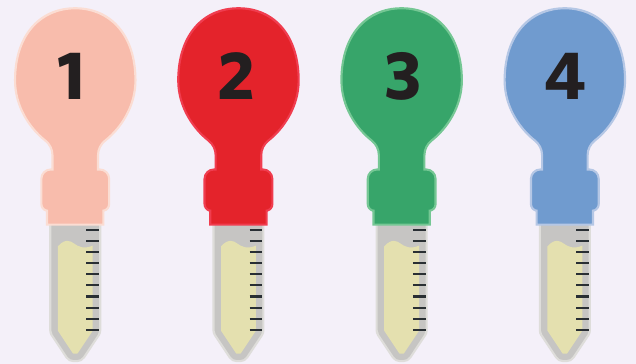
The diagram below shows what your four tubes should look like with the balloons attached:
Summary of tube contents
The table below summarises what goes into each tube. Notice how each tube tests a different variable:
| Component | Tube 1 | Tube 2 | Tube 3 | Tube 4 |
|---|---|---|---|---|
| Freeze-dried yeast | ✓ | ✓ | ✓ | ✓ |
| Sugar | ✓ | ✓ | ✓ | - |
| Artificial sweetener | - | - | - | ✓ |
| Shampoo | - | - | ✓ | - |
| Water | ✓ | ✓ | ✓ (8 mL) | ✓ |
| Placed in water bath | ✓ | - | ✓ | ✓ |
Key differences between tubes:
- Tube 1: Standard conditions (sugar, 32°C water bath) - this serves as your reference
- Tube 2: Same as Tube 1 but kept at room temperature instead of in the water bath
- Tube 3: Contains shampoo in addition to sugar, kept in water bath
- Tube 4: Contains artificial sweetener instead of real sugar, kept in water bath
Note
Understanding the Experimental Design
Each tube changes only one variable compared to Tube 1:
- Tube 2 tests the effect of temperature
- Tube 3 tests the effect of shampoo (chemical environment)
- Tube 4 tests the effect of food source type
This design allows you to isolate the effect of each variable on yeast respiration.
Recording your results
After one hour, measure the diameter of each balloon and record your observations in the table below. The size of the balloon indicates how much carbon dioxide gas the yeast produced, which tells you how active the yeast cells were in each tube.
| Measurement | Tube 1 | Tube 2 | Tube 3 | Tube 4 |
|---|---|---|---|---|
| Size of balloon after one hour |
Tips for measuring:
- Measure the widest part of each balloon
- Use the same unit of measurement for all balloons (e.g. centimetres)
- Be consistent in how you measure each balloon
- Take multiple measurements if possible and calculate an average
Note
Why Balloon Size Matters
The balloon inflates because carbon dioxide gas is produced during anaerobic respiration. The more active the yeast cells are, the more carbon dioxide they produce, and the larger the balloon becomes. By comparing balloon sizes, you can determine which conditions led to the highest rate of respiration.
Understanding the investigation
Use these questions to help you understand your results and the science behind the investigation.
Purpose and hypothesis
1. Hypothesis and results
What was your hypothesis for this experiment? A hypothesis is your prediction about what will happen. Think about which tube you expected to have the largest balloon and why. After completing the experiment, explain whether your results support your hypothesis.
2. Purpose of cellular respiration
Identify the main purpose of cellular respiration in organisms. Remember, respiration isn't about breathing - it's about breaking down food molecules to release energy that cells can use.
Note
Cellular respiration releases energy stored in food molecules (like glucose) and converts it into ATP, which cells can use directly to power all their activities - from growth and reproduction to movement and maintaining their structure.
Cellular respiration concepts
3. Aerobic versus anaerobic respiration
What is the difference between aerobic and anaerobic cellular respiration? Think about what "aerobic" and "anaerobic" mean, and what products are formed in each type.
Important
Key Difference: Oxygen
- Aerobic respiration requires oxygen and produces carbon dioxide, water, and lots of ATP
- Anaerobic respiration does NOT require oxygen and produces different waste products (ethanol and carbon dioxide in yeast, or lactic acid in humans) and less ATP
The prefix "aero-" means air or oxygen, while "an-" means without!
Analysing your results
4. Fastest respiration
Which tube experienced the greatest rate of respiration? How do you know this? Remember, the size of the balloon indicates how much carbon dioxide was produced, which reflects the rate of respiration.
5. Effect of temperature
Was there a difference in the result for tube 1 and tube 2? If so, account for this difference. These two tubes had the same contents but were kept at different temperatures. What does this tell you about how temperature affects yeast respiration?
Example
Understanding Temperature Effects
Temperature affects the rate of enzyme activity in yeast cells. Enzymes are biological catalysts that speed up the chemical reactions of respiration. At optimal temperatures (around 30-35°C for yeast), enzymes work most efficiently. At room temperature, enzymes work more slowly, so respiration occurs at a reduced rate.
If Tube 1 (32°C) had a larger balloon than Tube 2 (room temperature), this supports the idea that higher temperatures increase respiration rate - up to a point. Temperatures that are too high can denature enzymes and stop respiration entirely!
6. Water volume in tube 3
Why was only 8 mL of water added to tube 3 when all the others received 10 mL of water? Think about what else was added to tube 3.
7. Control group
Was a control used in this experiment? A control is a tube that shows what happens under standard conditions, allowing you to compare the effects of changing different variables.
8. Effect of shampoo
What do you think happened in tube 3? Why? Hint: shampoo is an emulsifier, meaning its molecules have a hydrophobic (water-hating) end and a hydrophilic (water-loving) end. Think about how this might affect the yeast cells.
Note
Understanding Emulsifiers
Shampoo molecules have two ends: one that loves water (hydrophilic) and one that hates water (hydrophobic). Yeast cells have a membrane made of lipids (fats) that is hydrophobic. The hydrophobic end of shampoo molecules can interact with and potentially disrupt the cell membrane, interfering with the cell's ability to function properly and respire efficiently.
9. Improving accuracy and precision
Considering the method, what steps could you add in or modify to increase the accuracy and precision of your experiment? Think about replication, measurement techniques, and controlling variables.
Extensions
10. Testing different fuel sources
Yeast can use a variety of fuel sources. They can utilise various sugars and starches, not just the packet sugar or artificial sweetener used in this experiment. If the experiment was to be repeated with the initial four tubes, plus the addition of a fifth tube containing honey and a sixth tube containing energy drink, how would these additional tubes be designed? Make sure you indicate whether each component from the table above is included in each tube or not.
11. Designing your own investigation
Other than the type of sugar, temperature, and presence of shampoo, there are many more variables that influence the rate of anaerobic cellular respiration in yeast. Select one of these variables, and design a method to test the effect this variable has on yeast anaerobic cellular respiration rate. Consider the following aspects:
- a) Replication: How will you address replication? Will you set up multiple tubes with the same conditions?
- b) Independent variables: What are the independent variables? (These are the factors you deliberately change)
- c) Control group: What is the control group? (This is your reference point for comparison)
- d) Hypothesis: What is the hypothesis? (What do you predict will happen?)
- e) Minimising errors: How will errors be minimised? (What steps will you take to make your results more reliable?)
Note
Possible Variables to Investigate
You could test the effect of:
- Different sugar concentrations (0.2 g, 0.4 g, 0.6 g, 0.8 g)
- pH levels (adding acid or base to the water)
- Different types of sugars (glucose, fructose, sucrose, lactose)
- Amount of yeast (0.3 g, 0.6 g, 0.9 g)
- Presence of salt or other chemicals
- Light versus dark conditions
Writing your conclusion
Write a concluding paragraph to summarise your investigation. Your conclusion should be a coherent piece of writing that brings together all aspects of your investigation. Be sure to include:
- Hypothesis evaluation: State whether the hypothesis was supported by referring to your actual results. Use specific data from your results table.
- Limitations: Discuss the limitations of the experiment. What factors might have affected your results? What was difficult to control or measure accurately?
- Improvements: Suggest potential ways to improve the experiment. How could you make the results more reliable or accurate? What would you do differently next time?
- Broader implications: Consider the broader implications of your research or further areas of exploration that stem from your findings. What real-world applications does this have? What questions does it raise that could be investigated further?
Note
Tips for Writing a Strong Conclusion
- Start by restating your hypothesis and whether your results supported or did not support it
- Use specific numbers from your results table (e.g., "Tube 1 had a balloon diameter of 8 cm, while Tube 2 only reached 5 cm")
- Be honest about limitations - all experiments have them!
- Think about real-world applications: How does understanding yeast respiration help bakers? Brewers? Scientists developing biofuels?
Remember!
Summary
Key Points to Remember:
-
Yeast are eukaryotic fungi that perform anaerobic cellular respiration (fermentation) to break down glucose into ethanol, carbon dioxide, and energy in the form of ATP.
-
The anaerobic respiration equation:
This is different from human anaerobic respiration, which produces lactic acid instead of ethanol.
-
Carbon dioxide production can be measured by balloon inflation, providing a way to measure the rate of yeast respiration under different conditions.
-
Multiple variables affect yeast respiration rate, including temperature, type of fuel source, and chemical environment. A well-designed experiment changes only one variable at a time to determine its effect.
-
Scientific investigations require careful control of variables, proper replication, and accurate measurement to produce reliable results that can be used to draw valid conclusions.