Yeasty Boys (v2) (VCE SSCE Biology): Revision Notes
📚Revision Notes
Yeasty Boys (v2)
Introduction
What is yeast?
Yeast are microscopic organisms that play a crucial role in many biological processes. They are eukaryotic, single-celled microorganisms belonging to the fungi kingdom. Unlike plants, yeast cannot perform photosynthesis, so they must obtain their food molecules from the surrounding environment. This makes them heterotrophs that rely on external nutrient sources.
In nature, different species of yeast commonly grow on fruits and grains, where they access various food molecules. Humans have domesticated certain yeast strains for practical purposes, particularly in baking and brewing industries.
Anaerobic cellular respiration in yeast
Yeast have a remarkable ability: they can respire without oxygen through a process called anaerobic cellular respiration, also known as fermentation. This process follows a specific chemical pathway:
Important
Fermentation Equation:
The energy produced during this reaction takes the form of ATP (adenosine triphosphate), which cells use to power their activities.
How yeast differs from humans
Whilst yeast produce ethanol and carbon dioxide during anaerobic respiration, humans produce something quite different. When we respire without oxygen (such as during intense exercise), our cells produce lactic acid instead of ethanol. This is fortunate – imagine getting drunk every time you exercised vigorously!
Note
The difference in anaerobic respiration products between yeast and humans reflects their different evolutionary adaptations. Yeast evolved to break down sugars in low-oxygen environments like fruit surfaces, while human muscle cells need a quick energy source during intense activity that can be rapidly cleared from the bloodstream.
Yeast in baking
When making bread, bakers mix yeast with dough containing refined sugar. As the dough rests, the yeast consumes the sugar and undergoes fermentation. The carbon dioxide bubbles produced during this process cause the dough to rise, creating the light, airy texture we associate with fresh bread.
The experiment
This investigation examines how different conditions affect the rate of yeast respiration. You will test four tubes containing yeast under varying conditions:
- Different food sources (sugar vs artificial sweetener)
- Different temperatures (room temperature vs 32°C water bath)
- Different additives (plain water vs water with shampoo)
By measuring carbon dioxide production through balloon inflation, you can compare respiration rates across these different conditions.
Note
The balloon acts as a visual indicator of respiration rate. As yeast ferments the sugar, it produces carbon dioxide gas that inflates the balloon. A larger balloon indicates more carbon dioxide produced and therefore a faster respiration rate.
Aim
To observe the rate of respiration in yeast with varying food sources and conditions.
Materials
You will need the following equipment:
- 4 screw cap tubes with lids (such as falcon tubes that can accommodate both a lid and a balloon)
- 1 tube rack
- 1 digital scale
- Watch glasses (for weighing materials)
- 1 × 10 mL pipette or measuring syringe
- 1 × 2 mL pipette or measuring syringe
- Freeze-dried yeast
- Sugar
- Artificial sweetener (such as stevia)
- Shampoo
- 4 balloons
- 32°C water bath
Method
Follow these steps carefully to set up your experiment:
Step 1: Working in pairs or small groups, label your four tubes with numbers 1, 2, 3, and 4.
Step 2: Use watch glasses and the digital scale to measure 1.2 grams of freeze-dried yeast. Add this amount to each of the four tubes.
Step 3: Measure 0.8 grams of sugar using watch glasses and the scale. Add this sugar to tubes 1, 2, and 3. Do not add sugar to tube 4.
Step 4: Measure 0.8 grams of artificial sweetener and add it to tube 4 only.
Step 5: Use a pipette to add 2 mL of shampoo to tube 3. The other tubes should not contain shampoo.
Step 6: Add 8 mL of water to tube 3 using a pipette. Cover the tube with its lid and shake the contents to mix them. Place the tube in the rack.
Step 7: Add 10 mL of water to tubes 1, 2, and 4 using a pipette. Put the lids on these tubes and shake to mix the contents. Return them to the tube rack.
Important
Step 8: Remove the lid from each tube one at a time and place a balloon over the top opening. Make sure the balloon is securely attached to prevent gas leakage, as this would affect your results.
Step 9: Place tubes 1, 3, and 4 into the 32°C water bath.
Step 10: Leave tube 2 in the tube rack on the bench at room temperature.
Step 11: After 1 hour has passed, observe all four tubes and measure the size (diameter) of each balloon. Record your measurements in the results table.
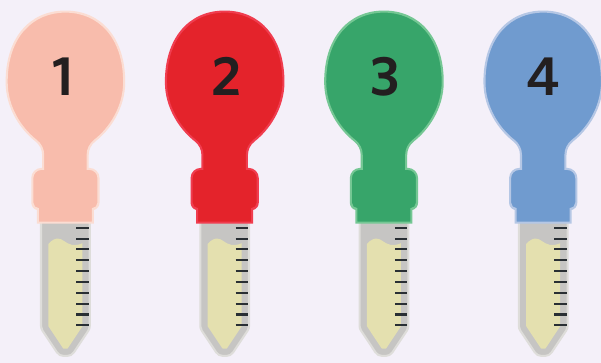
Summary of tube contents
The following table shows exactly what each tube contains:
| Component | Tube 1 | Tube 2 | Tube 3 | Tube 4 |
|---|---|---|---|---|
| Freeze-dried yeast | ✔ | ✔ | ✔ | ✔ |
| Sugar | ✔ | ✔ | ✔ | – |
| Artificial sweetener | – | – | – | ✔ |
| Shampoo | – | – | ✔ | – |
| Water | ✔ (10 mL) | ✔ (10 mL) | ✔ (8 mL) | ✔ (10 mL) |
| Placed in water bath | ✔ | – | ✔ | ✔ |
Note
Understanding the experimental design:
Each tube tests a different variable while keeping others constant:
- Tube 1 is the standard condition (sugar + warm temperature)
- Tube 2 tests the effect of temperature (sugar + room temperature)
- Tube 3 tests the effect of shampoo (sugar + warm temperature + shampoo)
- Tube 4 tests the effect of artificial sweetener (artificial sweetener + warm temperature)
Results
Record your observations in this table:
| Measurement | Tube 1 | Tube 2 | Tube 3 | Tube 4 |
|---|---|---|---|---|
| Size of balloon after one hour |
The balloon size indicates how much carbon dioxide was produced through respiration. Larger balloons suggest higher rates of respiration.
Discussion questions
Consider these questions to deepen your understanding:
Question 1: What was your hypothesis for this experiment? Does your data support or contradict your initial prediction?
Question 2: Explain the main purpose of cellular respiration in living organisms.
Question 3: What distinguishes aerobic cellular respiration from anaerobic cellular respiration?
Question 4: Which tube showed the greatest rate of respiration? What evidence supports this conclusion?
Question 5: Compare the results from tube 1 and tube 2. If they differ, what might explain this difference?
Note
Questions 5 and 6 help you understand variable isolation – how changing one factor while keeping others constant reveals the effect of that specific variable.
Question 6: Why did tube 3 receive only 8 mL of water when all other tubes received 10 mL?
Question 7: Did this experiment include a control? If so, which tube served as the control?
Question 8: What effect did the shampoo have in tube 3? Consider that shampoo acts as an emulsifier.
Question 9: How could you modify the method to increase the accuracy and precision of your measurements?
Question 10: If you added two more tubes – one containing honey and one containing energy drink – how would you design these additional tubes? Specify which components from the original setup each would include.
Important
Question 11: Many other variables affect yeast respiration rates beyond those tested here. Choose one additional variable and design a complete experiment to test it. Your design should include:
- How you will address replication
- What the independent variables are
- What constitutes the control group
- Your hypothesis
- How you will minimise errors
This question tests your understanding of experimental design principles and your ability to apply them to new situations.
Writing your conclusion
Your conclusion should form a comprehensive paragraph addressing these key points:
- Whether your hypothesis was supported, with specific reference to your results
- Limitations of the experimental design
- Potential improvements you could make to the experiment
- Broader implications of your findings or related questions worth investigating further
Key concepts to remember
Understanding fermentation
Anaerobic cellular respiration occurs without oxygen. In yeast, this process converts glucose into ethanol and carbon dioxide whilst producing ATP for energy. The carbon dioxide produced can be measured by balloon inflation.
Example
How to calculate respiration rate:
If Tube 1's balloon measured 5 cm in diameter after 1 hour, and Tube 2's balloon measured 3 cm:
Step 1: Record balloon diameters
- Tube 1: 5 cm
- Tube 2: 3 cm
Step 2: Compare the sizes
- Tube 1 produced more (larger balloon)
- Therefore, Tube 1 had a faster respiration rate
Step 3: Identify the variable
- The only difference was temperature (32°C vs room temperature)
- Conclusion: Higher temperature increased respiration rate
Variables in this experiment
Independent variables are factors you deliberately change:
- Type of sugar (regular sugar vs artificial sweetener)
- Temperature (room temperature vs 32°C)
- Presence of additives (plain water vs water with shampoo)
Dependent variable is what you measure:
- Rate of respiration (indicated by balloon size)
Control conditions help you understand what caused changes:
- Tube 2 (room temperature with sugar) serves as a control for temperature effects
- Comparing tubes helps isolate the effect of each variable
Why temperature matters
Yeast respiration occurs faster at warmer temperatures (like 32°C) because enzymes involved in the process work more efficiently. However, if temperatures become too hot, enzymes denature and respiration stops.
Important
Common mistake to avoid:
Students often think that hotter is always better for yeast respiration. However, temperatures above 40°C will denature the enzymes and kill the yeast, stopping respiration entirely. The optimal temperature range for most yeast is between 30–37°C.
The role of food sources
Yeast can metabolise real sugars like glucose, but artificial sweeteners have different chemical structures that yeast enzymes cannot break down effectively. This explains different respiration rates between tubes with sugar versus artificial sweetener.
Summary
Key Points to Remember:
- Yeast are single-celled fungi that perform anaerobic cellular respiration (fermentation)
- The fermentation equation is:
- Carbon dioxide production can be measured by balloon inflation
- Multiple variables affect yeast respiration rate: temperature, food source type, and environmental conditions
- Controls are essential in experiments to identify which variables cause observed effects
- Yeast cannot effectively use artificial sweeteners as food sources, only real sugars
- Temperature affects enzyme activity: warmer temperatures increase respiration rate up to an optimal point, after which enzymes denature