Capillarity & Infiltration Rate of Soil (Leaving Cert Agricultural Science): Revision Notes
📚Revision Notes
Capillarity & Infiltration Rate of Soil
Introduction to the practical
This specified practical activity helps you understand how water moves through different types of soil. You'll be comparing two important soil properties - capillarity (how water rises up through soil) and infiltration rate (how quickly water soaks into soil) - between compacted and uncompacted soil samples.
The main goal is to discover why soil structure affects water movement and what this means for farming practices.
Understanding the science behind water movement
Capillarity explained
Capillarity refers to water's upward movement through tiny soil pores, working against gravity. This happens because of:
- Surface tension - water molecules stick together
- Adhesion - water molecules stick to soil particles
Note
Think of it like water climbing up a narrow straw. In soil, finer pores (like those found in compacted or clayey soils) create stronger capillary forces, causing water to rise higher. However, this same fine pore structure actually slows down the movement of water.
Infiltration rate explained
Infiltration rate measures how quickly water enters the soil surface, expressed in millimetres per hour (mm h⁻¹). This depends heavily on soil structure:
- Larger, continuous pores (macropores) allow faster water entry
- Good soil structure with plenty of air spaces increases infiltration
- Soil compaction collapses these important macropores, dramatically reducing infiltration rates
Equipment and setup
You'll need these key materials for both tests:
For both experiments:
- Two soil cores from the same soil type - one compacted (pressed/rolled) and one uncompacted (friable)
- Measuring equipment (ruler, stopwatch, measuring jug)
- Water and containers
For capillarity test:
- Narrow glass tubes or clear straws
- Fine mesh to secure soil base
- Tray with shallow dyed water
For infiltration test:
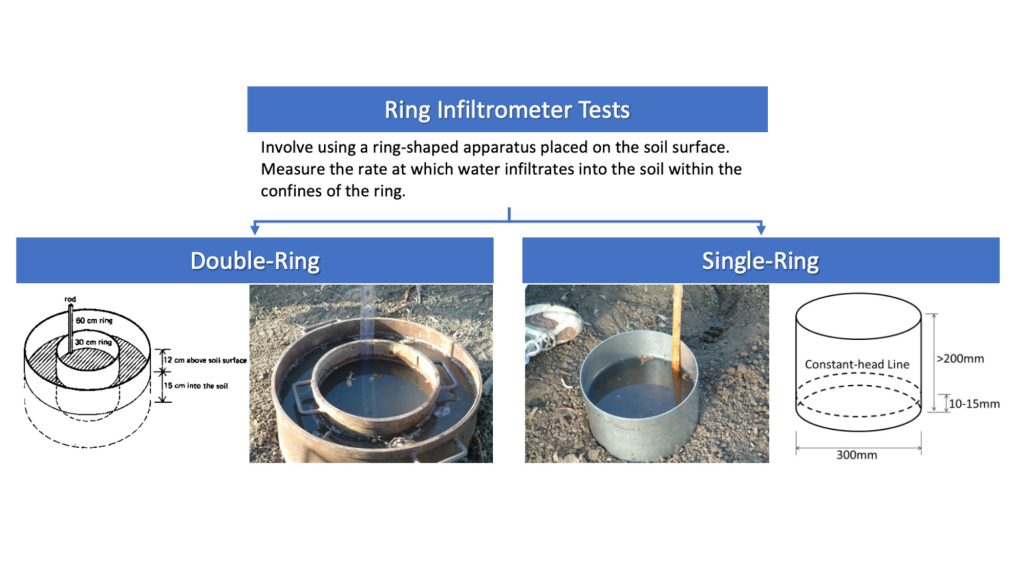
- Metal rings or cylinders (like food cans with ends removed)
- Balance (optional for precise measurements)
Note
Ensure all equipment is clean and calibrated before starting. Having duplicate equipment allows you to run both tests simultaneously for more efficient use of time.
Testing procedures
Capillarity rise test
This test shows how high water can climb through your soil samples:
Example
Worked Example: Capillarity Test Setup
Step 1: Pack your tubes - fill short glass tubes with soil at the same bulk density as your compacted and uncompacted samples
Step 2: Secure the base with fine mesh to prevent soil loss
Step 3: Set up vertically in a tray containing 1-2 cm of dyed water
Step 4: Record measurements of capillary rise height at regular intervals (every 5 minutes for 30-60 minutes) until the rise stabilises
Step 5: Compare results between both soil types
Infiltration rate test
This test measures how quickly water soaks into your soil:
Example
Worked Example: Infiltration Test Procedure
Step 1: Insert rings gently into the surface of each soil core
Step 2: Add measured water and record the initial water level
Step 3: Monitor water level drop over time (every minute initially, then every 5 minutes)
Step 4: Maintain constant head - keep adding water to maintain the same level if possible
Step 5: Calculate infiltration rate using: depth infiltrated ÷ time = mm h⁻¹
Step 6: Continue until steady-state rate is achieved (usually 30-40 minutes)
Data analysis and calculations
Working with your results
Understanding your measurements requires proper calculation and interpretation of the data collected.
Example
Worked Example: Capillarity Interpretation
Results obtained:
- Compacted soil: 14 cm rise after 40 minutes
- Uncompacted soil: 9 cm rise after 40 minutes
This shows that smaller pores in compacted soil create higher capillary rise but slower water movement.
Example
Worked Example: Infiltration Rate Calculation
Given data:
- Ring area = 200 cm²
- Uncompacted soil: 30 mm depth infiltrated in 10 minutes
- Compacted soil: 6 mm infiltrated in 10 minutes
Calculations:
- Uncompacted infiltration rate = mm h⁻¹
- Compacted infiltration rate = mm h⁻¹
At steady-state, typical results might show:
- Uncompacted soil: 60-80 mm h⁻¹
- Compacted soil: 10-20 mm h⁻¹
Understanding your results
What the data tells us
The contrasting behaviour between compacted and uncompacted soil reveals fundamental principles about soil physics and water movement.
Compacted soil characteristics:
- Higher capillary rise potential (due to finer pores)
- Much slower infiltration rate (blocked macropores)
- Higher risk of surface runoff and waterlogging
- Increased chance of anaerobic conditions after rain
Uncompacted soil benefits:
- Lower capillary rise height but faster water movement
- Better infiltration and drainage
- Improved soil aeration
- Enhanced root growth and earthworm activity
Agricultural implications
Understanding these principles helps with farm management:
Important
Critical Farm Management Practices:
- Avoid trafficking on wet soils to prevent compaction
- Use controlled traffic systems where possible
- Add organic matter to build and maintain soil structure
- Maintain earthworms and plant roots as they create vital macropores
Practical considerations
Controlling your experiment
To get reliable results, you need to maintain consistent experimental conditions throughout your testing.
Note
Essential Control Measures:
To get reliable results, ensure:
- Equal packing density between compacted and uncompacted treatments
- Same moisture content before starting tests
- Consistent temperature - conduct tests indoors to avoid evaporation effects
- Proper sealing around ring edges to prevent side leakage
Common sources of error
Important
Watch out for these common issues:
- Inconsistent soil packing between samples
- Water leakage around equipment edges
- Evaporation affecting readings
- Temperature differences between water used in tests
Safety reminders
- Wear gloves when handling wet soils and metal equipment
- Be careful with sharp edges on metal rings
- Clean up spills immediately to prevent slipping
- Dispose of dyed water appropriately
Exam tips and key concepts
For your Leaving Certificate exam, understanding the relationship between soil structure and water movement is crucial for answering questions about agricultural productivity and soil management.
Summary
Key Points to Remember:
- Capillarity is higher in fine-pored, compacted soil but infiltration rate is lower due to reduced macropores
- Uncompacted soil shows faster infiltration, better aeration, and improved growing conditions
- Soil compaction reduces agricultural productivity by limiting water movement and root growth
- Management practices should focus on maintaining soil structure through organic matter and avoiding traffic on wet soils
Understanding pore size distribution and soil structure helps explain both water movement patterns and their practical implications for farming.
Summary
Essential Takeaways:
- Capillarity rises higher in compacted soil due to smaller pore sizes, but water moves more slowly overall
- Infiltration rate decreases dramatically with soil compaction because macropores become blocked
- Good soil structure with adequate macropores is essential for healthy plant growth and effective drainage
- Practical farm management should focus on maintaining soil structure and avoiding compaction
- Both tests use standardised methods with timed measurements to ensure reliable, comparable results