Flocculation in Soil (Leaving Cert Agricultural Science): Revision Notes
📚Revision Notes
Flocculation in Soil
What is flocculation?
Flocculation is the process where small particles suspended in water stick together to form larger clumps called "flocs". In soil science, this is particularly important for clay particles, which are naturally very small and can remain suspended in water for long periods. When flocculation occurs, these tiny clay particles group together and become heavy enough to settle to the bottom, leaving clearer water above.
This process is crucial for improving soil structure and water quality, making it an essential concept for agricultural science students to understand.
Note
Understanding flocculation is fundamental to soil science because it explains how we can transform problematic clay soils into more workable, well-draining agricultural land. This process occurs naturally in some conditions but can be enhanced through proper soil management techniques.
Purpose of the experiment
This practical activity demonstrates how adding lime (calcium carbonate) to soil can cause clay particles to flocculate and settle out of suspension. The experiment provides a visual comparison between treated and untreated soil samples, showing the effectiveness of lime in improving water clarity.
Important
The key to this experiment's success is maintaining a proper control group. Always ensure you have one untreated sample to compare against your treated sample - this allows you to clearly observe the difference that lime treatment makes.
Equipment and materials needed
For this experiment, you will require:
- Two graduated cylinders or test tubes (labelled A and B)
- Soil sample containing clay particles
- Calcium carbonate (lime)
- Clean water
- Measuring equipment for accurate volumes
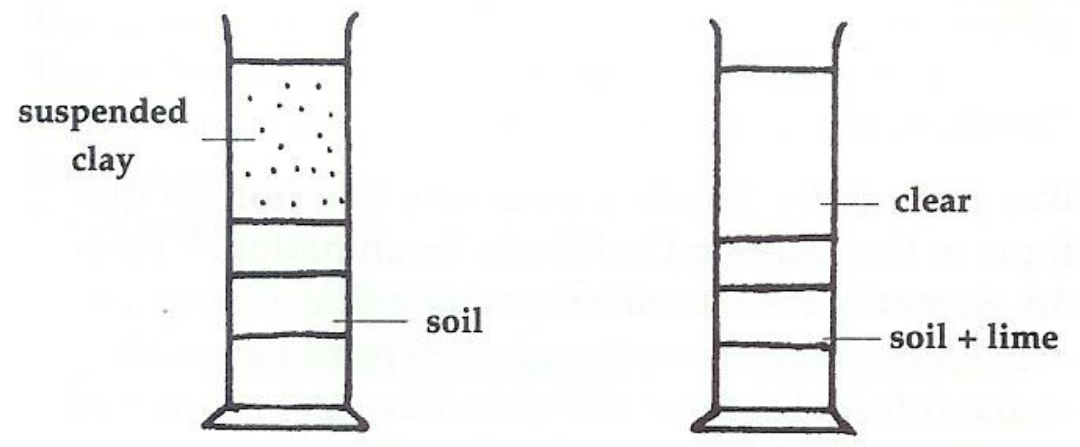
The diagram above shows the expected results: the left tube contains murky water with suspended clay particles, while the right tube shows clear water after lime treatment.
Step-by-step method
The experimental procedure involves several careful steps to ensure accurate results:
Example
Worked Example: Complete Experimental Procedure
Setup phase:
- Begin by labelling your two test containers as A and B for clear identification
- Add exactly of your soil sample to each container to ensure fair comparison
Treatment phase:
- Add of lime to tube A only - this serves as your treatment group
- Leave tube B without lime - this acts as your control group
- Fill both containers three-quarters full with clean water
Mixing and observation:
- Cover both containers and shake vigorously for one minute to thoroughly mix the contents
- Allow both tubes to stand undisturbed for 3-5 minutes
- Carefully observe and record what happens in each container during this settling period
Expected observations and results
In this experiment, you should observe a clear difference between the two tubes:
Example
Expected Results: Visual Comparison
Tube A (with lime):
- Clay particles will clump together quickly
- Larger flocs will settle rapidly to the bottom
- Water becomes noticeably clearer in the upper portion
- A distinct layer of settled material forms at the base
Tube B (without lime):
- Clay particles remain individually suspended
- Water stays cloudy or turbid throughout
- Very little settling occurs during the observation period
- No clear separation between water and particles
Scientific explanation
The flocculation process occurs because lime alters the electrical charges around clay particles. Clay particles naturally carry negative electrical charges, causing them to repel each other and remain suspended in water. When lime is added, it releases positive calcium ions that neutralise these negative charges.
Once the electrical repulsion is reduced, the clay particles can come together through natural attraction forces. These larger clumped particles are much heavier than individual clay particles, so gravity pulls them down to settle at the bottom of the container.
Note
Think of clay particles like tiny magnets with the same poles facing each other - they naturally push apart. Lime acts like a neutralising agent that removes this repulsion, allowing the particles to stick together instead of staying apart.
Practical applications in agriculture
Understanding flocculation has important real-world applications for Irish farmers and land managers:
Soil structure improvement:
- Adding lime to heavy clay soils helps particles clump together
- This creates better soil structure with improved drainage
- Root penetration becomes easier in flocculated soils
Water management:
- Farm ponds and water storage areas benefit from natural settling
- Reduced soil erosion from fields treated with appropriate lime levels
- Clearer water in agricultural drainage systems
Crop production benefits:
- Better soil aeration supports healthier root development
- Improved nutrient availability in well-structured soils
- Reduced waterlogging in previously problematic clay areas
Note
Many Irish farms with heavy clay soils have been transformed through proper liming programmes. What were once waterlogged, difficult-to-work fields can become productive agricultural land through understanding and applying flocculation principles.
Exam tips
When answering questions about this practical activity, focus on demonstrating your understanding of both the experimental method and the underlying science:
Summary
Key Exam Strategies:
- Always mention the importance of having a control group (tube without lime)
- Explain the scientific principle behind the observations, not just what you see
- Use correct terminology like "flocculation", "suspended particles", and "settlement"
- Remember that lime provides calcium ions that neutralise negative charges on clay
- Be able to describe both the method and the expected results clearly
Remember!
Summary
Essential Concepts to Remember:
- Flocculation is the clumping together of small particles to form larger, settleable masses
- Lime (calcium carbonate) provides the positive ions needed to neutralise clay particles
- Control experiments are essential - always compare treated and untreated samples
- Practical applications include improving soil structure and water clarity on farms
- The process works by neutralising electrical charges that keep clay particles apart