Texture of Soil - Hand Testing (Leaving Cert Agricultural Science): Revision Notes
📚Revision Notes
Texture of Soil - Hand Testing
What is soil texture hand testing?
Soil texture hand testing is a practical field method used by farmers and agronomists to quickly identify the type of soil they're working with. This simple technique involves using your hands to feel and manipulate a moist soil sample to determine whether it's predominantly sandy, loamy, or clay-based. The method relies on the different physical properties of soil particles - sand particles feel gritty, silt feels smooth and floury, whilst clay feels sticky and can be moulded.
Why is soil texture testing important?
Understanding soil texture is crucial for making informed agricultural decisions. Different soil textures have varying properties that directly affect:
- Drainage rates - sandy soils drain quickly whilst clay soils retain water
- Nutrient availability - clay soils hold nutrients well but sandy soils lose them quickly
- Crop suitability - different plants thrive in different soil types
- Cultivation timing - clay soils are harder to work when wet
This knowledge helps farmers choose appropriate crops, plan irrigation, and manage their land effectively.
Note
The ability to quickly assess soil texture in the field gives farmers immediate information that would otherwise require expensive laboratory testing, making it an essential skill for efficient farm management.
Equipment needed
The beauty of hand testing lies in its simplicity. You only need:
- A soil sample (collected from 10-15 cm depth, free from debris)
- Clean water (to moisten the soil if it's too dry)
- Clean hands (to perform the tactile tests)
This makes it an ideal technique for farmers working in the field who need immediate results without expensive laboratory equipment.
Step-by-step method
Step 1: Sample preparation
Collect your soil sample from the appropriate depth (10-15 cm below the surface). Remove any stones, roots, or organic debris. If the soil is very dry, add small amounts of water until it's damp but not dripping wet - the consistency should be similar to plasticine.
Step 2: Feel test
Rub the moist soil between your fingers and palm. This initial test reveals the basic texture:
Example
Feel Test Demonstration:
- Sandy soil feels gritty and rough, like sandpaper
- Silty soil feels smooth, floury, and has weak cohesion
- Clay soil feels sticky and smooth, and can be easily moulded
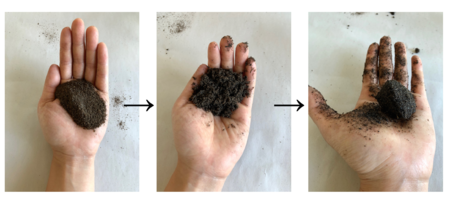
Step 3: Ball formation test
Try to roll the soil into a ball in your palm:
Example
Ball Formation Test Results:
- Sandy soil breaks apart and won't hold its shape
- Loam soil holds together but feels mixed in texture
- Clay soil sticks together firmly and maintains its shape well
Step 4: Ribbon test
This is the most definitive test. Try to squeeze the soil between your thumb and forefinger to form a ribbon:
Example
Ribbon Test Measurements:
- Sandy soil: No ribbon can be formed at all
- Loam soil: Forms a short ribbon (less than 2.5 cm long)
- Clay loam: Forms a medium ribbon (2.5-5 cm long)
- Clay soil: Forms a long ribbon (greater than 5 cm long)
Understanding the three main soil types
Sandy soil characteristics
Sandy soils are dominated by large sand particles that create a gritty texture. These soils are free-draining, meaning water moves through them quickly. Whilst this prevents waterlogging, it also means nutrients are easily washed away, resulting in lower fertility. Sandy soils warm up quickly in spring, making them suitable for early crops, but they may need frequent irrigation and fertilisation.
Note
Sandy soils are excellent for root crops like carrots and potatoes because the loose structure allows easy root penetration and harvesting.
Loam soil characteristics
Loam represents the ideal agricultural soil, containing a balanced mixture of sand, silt, and clay particles. It feels smooth with a slightly gritty texture and forms short ribbons when tested. Loam soils have excellent structure and fertility, holding both nutrients and moisture whilst still allowing proper drainage. Most crop plants thrive in loamy conditions.
Note
The balanced particle size distribution in loam soils creates the perfect combination of water retention, drainage, and air circulation that plants need for optimal growth.
Clay soil characteristics
Clay soils contain tiny particles that give them a sticky, moldable texture. They can form long ribbons during testing and feel smooth when wet. Whilst clay soils are typically fertile and nutrient-rich, they have poor drainage and can become waterlogged. They're also heavy to work with and can become very hard when dry, making cultivation challenging.
Important
Never work clay soils when they're too wet, as this can cause compaction and destroy soil structure. Wait until the soil crumbles in your hand rather than forming a sticky ball.
Interpreting your results
Your hand testing results provide valuable information for farm management:
Sandy soil results indicate you're working with well-drained but potentially less fertile ground. Consider crops that tolerate drier conditions and plan for regular fertilisation and irrigation.
Loam soil results suggest ideal growing conditions for most crops. These soils offer the best balance of drainage, nutrient retention, and workability.
Clay soil results indicate fertile but potentially poorly drained soil. Focus on improving drainage through cultivation techniques, and avoid working the soil when it's too wet.
Important
Critical Management Tips:
- Sandy soils need frequent but light applications of fertiliser
- Clay soils benefit from organic matter additions to improve structure
- Loam soils require balanced management to maintain their ideal properties
Sources of error to watch out for
Several factors can affect the accuracy of your hand testing:
Important
Water content is critical - too much or too little water can alter how the soil feels and behaves. The soil should be moist but not saturated.
Subjective judgement means results can vary between different people. Practice and experience improve accuracy, so don't worry if your first attempts feel uncertain.
Important
High organic matter content can change how soil feels, making it seem more cohesive than the mineral particles alone would suggest. This can lead to overestimating clay content.
Agricultural significance in Ireland
Understanding soil texture is particularly important in Irish agriculture, where varied geology creates diverse soil types across the country. The heavy clay soils of the midlands require different management approaches compared to the free-draining soils of coastal areas. Irish farmers use hand testing as a quick field assessment before making decisions about crop selection, drainage improvements, or soil amendments.
Summary
Key Points to Remember:
- Hand testing is a quick, practical method for identifying soil texture using feel, ball formation, and ribbon tests
- Three main soil types: sandy (gritty, no ribbon), loam (balanced, short ribbon), and clay (sticky, long ribbon)
- Soil texture affects crucial factors like drainage, fertility, and crop suitability
- Loam soils are considered ideal for most agricultural purposes due to their balanced properties
- Practice improves accuracy - the more you use this technique, the better your results will become