The Activity of Liver Enzyme Catalase (Leaving Cert Agricultural Science): Revision Notes
📚Revision Notes
The Activity of Liver Enzyme Catalase
Introduction to catalase
Catalase is a vital enzyme found in nearly all living cells, with particularly high concentrations present in liver tissue. This powerful biological catalyst plays a crucial role in protecting cells from damage by breaking down harmful hydrogen peroxide into harmless water and oxygen gas.
What does catalase do?
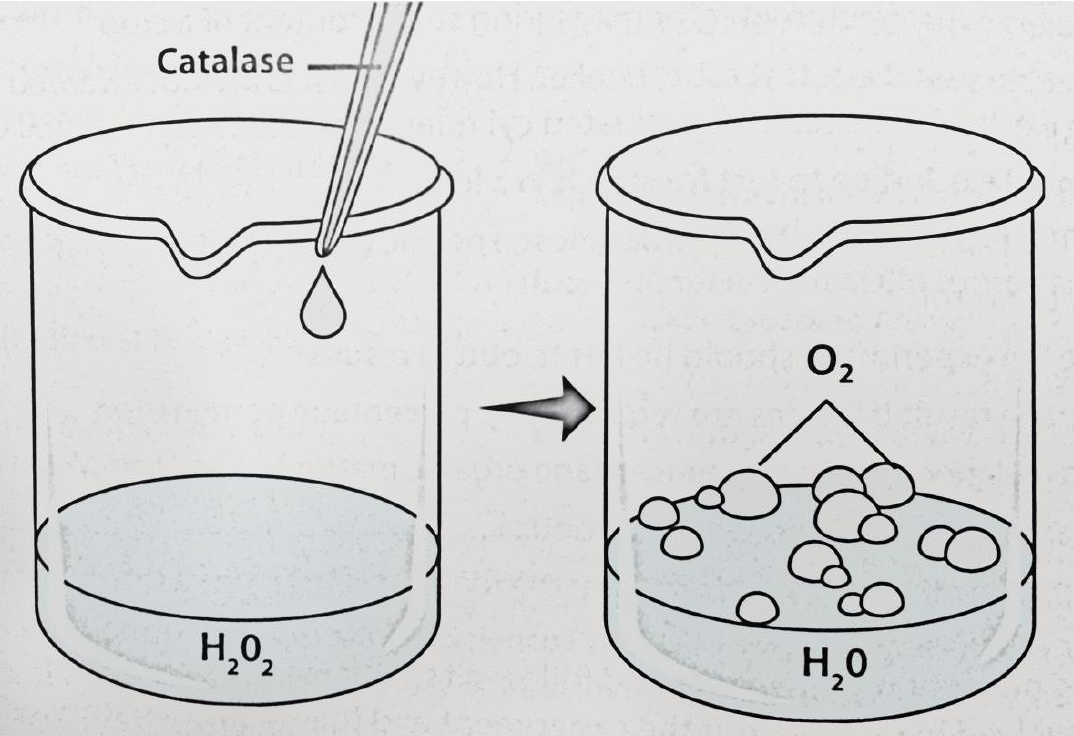
The primary function of catalase is to decompose hydrogen peroxide (H₂O₂), a toxic byproduct of cellular metabolism. Without this enzyme, hydrogen peroxide would accumulate in cells and cause severe damage to proteins, lipids, and DNA. The enzyme facilitates the following reaction:
This means that two molecules of hydrogen peroxide are converted into two molecules of water and one molecule of oxygen gas.
Note
The catalase reaction is one of the fastest known enzymatic reactions, with each catalase molecule capable of converting millions of hydrogen peroxide molecules per second!
Experimental aim
Note
Experimental Purpose
This practical activity demonstrates the remarkable efficiency of the catalase enzyme by showing how quickly it can break down hydrogen peroxide when liver tissue is added to the substrate solution.
Required apparatus and materials
Setting up this experiment requires careful preparation and the right materials to ensure clear, observable results.
Note
Equipment List
- Fresh liver tissue (source of catalase enzyme)
- Pestle and mortar for grinding liver
- Sand (to help break up liver cells)
- Stop watch for timing observations
- Two large boiling tubes (test and control)
- Hydrogen peroxide solution (H₂O₂)
- Washing up liquid (to help foam formation)
- Measuring cylinders for accurate volumes
Experimental method
Step 1: Prepare the liver extract Begin by cutting up fresh liver tissue into small pieces. Using a pestle and mortar, grind the liver with some sand to create a fine purée. The sand acts as an abrasive material to help break open the liver cells and release the catalase enzyme.
Step 2: Set up the test tubes Pour exactly 10ml of hydrogen peroxide solution into each of the two boiling tubes. This ensures both tubes contain identical amounts of substrate for comparison.
Step 3: Maintain optimal conditions Throughout the experiment, keep both tubes at a constant temperature of 37°C and ensure the pH remains at 7. These conditions represent the optimal environment for catalase activity, matching human body conditions.
Step 4: Add washing up liquid Add 3ml of washing up liquid to each tube. This helps create visible foam when oxygen gas is produced, making it easier to observe the enzyme activity.
Step 5: Test vs control Add the prepared liver purée to one tube (this becomes your test tube), but deliberately do not add any liver to the other tube (this serves as your control). The control tube helps demonstrate that the reaction only occurs when the enzyme is present.
Step 6: Observe and compare Carefully observe and compare the height of foam produced in each tube. Record your observations immediately and note any differences between the two tubes.
Example
Worked Example: Setting Up the Experiment
Step 1: Prepare two identical boiling tubes
- Tube A (Test): 10ml H₂O₂ + 3ml washing liquid + liver purée
- Tube B (Control): 10ml H₂O₂ + 3ml washing liquid + no liver
Step 2: Maintain conditions at 37°C and pH 7
Step 3: Add liver purée to Test tube only and observe immediately
Expected observations and results
The dramatic difference between your test and control tubes will clearly demonstrate enzyme activity.
In the test tube (containing liver catalase):
- Immediate and vigorous bubbling occurs
- Rapid formation of white foam
- Foam height increases quickly and significantly
- The reaction continues for several minutes
In the control tube (no liver added):
- Little to no bubbling observed
- Minimal or no foam formation
- Any small amount of foam remains constant
- No significant reaction occurs
Scientific explanation
The dramatic difference between the two tubes demonstrates the catalytic power of the catalase enzyme. When liver tissue is added to hydrogen peroxide, the catalase enzyme rapidly breaks down the substrate into water and oxygen gas. The oxygen gas creates the visible bubbles and foam, providing clear evidence that the enzymatic reaction is occurring.
Important
The control tube shows what happens without the enzyme present - the hydrogen peroxide remains largely unchanged, proving that the enzyme is essential for the rapid breakdown reaction.
Why is this experiment important?
This practical activity illustrates several fundamental biological concepts:
Enzyme specificity: Catalase specifically targets hydrogen peroxide as its substrate, demonstrating how enzymes are highly selective in their action.
Catalytic efficiency: The immediate and vigorous reaction shows how enzymes dramatically increase the rate of chemical reactions that would otherwise occur very slowly.
Cellular protection: Understanding catalase activity helps explain how cells protect themselves from toxic substances produced during normal metabolism.
Experimental design: Using a control tube demonstrates proper scientific methodology and the importance of fair testing.
Factors affecting catalase activity
Several conditions influence how effectively catalase functions:
Temperature: The experiment uses 37°C because this is the optimal temperature for human catalase activity. Higher temperatures would denature the enzyme, while lower temperatures would slow the reaction rate.
pH levels: Maintaining pH 7 ensures the enzyme maintains its proper shape and active site configuration for maximum efficiency.
Enzyme concentration: Fresh liver tissue provides abundant catalase, but older or processed tissue would show reduced activity.
Substrate concentration: Using sufficient hydrogen peroxide ensures the enzyme can work at maximum rate.
Note
Optimal Conditions for Human Enzymes
Most human enzymes, including catalase, work best at body temperature (37°C) and neutral pH (7). These conditions maintain the enzyme's three-dimensional structure and active site shape.
Practical considerations for students
When performing this experiment, proper technique and safety measures are essential for obtaining reliable results.
Important
Safety and Methodology Guidelines
- Handle liver tissue hygienically and wash hands thoroughly
- Use safety equipment when working with hydrogen peroxide
- Make accurate measurements for reliable results
- Observe immediately as the reaction occurs quickly
- Record both qualitative (descriptive) and quantitative (measurable) results
- Consider repeating the experiment for more reliable data
Remember!
Summary
Key Points to Remember:
- Catalase enzyme breaks down toxic hydrogen peroxide into harmless water and oxygen gas
- Fresh liver tissue contains high concentrations of catalase enzyme
- Optimal conditions for human catalase are 37°C temperature and pH 7
- Control experiments are essential to prove that observed effects are due to the enzyme
- Visible foam formation provides clear evidence of oxygen gas production and enzyme activity