The Conditions Necessary for Germination (Leaving Cert Agricultural Science): Revision Notes
📚Revision Notes
The Conditions Necessary for Germination
What is germination?
Germination is the fascinating process where a dormant seed awakens and begins to grow into a new plant. During germination, the seed absorbs water, swells up, and the tiny plant embryo inside starts to develop. The first signs you'll see are usually a small root (called a radicle) pushing out, followed by the first shoot.
Note
Understanding germination is crucial for farmers, gardeners, and anyone growing plants. If seeds don't have the right conditions, they simply won't grow - which means no crops, no flowers, and no new plants!
The three essential conditions
Seeds are quite particular about their growing conditions. Through scientific investigation, we know that three key factors must be present for successful germination:
Important
The Three Essential Conditions for Germination:
1. Water (moisture) Seeds need water to activate their internal processes. Water softens the tough seed coat, allowing the embryo to break through. It also triggers important chemical reactions inside the seed that start the growth process.
2. Oxygen Just like us, growing plants need oxygen to breathe. Seeds use oxygen for respiration - the process that releases energy for growth. Without oxygen, the seed cannot generate the energy needed to develop.
3. Suitable temperature Seeds need warmth to germinate effectively. Different plants prefer different temperatures, but most common seeds germinate best at moderate temperatures around room temperature. Too cold, and the chemical processes slow down or stop completely.
Investigating germination experimentally
Scientists use controlled experiments to prove which conditions are truly necessary for germination. The key principle is to test one factor at a time while keeping everything else the same.
Example
Experimental Setup: Testing Germination Conditions
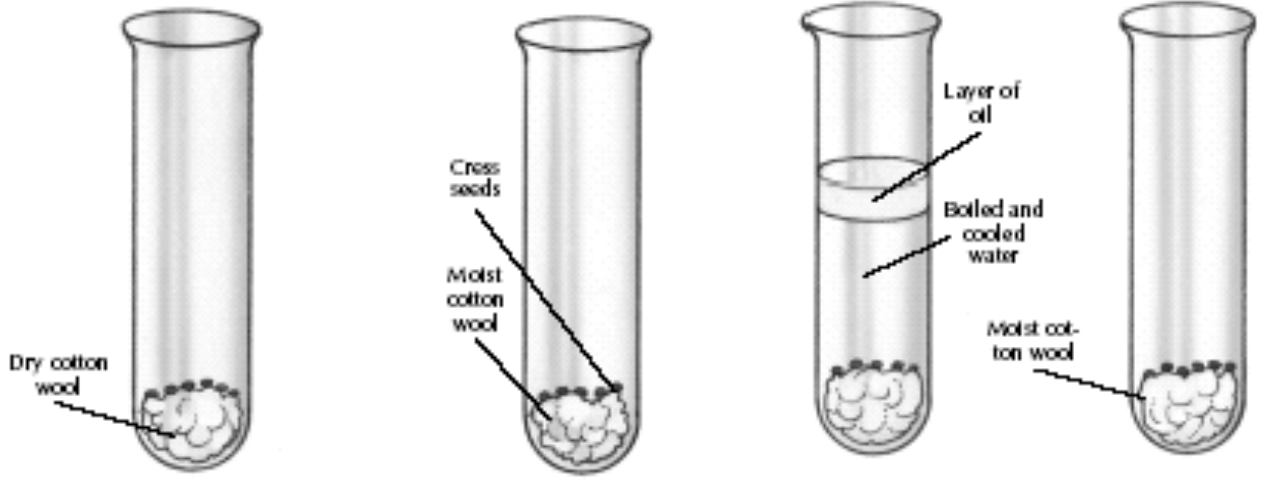
The experimental setup uses four test tubes, each designed to test a different condition:
Test tube A - Testing water This tube contains dry cotton wool with no water added. Seeds are placed on top, but they won't receive any moisture. This tests whether water is essential for germination.
Test tube B - Testing temperature This tube has moist cotton wool and seeds, but it's placed in a refrigerator where it's too cold. This tests whether suitable temperature is necessary for germination.
Test tube C - Testing oxygen This clever setup covers the moist cotton wool and seeds with cooled boiled water, then adds a layer of oil on top. The boiled water contains no dissolved oxygen, and the oil layer prevents oxygen from the air getting in. This tests whether oxygen is essential.
Test tube D - The control This tube has moist cotton wool, seeds, and is kept at room temperature with access to air. It has all three conditions present and should show successful germination. This is called the control group because it helps us compare results.
Expected results and interpretation
After several days of observation, the expected results would be:
- Test tube A: No germination (lacks water)
- Test tube B: No germination (too cold)
- Test tube C: No germination (lacks oxygen)
- Test tube D: Successful germination (has all three conditions)
Note
Only the seeds in test tube D should germinate because it's the only setup with water, oxygen, and suitable temperature all present together.
Why this experiment works
This is an excellent example of a controlled experiment. By changing only one factor in each test tube while keeping the others constant, we can identify exactly which conditions are necessary. This method helps us avoid confusion and draw clear conclusions.
Important
The experiment also demonstrates the concept of limiting factors - if just one essential condition is missing, germination cannot occur, regardless of how perfect the other conditions might be.
Practical applications
Understanding germination conditions helps:
- Farmers choose the right time to plant crops and ensure proper soil moisture
- Gardeners improve their success rate with seeds
- Seed companies store seeds properly to maintain viability
- Conservationists preserve rare plant species through proper seed storage
Summary
Key Points to Remember:
- Seeds need three essential conditions to germinate: water, oxygen, and suitable temperature
- If any one of these conditions is missing, germination will not occur
- Controlled experiments test one factor at a time to identify what's truly necessary
- The control group (test tube D) provides a standard for comparison with the other setups
- Understanding germination conditions has important practical applications in agriculture and gardening