Variation in Inheritable Characteristics (Leaving Cert Agricultural Science): Revision Notes
📚Revision Notes
Variation in Inheritable Characteristics
Introduction to genetic variation
This practical investigation explores the fascinating world of human genetic variation by studying inheritable characteristics within a classroom population. Genetic variation refers to the differences in traits that exist between individuals and are passed down from parents to their offspring through genes. Understanding this variation helps us learn about inheritance patterns and population genetics.

Note
Genetic variation is essential for species survival as it provides the raw material for natural selection and adaptation to changing environments. Even in small populations like your classroom, you'll observe remarkable diversity in inherited traits.
Purpose of the investigation
The main aim of this practical is to investigate how frequently different inherited traits appear in a human population. By surveying your classmates, you'll discover which characteristics are more common and which are rarer, helping you understand the concepts of dominant and recessive alleles in real-world populations.
What you'll need
The beauty of this practical lies in its simplicity. Your main resource is a sample of pupils from your class who will act as your study population. No expensive equipment is required - just careful observation and systematic data collection.
Note
This simplicity is actually a strength! Unlike many genetics experiments that require laboratory conditions, this investigation demonstrates that important scientific principles can be studied using readily available subjects and basic observation skills.
Step-by-step method
This investigation follows a straightforward four-step process that will give you valuable insights into human genetic variation:
Step 1: Select your characteristics Choose five genetically inherited characteristics from the comprehensive list provided. This selection allows you to focus your study while still gathering meaningful data about genetic variation.
Step 2: Conduct your survey Carefully survey each member of your class to determine how many pupils display each allele for your chosen characteristics. This systematic approach ensures you collect reliable data from your population sample.
Step 3: Record your findings Make detailed records of your results using the data collection tables provided. Accurate record-keeping is essential for proper scientific analysis.
Step 4: Analyse dominance patterns For each characteristic you studied, determine which allele appears to be dominant (more common) and which appears to be recessive (less common) in your population.
Important
Critical for Success: Systematic data collection is essential. Rushing through observations or making assumptions can lead to inaccurate results. Take time to carefully observe each trait in every individual to ensure your data is reliable for analysis.
Data collection process
The investigation uses a comprehensive list of 15 observable human traits that are known to be genetically inherited. These characteristics provide excellent examples of how genes influence our physical appearance and preferences.
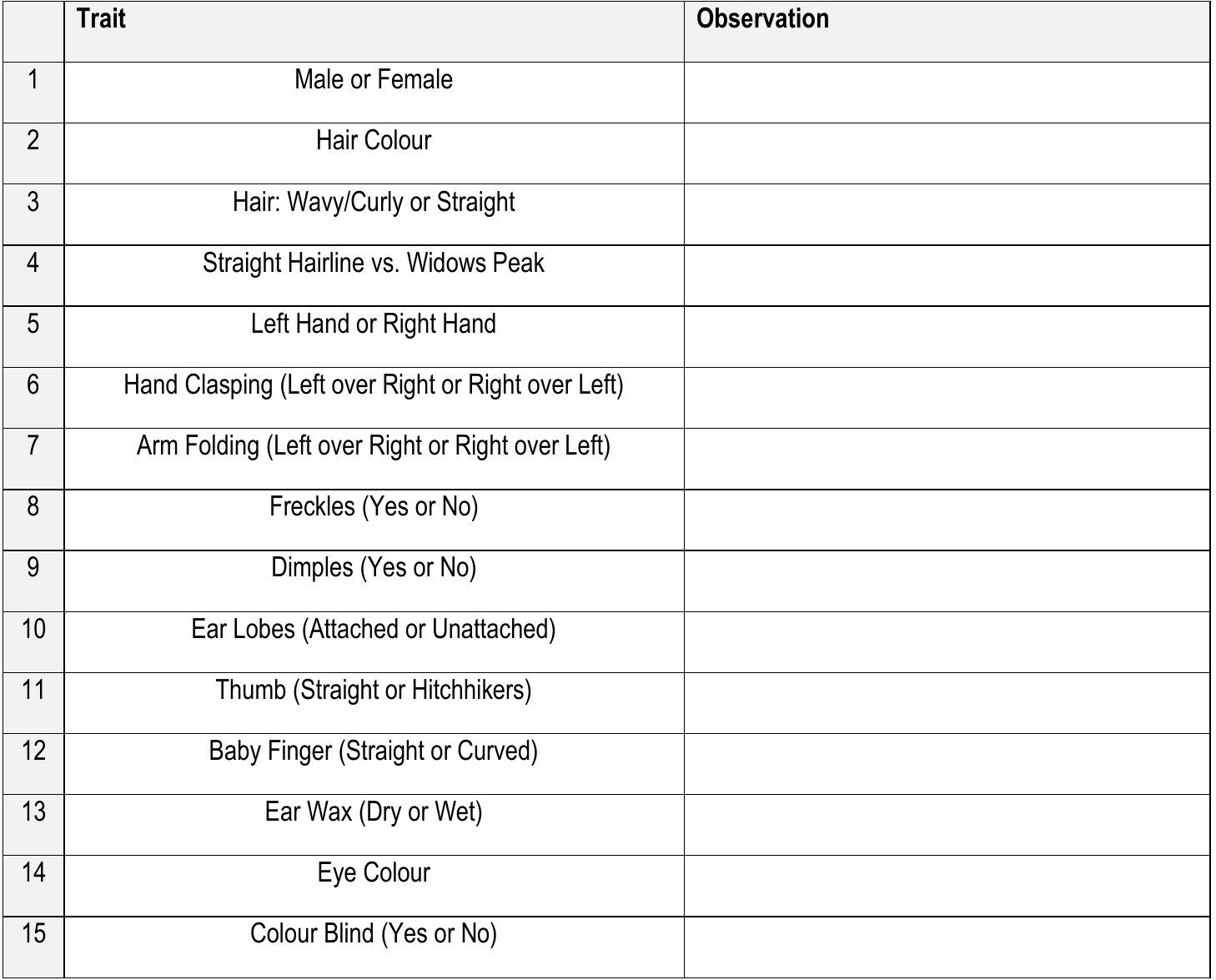
This observation chart includes diverse traits such as gender, hair characteristics, facial features, handedness preferences, and sensory differences. Each trait represents a different gene with typically two possible variations (alleles) that you can easily observe in your classmates.
After collecting your initial observations, you'll transfer your data to a results table that helps you analyse the frequency of each trait in your population.
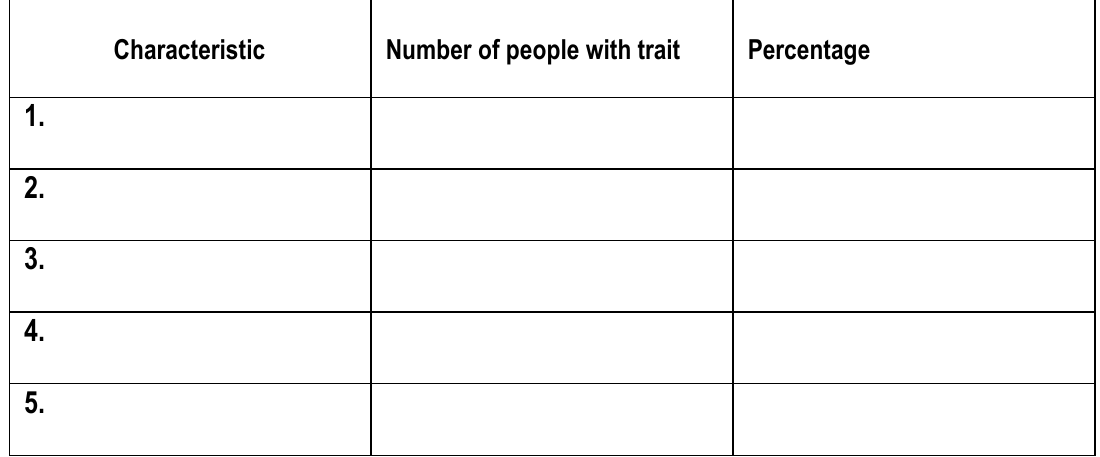
This results table allows you to calculate both the raw numbers and percentages of people showing each characteristic, making it easier to identify patterns and draw conclusions about dominance.
Understanding your results
When you analyse your data, you're looking for patterns that reveal which traits are more common in your population. Generally, if a trait appears in more than 50% of your sample, it suggests that allele might be dominant. However, remember that classroom populations are relatively small, so your results might not perfectly match larger population studies.
Example
Worked Example: Calculating Trait Frequency
If you surveyed 25 students and found that 18 can roll their tongue:
Step 1: Calculate the percentage Percentage = (Number showing trait ÷ Total sample size) × 100 Percentage = (18 ÷ 25) × 100 = 72%
Step 2: Interpret the result Since 72% > 50%, tongue rolling appears to be the dominant trait in your sample.
The percentage calculations help you compare different traits more easily and identify the most and least common characteristics in your study group. This mathematical analysis transforms your observations into meaningful scientific data.
Important
Remember About Sample Size: Classroom populations are relatively small (typically 20-30 students), so your results might not perfectly represent the wider population. In larger studies, percentages might be different, but the principles of dominant and recessive inheritance remain the same.
Scientific significance
This practical demonstrates several important genetic principles. First, it shows that all populations contain genetic variation - no two individuals (except identical twins) are exactly alike. Second, it illustrates how some traits appear more frequently than others due to dominance relationships between alleles.
The investigation also highlights the difference between genotype (the genes you carry) and phenotype (the characteristics you can observe). What you're recording is phenotype - the visible expression of underlying genetic information.
Note
Genotype vs Phenotype: This distinction is crucial in genetics. Your genotype is your complete genetic makeup, while your phenotype is what can actually be observed. For example, someone might carry a recessive allele for blue eyes (part of their genotype) but have brown eyes (their phenotype) because they also carry a dominant brown-eye allele.
Real-world applications
Understanding genetic variation has practical applications in agriculture, medicine, and conservation biology. In agricultural science, farmers use knowledge of genetic variation to develop crop varieties with desired traits like disease resistance or improved yield. This same understanding helps in breeding programmes for livestock improvement.
The skills you develop in this practical - systematic observation, data collection, and statistical analysis - are fundamental to scientific research and are used extensively in agricultural research and development.
Exam tips
Important
Essential Exam Strategies:
When answering questions about this practical, remember to:
- Clearly distinguish between dominant and recessive alleles based on frequency data
- Show your percentage calculations when analysing results
- Explain that small sample sizes (like a classroom) might not represent the wider population perfectly
- Connect your findings to broader principles of inheritance and population genetics
- Always justify your conclusions with reference to your data
Remember!
Summary
Key Points to Remember:
-
Genetic variation exists in all populations - this practical demonstrates the natural diversity that exists even within small groups like your classroom
-
Dominant alleles typically appear more frequently than recessive alleles in populations, though your small sample size might show exceptions
-
Systematic data collection and analysis are essential skills for understanding biological patterns and drawing valid scientific conclusions
-
This practical connects theory to reality by showing how inheritance patterns you learn about in textbooks actually appear in real human populations
-
Agricultural applications abound - the same principles of genetic variation and inheritance that you observe in humans apply to crop plants and farm animals
-
Sample size matters - larger populations give more reliable data about true frequencies of traits in the wider population