Metallic bonding (Edexcel GCSE Chemistry): Revision Notes
📚Revision Notes
2.1.5 Metallic Bonding
Metallic Bonds
Formation:
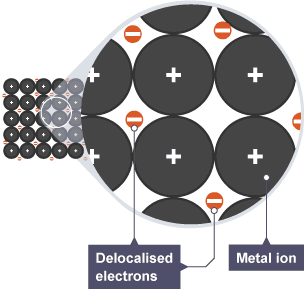
Metallic bonds occur between atoms of metals. In these bonds, metal atoms release some of their electrons to form a "sea of free electrons" that move throughout the structure.
Example
Example: In a piece of copper (Cu), the copper atoms are held together by metallic bonds.
Bonding:
The positive metal ions are surrounded by the sea of free electrons, which allows the atoms to slide over each other. This movement of electrons gives metals their characteristic properties.
Properties:
- Metals are good conductors of heat and electricity due to the free electrons.
- They are malleable (can be hammered into shapes) and ductile (can be drawn into wires) because the layers of atoms can slide over each other without breaking the bond.
- Metals have high melting and boiling points due to the strong attraction between the positive ions and the sea of electrons.