Water treatment (Edexcel GCSE Chemistry): Revision Notes
📚Revision Notes
10.1.4 Waste Water Treatment
Sources of Pollutants in Waste Water
- Human Waste:
- Contains: Harmful bacteria and high levels of nitrogen compounds.
- Impact: These can harm aquatic ecosystems by depleting oxygen levels and promoting excessive algae growth.
- Industrial Waste Water:
- Contains: Harmful chemicals, including toxic metal compounds.
- Impact: These chemicals can be highly toxic to both aquatic life and humans if not properly treated.
- Agricultural Waste Water:
- Contains: Fertilisers and pesticides.
- Impact: These substances can disrupt sensitive ecosystems by causing nutrient pollution, leading to problems like algal blooms and loss of biodiversity.
Treatment of Public Water
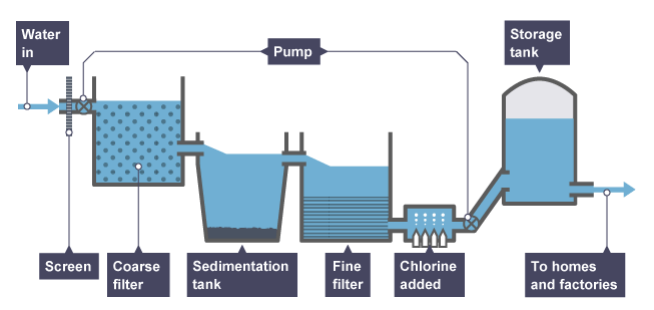
Note
To ensure that water is safe for consumption, it undergoes several processes:
- Water In:
- Water is sourced from groundwater and rivers and then provided to reservoirs.
- Coarse Filter:
- Purpose: To remove large particles and debris from the wastewater. This is the first step in the treatment process.
- Sedimentation:
- Purpose: In reservoirs or tanks, larger solid particles settle under gravity, allowing them to be removed from the water.
- Produces:
- Sewage Sludge: The solid waste that settles at the bottom.
- Effluent: The liquid that remains on top, which still contains dissolved pollutants.
- Fine Filtration:
- Water is passed through layers of sand and gravel to remove smaller insoluble particles.
- Anaerobic Digestion of Sewage Sludge:
- Process: The sewage sludge is broken down by specific bacteria in the absence of oxygen.
- Purpose: To reduce the volume of sludge and produce biogas, which can be used as a renewable energy source.
- Aerobic Treatment of Effluent:
- Process: The effluent is treated with aerobic bacteria that require oxygen to survive.
- Purpose: These bacteria break down the remaining organic matter, further purifying the water before it is released into the environment.
- Chlorination:
- Chlorine is added to the water to kill bacteria, prevent disease, and make the water safe to drink. This treated water is then stored in storage tanks before being distributed to homes and factories.
Note
Importance of Wastewater Treatment:
- Environmental Protection: Proper treatment of wastewater is essential to protect natural water bodies from pollution, which can lead to severe ecological damage.
- Public Health: Treating wastewater prevents the spread of diseases and protects communities from exposure to harmful chemicals.
- Sustainability: Recycling and treating wastewater is a key part of managing water resources sustainably, especially in areas where water is scarce.